Insights, Products
RCS in banking: The next step in digital customer experience
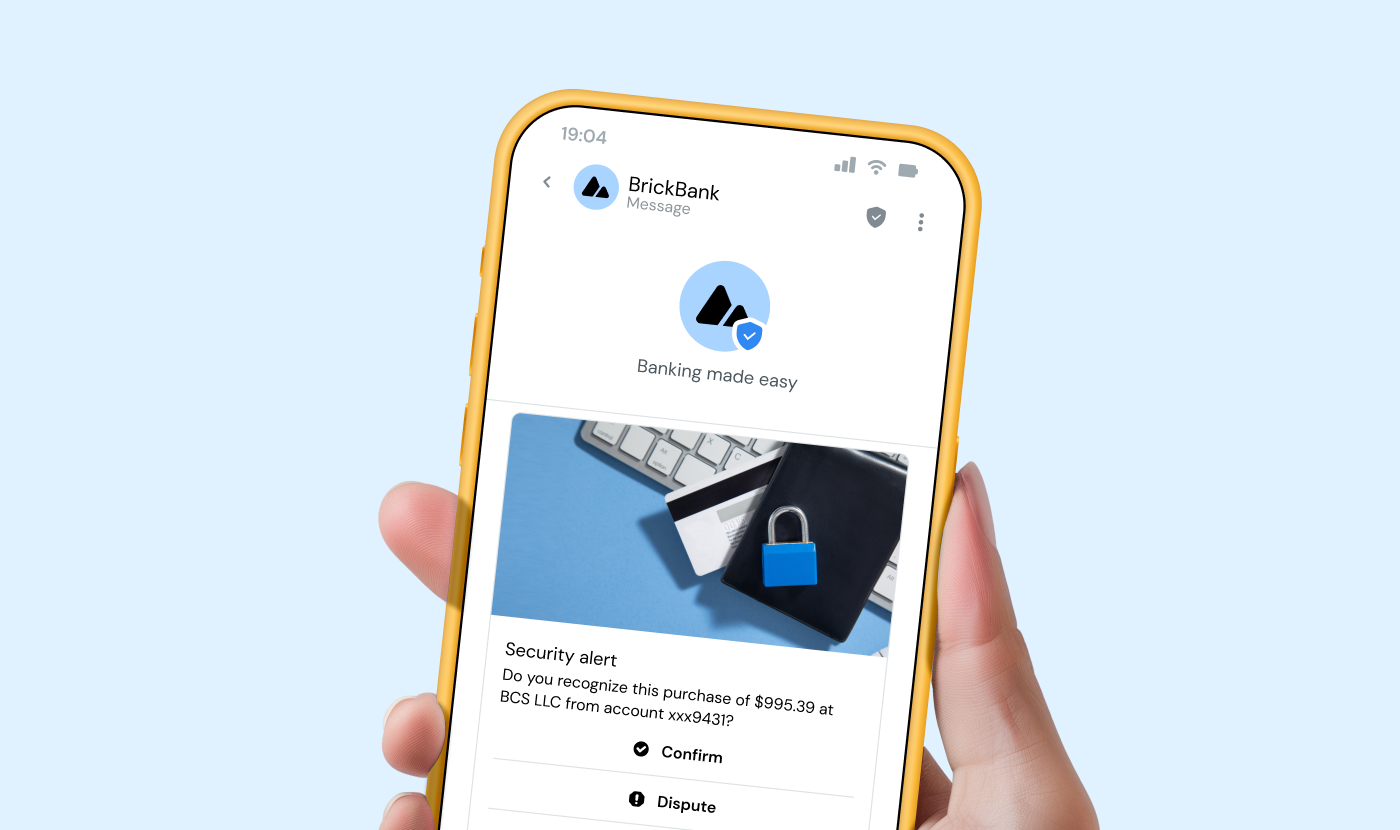
RCS gives banks and financial institutions a way to send verified, branded messages – fraud alerts, one-time passwords, payment reminders, account updates – directly to the text inbox customers already check. Every message carries the bank’s vetted name and logo, which does something SMS never could: it lets your customers tell a real bank message from a scam at a glance.
That’s why financial services is adopting Rich Communication Services (RCS) faster than almost any other industry. In our State of customer communications survey – which gathered insights from over 2,800 global consumers and 400+ financial services business leaders – the numbers were hard to ignore:
- Among financial institutions familiar with RCS, 55% called it “game changing”
- Nearly half are already using it
- Another 45% plan to adopt or expand RCS use
When we asked why, one answer stood out: security. More than half (54%) of financial institutions pointed to improved security as the top benefit of RCS. With impersonation scams on the rise, that carries serious weight – and your customers feel it too.
In this post, we’ll break down what makes RCS in banking different from SMS, the use cases where it’s already earning its keep, and how a digital lender put it to work.
What makes RCS in banking different
RCS doesn’t replace SMS – it solves for what SMS lacks in a highly regulated environment:
- Branded messages: Every RCS for Business message includes your name, logo, and brand colors. Messages look like your bank from the first pixel.
- Verified sender profiles: RCS for Business requires brand vetting and third-party verification before a single message sends, making it extremely hard for fraudsters to impersonate your institution.
- Native inbox delivery: Messages arrive in the same inbox as SMS – no app to download, no interface to learn, and reach of around 1.5 billion RCS users globally with SMS fallback for the rest.
- Security built for regulated industries: RCS for Business messages are encrypted in transit – a real upgrade over SMS, which isn’t encrypted at all – and the channel carries ISO 27001, SOC 2, SOC 3, GDPR, and PSD2 compliance credentials. Note that business RCS is not end-to-end encrypted, so like SMS, it’s the right channel for alerts, codes, and updates rather than confidential account data.

How banks can use RCS today
Our survey confirmed what many financial services teams have long suspected: people want their financial messages to be clear, timely, and secure. From fraud alerts to payment reminders, here’s where RCS in banking delivers across the customer journey.
Fraud notifications
Bank fraud is depressingly common: a 2024 J.D. Power study found that 29% of bank customers experienced fraud in the past year – and of those, 45% were hit more than once. Customers expect their bank to respond quickly and clearly when something’s wrong. From our survey:
- Over 90% of consumers say fraud alerts are important.
- 72% want fraud alerts immediately, and another 15% expect them within five minutes.
- 46% want to resolve a fraud issue over the phone after the alert.
Most institutions still send fraud alerts over SMS. RCS makes the same alert work harder: the branded sender profile tells customers instantly that the warning is real, and built-in action buttons – like tap-to-call – take them from alert to resolution in seconds. The payoff for getting this right is loyalty: the same J.D. Power research found 92% of banking customers would stick with their bank after a fraud issue was successfully resolved. Speed builds trust, and RCS delivers both.
of consumers say fraud alerts are critically important
of consumers want fraud alerts immediately
of consumers want to resolve a fraud issue over the phone
of banking customers would stick with their bank after fraud was resolved successfully
OTPs and verification
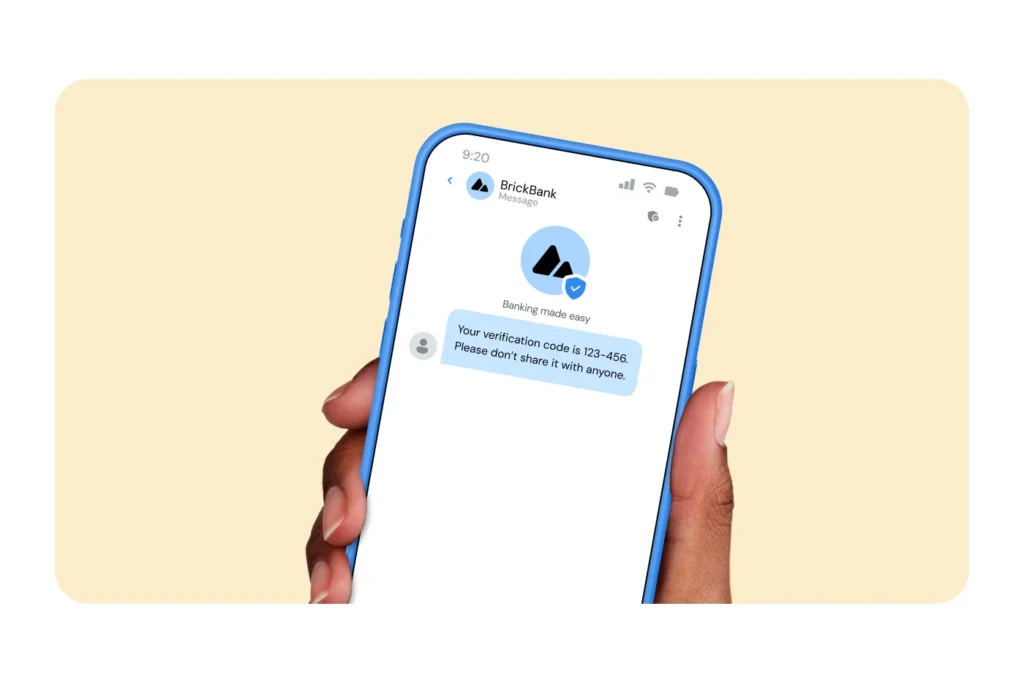
SMS became the default for one-time passwords because it reaches nearly every phone on Earth. But SMS is also where smishing lives – and customers have noticed. Our research found that more than half of consumers received a legitimate brand message in the past year that they initially found suspicious.
RCS solves the identity half of that problem. Every RCS for Business sender is verified, logo and all, so a verification code from your bank is visibly, provably yours. Customers recognize it and act on it with confidence – which is exactly what you want in the authentication moment.
Account updates
Customers want providers who guide them through their financial lives: more than 50% of consumers prefer weekly-to-monthly updates about their financial accounts, and 73% find balance notifications important to their money management.
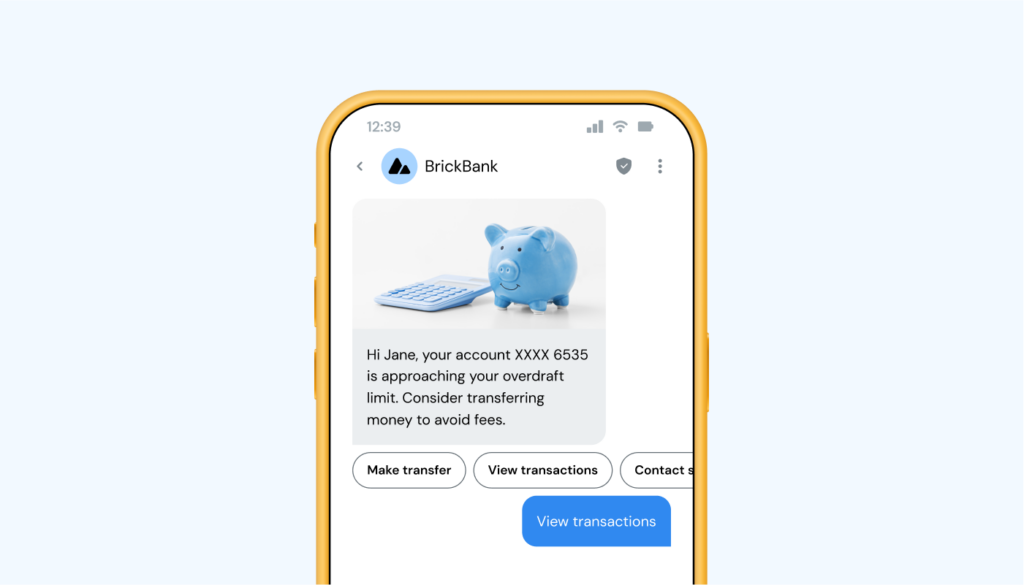
RCS turns those updates from plain text into branded, actionable messages – transaction activity, policy changes, overdraft warnings – with visuals, buttons, and context that make each one feel personal rather than automated.
Payment reminders and “Pay now” actions
Late payments hurt everyone – and they’re often a communication failure, not a money failure. 84% of consumers consider payment due reminders important, and RCS payments experiences make the reminder and the action one step: a recognizable sender profile, the amount and due date, and suggested-action buttons like “Pay now” or “Talk to support” that deep-link the customer straight into the payment flow.
That last tap matters. A reminder a customer trusts and can act on immediately beats a plain text that asks them to find the app, remember the login, and hope they get there before the deadline.
Automation of everyday interactions
Not every task needs a human agent. For simple things – booking time with an advisor, answering FAQs – most customers just want speed. Institutions are already moving: our research found 59% of financial institutions already use chatbots, and another 60% plan to invest in AI chatbots, and 42% of consumers are willing to engage with AI chatbots trained on support documentation.
Pairing RCS with an AI chatbot automates the routine while keeping the human option one tap away – the balance most customers say they want, given lingering privacy concerns around AI.
Promotions
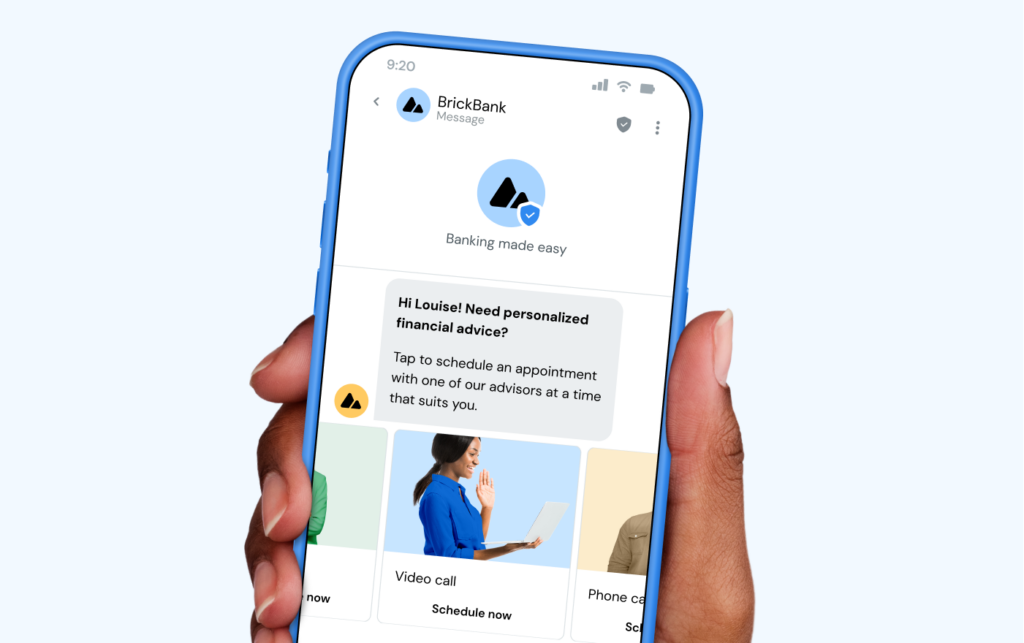
Personalization is the price of entry in financial services: 83% of consumers want communications personalized to their real financial situation. RCS delivers that expectation with rich elements – carousels, images, suggested replies – so offers feel relevant instead of generic, and the results follow.
A real-life example of RCS in banking: WeCredit
WeCredit, a digital lending platform in India, uses RCS to make it easier for customers to discover and apply for paperless loans – promotional offers, nudges to complete applications, and updates throughout the loan process.
Before RCS, they relied on SMS and WhatsApp: SMS was affordable but limited on interactivity and tracking; WhatsApp was richer but required a separate app.
“RCS sits in the perfect middle ground between SMS and WhatsApp. It has the visual appeal of WhatsApp with the cost-effectiveness of SMS, plus great tracking and analytics.”

The result? With 35–40% of their customers on RCS-enabled devices, WeCredit reaches a large share of its audience in a visually rich, interactive way – and uses WhatsApp and SMS as fallbacks so no customer misses an update. That fallback-first architecture is the pattern to copy: the richest channel each device supports, reliability guaranteed underneath.
Is it time to rethink your banking communications?
SMS remains critical for banks because it reaches everyone. But it wasn’t built for today’s fraud landscape, privacy expectations, or customer standards – and stretching it further only goes so far.
Ask yourself:
- Are your current channels giving customers the confidence and clarity they need?
- Could richer, branded messaging reduce fraud risk and speed up resolution at your organization?
- What would it mean for your customers (and your teams) to close those gaps this year?
Your customers already expect this level of clarity. RCS in banking is how you deliver it.
Ready to bring verified, branded messaging to your financial institution? Reach out to our team to start the conversation. Or, for the full data on what consumers expect from financial communications, explore the State of customer communications report.

Author: