Insights
What shoppers actually trust AI agents to handle

AI assistants are now part of the customer journey for many retailers, from offering product recommendations to sharing delivery updates. The question is which conversations shoppers are actually happy to hand them. When an order is delayed, or a card has been charged twice, do they type their question to the AI agent on the website, or go looking for a phone number to resolve the issue with a real person?
For most shoppers, it depends on the question. Ahead of the busiest shopping period of the year, Sinch asked 2,501 consumers across eight countries what kind of digital communication they want from brands, and respondents shared their opinions on AI use. The findings show shoppers are cautious about AI in general, yet confident it can handle specific tasks.
AI optimism is down, and privacy is shoppers’ biggest reason for caution
Most shoppers aren’t sold on AI yet, and overall optimism has slipped since last year. According to our survey, just 43% think AI will make their shopping easier this year, down from 48% in 2025. Another 31% say it won’t, and 26% aren’t sure.
Data privacy is what worries them most. For the second year running, privacy or data use tops shoppers’ list of AI concerns, named by 43%. Just 7% have no concerns at all, down from 9% in 2025.
What is your single biggest concern about using AI during major shopping events?
Many shoppers also still trust people more than AI. For product advice, 53% would rather take a recommendation from a real person than from AI, up from 51% in 2025.
For phone support specifically, nearly half (48%) would rather speak to a human agent than an AI voice agent, while 52% are open to using one as long as they can be transferred to a person if needed.
But age changes the picture a lot. Over half of Millennials (55%) and Gen Z (51%) trust AI recommendations as much as or more than a human’s, dropping to 47% of Gen X and 30% of Baby Boomers. Younger shoppers are also far more optimistic that AI will make shopping easier. 55% of Gen Z say it will, compared with just 18% of Baby Boomers. The older the shopper, the more AI has to prove itself.
U.S. shoppers are the most skeptical of AI
An AI agent can also get a very different welcome depending on the shopper’s country. AI skepticism is highest in the U.S.: just 26% of consumers think AI will make their shopping easier, 17 points below the global average.
Latin America sits at the other end, with the strongest AI confidence anywhere: 72% of shoppers in this region think AI will make shopping easier, and 61% trust AI recommendations as much as or more than a person’s. This means a shopper in São Paulo may be happy to start with the AI agent, while one in Chicago may go straight to the “talk to a person” button.
Practical value is how AI wins over shoppers
Despite rising skepticism about AI overall, only one of the 2,501 people surveyed ruled out ever using an AI agent.
Checking on an order’s status is the most popular use, chosen by 48%, closely followed by learning more about a product before buying (47%) and accessing customer service after normal business hours (36%).
The survey also asked how confident shoppers are that a brand’s AI assistant can handle specific tasks, from tracking an order to changing payment details, and over 60% are confident AI can handle every task in the survey.
How confident are you that a brand’s AI assistant can handle the following?
Shoppers are most confident in AI for quick, informational tasks like tracking a parcel, and less so once their money or account details are involved. But even for payment or billing changes, the lowest-scoring task, 62% are confident AI can handle it.
“AI for AI’s sake doesn’t land with shoppers, but AI attached to a job they actually want done does. Order tracking and pre-purchase questions are the easy wins, where confidence is already high. Payment, billing and account changes are different: shoppers still want a human close by, and brands need to make that handoff easy and obvious.”

What actually makes an AI agent useful
The findings point to what good AI customer service looks like in practice, starting with the basics: quick, accurate answers to order and product questions, at any hour.
For payment or account changes, where confidence is lower, shoppers want an easy way to reach a person, without having to explain the problem again. Older shoppers are likely to need this most: 23% of Baby Boomers say they’re “not confident at all” that AI can handle payment and billing tasks for them, against 11% of Gen Z shoppers.
Finally, transparency truly matters: nearly six in 10 shoppers say their biggest worry about AI is either privacy (43%) or not knowing whether they’re talking to a person or a machine (15%). They want to know when they’re talking to AI, and what happens to their data.
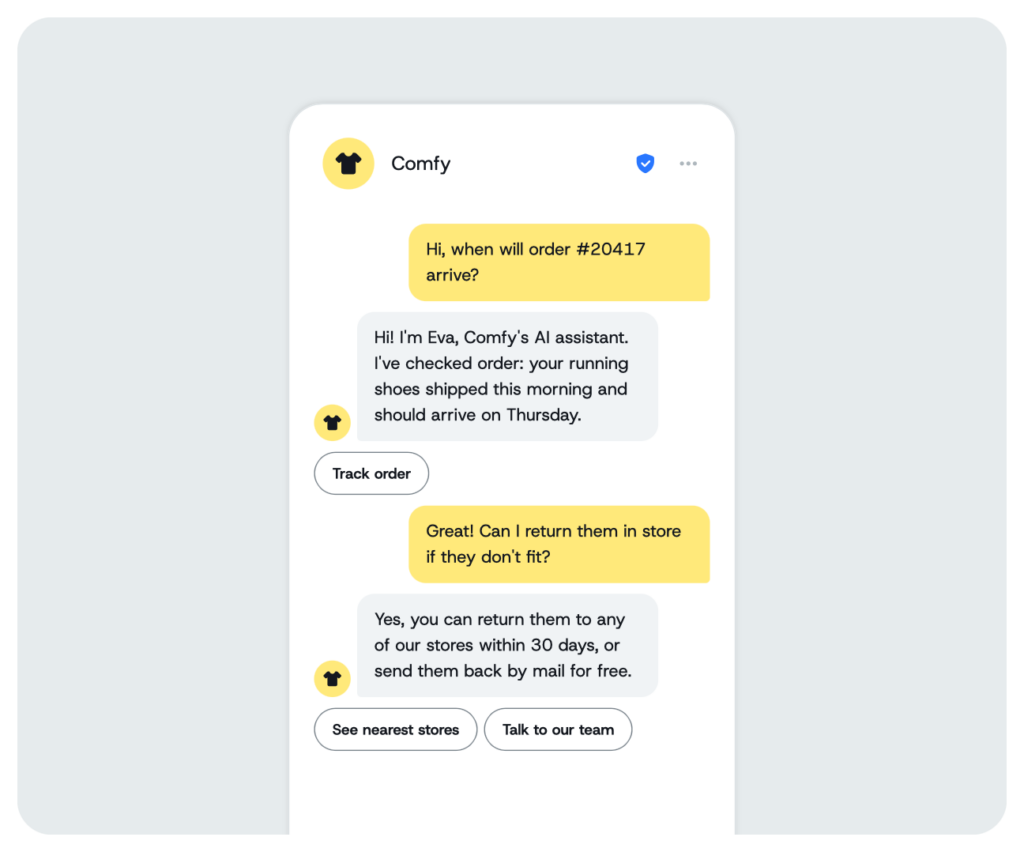
Confidence in AI comes down to the job it’s given
Shoppers’ wariness of AI is real, but it eases once they see the value AI brings to their experience, provided retailers use it openly, for the tasks that help them most, and with a real person close at hand.
Discover how Sinch AI helps businesses deliver intelligent customer communications at scale across messaging, email, and voice, even during the busiest times of year.

Author: