Conversations, Insights
The 6 best Vonage alternatives in 2026, detailed breakdown
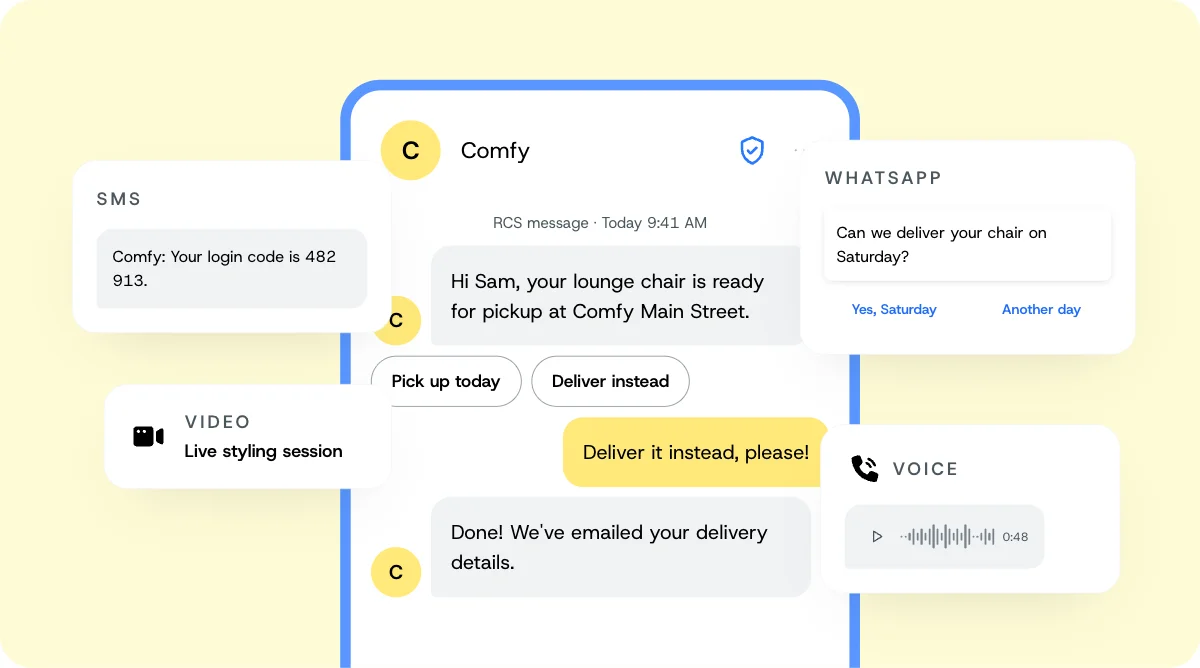
There are plenty of reasons to look for an alternative to Vonage. You might be looking for better SMS pricing, wider RCS coverage, stronger service guarantees, or a platform that can support more of your communication needs.
In this guide, we compare the best Vonage alternatives across SMS, RCS, WhatsApp, voice, and phone numbers, highlighting where each provider stands out.
Full disclosure: Sinch is one of the providers on this list. We’ve included competitors because each has strengths worth considering, and the right choice depends on your specific use case.
What is Vonage?
Vonage is a cloud communications platform that helps businesses connect with customers through SMS, RCS, WhatsApp, voice, video, and other channels. Its APIs cover more than 200 countries and 700 networks for outbound SMS, with pay-as-you-go pricing and free credit to get started.
Its biggest selling point is flexibility. Businesses can manage multiple messaging channels through a single API, access virtual phone numbers in 85 countries, and use features like Silent Authentication, programmable voice, and video calling.
Vonage offers a broad API portfolio, but feature breadth is only one part of the decision. As messaging programs grow, pricing predictability, coverage, operational support, and service commitments can matter just as much.
Reasons to look at Vonage alternatives
Vonage covers the essentials well. The questions below are worth asking when you’re comparing providers for a larger or more complex communications program.
- Pricing can be more complicated than it first appears. Vonage lists U.S. SMS rates by country on its pricing page, and carrier surcharges and 10DLC registration fees add to the final cost. Its Messages API also carries platform fees on top of carrier charges. For businesses sending large volumes of messages, it’s worth calculating the total cost rather than comparing headline rates alone.
- RCS coverage is still developing. Vonage launched RCS commercially in November 2024, and its published coverage currently lists 15 countries. Access is also limited to managed accounts. Businesses planning to roll out RCS across multiple markets may find these limitations worth considering.
- Service guarantees aren’t immediately clear. Vonage highlights its reach across more than 700 SMS networks, but its public SMS, phone number, and Voice API pages don’t specify uptime guarantees or explain whether U.S. messaging and voice traffic travels over direct carrier connections. Businesses with strict reliability requirements may need to clarify these details with sales.
- WhatsApp capabilities could be better documented. Vonage supports WhatsApp messaging and calling, with platform fees starting at €0.0001 per message in addition to Meta’s charges. However, its public documentation is less clear about features such as WhatsApp Flows, number migration, and Meta partner status. Businesses relying heavily on WhatsApp may want more detail before committing.
The best Vonage alternatives at a glance
| Alternative | Best for | Key advantage over Vonage | Pricing |
| Sinch | Businesses that need reliable, enterprise-grade communications across SMS, RCS, WhatsApp, email, and voice | Direct connections to all Tier-1 U.S. carriers, the largest independent voice network in the U.S., published SLAs, and direct RCS connections in 21 countries | U.S. SMS from $0.0078 (10DLC and toll-free) or $0.009 (short code), plus carrier fees |
| Twilio | Developers who want to experiment with APIs and build custom communications solutions | Extensive developer tools, a published 99.95% SLA (99.99% with Twilio Editions), and transparent support pricing | U.S. SMS from $0.0083 per segment, plus carrier fees |
| Infobip | Teams looking to combine customer engagement tools with messaging APIs | Claims 800+ direct telecom connections, alongside SOC 2 Type 2 and ISO certifications | Pay-as-you-go, with country-specific pricing |
| Bandwidth | U.S.-focused businesses that prioritise voice and messaging infrastructure | Owns and operates its U.S. carrier network, with published voice rates | U.S. outbound SMS from $0.004 per message, with volume-based pricing |
| Telnyx | Cost-conscious developers comfortable with a hands-on approach | No platform fees, competitive published rates, and AI voice capabilities | U.S. local SMS from $0.004, plus carrier fees |
| Bird | Marketing-led teams looking to manage customer communications and campaigns in one place | Built-in marketing automation, WhatsApp Flows, and unified messaging and email tools | U.S. outbound long-code SMS from $0.0035 per segment, plus carrier fees |
Prices and coverage are taken from each provider’s public website as of November 2026 and may have changed since. Check with each provider for current pricing before you decide.
1. Sinch: The best Vonage alternative for enterprise messaging, voice, and numbers
If you’re looking for a Vonage alternative that can handle enterprise-scale communications without unnecessary complexity, Sinch is a strong place to start. It brings messaging, voice, and email together, backed by direct carrier connections and clearly defined service guarantees.
Sinch’s key advantages vs. Vonage:
- A carrier path you can verify. Direct connections to every Tier-1 U.S. carrier and 600+ direct carrier connections worldwide for messaging. Vonage’s SMS page doesn’t say whether U.S. paths are direct.
- An owned U.S. voice network. Sinch runs the largest independent voice network in the U.S., carrying 250 billion+ minutes a year and delivering 95% of North American calls directly to the end-user carrier. Vonage’s voice pages describe a global carrier network but don’t say how U.S. calls are routed.
- SLAs in writing. 99.95% monthly for messaging, 99.99% on Voice API Enterprise and Elastic SIP Trunking. Vonage’s SMS and Voice API pages list none.
- A longer RCS record. Sinch’s RCS work began in 2017, Sinch carried 3.8 billion+ RCS messages in 2025, and it has direct RCS connections in 21 countries to the 15 on Vonage’s published coverage list.
Sinch pros:
- One Conversation API across 13 channels, with RCS-to-SMS fallback set by channel priority.
- Managed U.S. registration: Sinch submits 10DLC brand and campaign registrations to The Campaign Registry (TCR) for you and supports toll-free verification.
- Enterprise scale and support: 200,000+ business customers and a named customer success manager for enterprise accounts.
- ·A voice layer for your own AI agent. Voice Relay connects a text-based AI agent to live calls and covers speech recognition, text-to-speech, detecting when the caller is speaking, and interruptions in one usage-based rate. It works with any LLM, and Voice Streams sends live audio to your own voice AI instead. Text-to-speech covers 772 voices across 80+ languages.
- SIP trunking two ways. Elastic SIP Trunking is self-service, with no per-channel fees and STIR/SHAKEN, E911, and CNAM included, across 58 countries. Network SIP Trunking is a managed service for larger enterprises, with a 24x7x365 network operations center and Microsoft Teams Operator Connect support.
Sinch cons:
- Voice Relay and Voice API v2 are in Public Preview.
Sinch makes sense when routing, support, and commercial terms matter as much as the API itself. Its published U.S. SMS base rate is $0.0078 per message, plus carrier fees. U.S. number fees are also published: 10DLC at $1 per month plus $1 setup; toll-free at $2 per month plus $2 setup; and short codes at $500 (random) or $1,000 (vanity) per month. Compare complete quotes rather than base rates alone.
For voice-heavy programs, Sinch pairs its U.S. network with three ways in: the Voice API for programmable calls, Elastic SIP Trunking for self-service PSTN access, and Network SIP Trunking for managed enterprise connectivity. On the Voice API, Voice Relay lets developers give their own text-based AI agent a voice on phone calls, and four of the five largest ride-hailers use Sinch Voice.
TaskRabbit’s Alex Rossbach, Product Manager – Platform, says that “with our expansion, Sinch has been much more scalable than our previous provider.”
2. Twilio: The best Vonage alternative for tinkering developers
Twilio is a popular choice for developers who want the freedom to experiment, customize, and build their own communications solutions. Its extensive API catalogue gives technical teams plenty to work with, although putting everything together can require more development effort.
Twilio’s key advantages vs. Vonage:
- Reliability on paper. A 99.95% SLA, which Twilio Editions raises to 99.99%.
- Published support plans. Developer is free; Production is the greater of $250 or 4% of monthly spend; Business, $1,500 or 6%; Personalized, $5,000 or 8%.
- Published U.S. RCS rates. RCS Rich at $0.0083 per segment and Rich Media at $0.022 outbound, with per-carrier fees itemized.
Twilio pros:
- One Programmable Messaging API for SMS, MMS, RCS, and WhatsApp, with email alongside.
- Detailed published voice pricing, including Elastic SIP Trunking termination from $0.0011 a minute (toll-free route).
- Free trial with no credit card.
Twilio cons:
- Support is priced as a percentage of spend (4% to 8% on paid plans), and a $0.001 processing fee applies to messages that end in a failed status.
- Twilio’s docs advise four to six weeks to complete RCS setup and list that RCS senders can’t be onboarded programmatically at scale.
Twilio’s U.S. SMS list rate is $0.0083 per segment, plus carrier fees. The appeal is developer choice: broad documentation, SDKs, and plenty of tools for teams comfortable assembling their own solution. Its published RCS coverage lists 23 countries, though availability and onboarding requirements should be checked market by market.
3. Infobip: The best Vonage alternative for teams that want engagement tooling beside the API
Infobip is worth considering if you’re looking for more than a communications API. It combines messaging and voice with customer engagement and automation tools, making it a good fit for businesses that want everything in one platform, even if that means a little more complexity.
Infobip’s key advantages vs. Vonage:
- Direct-connection scale (Infobip’s claim). 800+ direct telco connections and local numbers in 100+ countries.
- A long certification list. ISO 9001, 22301, 27001, 27017, and 27018, plus SOC 2 Type 2, listed on its certificates page.
- Engagement tooling. People (a customer data platform), segmentation, send-time optimization, and automated workflows sit beside the SMS API.
Infobip pros:
- WhatsApp is a core strength: Infobip is a WhatsApp Business Solution Provider and Premier Meta Partner, with WhatsApp Flows.
- Voice covers a wide set of products: a Calls API, scenario APIs for IVR and number masking, cloud SIP trunking with BYOC, and WebRTC.
Infobip cons:
- Per-message rates aren’t in the page text: its SMS pricing page offers a calculator that shows average prices by country, with custom plans for volume.
- Infobip’s voice page lists no uptime percentage or SLA, and RCS pricing varies by region, carrier, and message type.
Infobip pairs communications APIs with customer-data and campaign tools. Its voice page cites coverage in 195 countries, 300 voice connections, and CLEC licensing in 49 U.S. states; these are provider-reported figures.
4. Bandwidth: The best Vonage alternative for U.S.-centric voice and messaging
Bandwidth takes a more infrastructure-focused approach, with its own carrier network and competitive pricing for U.S. messaging and voice. It’s particularly attractive for businesses with a strong North American presence, although its international and omnichannel capabilities are less extensive.
Bandwidth’s key advantages vs. Vonage:
- An owned carrier network (Bandwidth’s description). It describes an owned and operated Tier 1 network and says it built its own nationwide all-IP voice network.
- Published U.S. rates. Outbound SMS at $0.004 (10DLC), $0.007 (toll-free), and $0.008 (short code); U.S. local voice at $0.0100 a minute outbound and $0.0055 inbound.
- Support included. Bandwidth’s pricing page says support is included, with premium support packages available as upgrades.
Bandwidth pros:
- 6-second billing increments, and a free trial through Bandwidth Build with 3,000 credits and a real phone number.
- API-driven porting with dedicated porting specialists.
- A registration center for 10DLC and short code campaigns.
Bandwidth cons:
- Reach is U.S.-weighted: its voice page cites voice coverage in about 70 countries[N1] , and its RCS page focuses on U.S. carriers.
- WhatsApp isn’t listed on its messaging page, and inbound SMS rates, carrier fees, and 10DLC registration fees aren’t on its pricing page.
For a predominantly U.S. voice and SMS program, Bandwidth is worth evaluating for its network ownership and published rates. Its broader multichannel offering is more limited than those of the other global CPaaS platforms covered here.
5. Telnyx: The best Vonage alternative for those comfortable with a hands-on setup
Telnyx appeals to developers who want to keep communications costs down and maintain control over their setup. It offers competitive rates and a growing range of voice and AI tools, making it an interesting option for teams comfortable managing the technical side themselves.
Telnyx’s key advantages vs. Vonage:
- A $0 platform fee on pay-as-you-go and itemized U.S. rates: local SMS at $0.004 plus carrier fee, and numbers from $1 a month.
- Voice AI in one stack. Voice AI agents at $0.05 a minute covering speech-to-text, text-to-speech, and orchestration.
- TwiML-style migration. TeXML is positioned as compatible with TwiML so existing call flows port with minimal changes.
Telnyx pros:
- Voice API at $0.002 a minute plus a SIP trunking fee, with itemized add-ons for recording, conferencing, and answering machine detection.
- 24/7 free support advertised on its Voice API page.
- Programmable PSTN voice in 130+ countries.
Telnyx cons:
- Its Voice API page lists no uptime percentage or SLA, and its pricing page doesn’t state a voice billing increment.
- Docs state advanced number orders are best effort and not guaranteed.
Telnyx is an appealing option for developers prioritising published rates and a hands-on setup. Its pricing materials also describe carrier and 10DLC charges, along with higher-commitment plans. If formal SLAs, implementation help, or account management are essential, confirm those arrangements before choosing.
6. Bird: The best Vonage alternative for marketing-led initiatives
Bird brings messaging, email, and customer engagement tools together, with a particular focus on marketing automation. It’s an option for teams that want to manage campaigns and customer conversations in one place, although businesses with more demanding infrastructure requirements may want to look further.
Bird’s key advantages vs. Vonage:
- The lowest published base SMS rate here. $0.0035 per outbound long-code segment, with carrier and 10DLC fees itemized.
- WhatsApp Flows and commerce messages are listed natively on its WhatsApp page; Vonage’s WhatsApp pages don’t list Flows.
- Email in the same account. Bird Email (formerly SparkPost) shares one platform with SMS and WhatsApp, with a free plan of 1,000 emails a month.
Bird pros:
- Developer tooling: REST API, SDKs in four languages, a CLI, and an MCP server.
- Published pay-as-you-go pricing plus plans.
- Workspaces, team roles, and audit logs for enterprise controls.
Bird cons:
- RCS is in private beta with no published rate card, and supported destinations are confirmed through sales.
- Bird’s WhatsApp page doesn’t state its Meta partner category.
Bird, formerly MessageBird, is a strong candidate for marketing-led teams that want messaging and email workflows together. Its published U.S. SMS base rate is low, but carrier charges still apply. If RCS is on your roadmap, confirm availability and rollout timing before committing.
Which of these Vonage alternatives is best for you?
- If you’re an enterprise that needs carrier-direct messaging, an owned U.S. voice network, SLAs, and managed registration: Sinch.
- If you want to tinker with a broad API catalog: Twilio.
- If you want customer data and automation around the API: Infobip.
- If your traffic is almost all U.S. and you want published per-minute voice rates with 6-second billing: Bandwidth.
- If you’re price-led or building AI voice agents on a budget: Telnyx.
- If you’re a marketer and email and SMS share a program: Bird.
- If you want a unified Messages API, Silent Authentication, or Video: stay with Vonage.
Still deciding? You can always start by testing two shortlisted providers on the same representative traffic, then compare delivery receipts, latency, support responsiveness, and cost per delivered message. Nothing beats experiencing the products yourself.
Find the Vonage alternative that fits your traffic
Want to compare carrier connectivity, coverage, and service commitments for your traffic? Talk to the Sinch team about a quote based on your message and call mix, or explore the Conversation API, Voice API, and customer stories.

Author: