Insights
Migrating from Lumen is your chance to modernize voice infrastructure
A migration is rarely a welcome project. But if you’re a Lumen voice customer, finding a new provider is a chance to improve the voice infrastructure your business depends on.
Now’s the time to decide what you need in voice infrastructure, so you’re set up for the future. Consider factors like how easily a new provider connects with your calling platforms, scales with demand, and supports innovations such as AI agents that answer customer questions and handle routine requests.
You already have a reason to make a change. The real question is how to make your migration from Lumen count.
What’s prompting the switch from Lumen?
Lumen Technologies ended sales of its enterprise voice services as of August 1, 2026. It’s still honoring existing contracts, but Lumen hasn’t said what happens when existing contracts expire.
Lumen hasn’t announced an official end-of-life date for voice, but executives have made it clear the channel isn’t part of the company’s future. President and CFO Chris Stansbury said on an earnings call that Lumen plans to be “aggressive” about end of life for voice.
But voice is still a business-critical communication channel for many organizations. In our 2026 survey of enterprise decision-makers, more than two-thirds rated voice as equally or more important than messaging channels.
Keeping calls connected is a baseline expectation. You need a provider invested in the reliability, integrations, and capabilities your business needs next. Lumen’s exit is a good reason to consider whether your next provider can support you.
Why switching providers goes beyond a swap
If you’re a Lumen voice customer, you have a choice. You could replicate the current connection as closely as possible. Or you could use the move to rethink what your voice infrastructure needs going forward.
Plan for AI in that decision, even if your next AI project is still on the drawing board. We’re seeing firsthand how organizations are modernizing the infrastructure around voice while transforming the customer experience.

“AI-driven voice conversations today are much more context aware. The AI knows about your services, your history, your pain points and can help you solve the customer’s problem much quicker.”

Consider how your next voice provider connects with AI platforms, supports changing call volumes, and stays reliable as customer interactions grow. Not every provider can check those boxes.
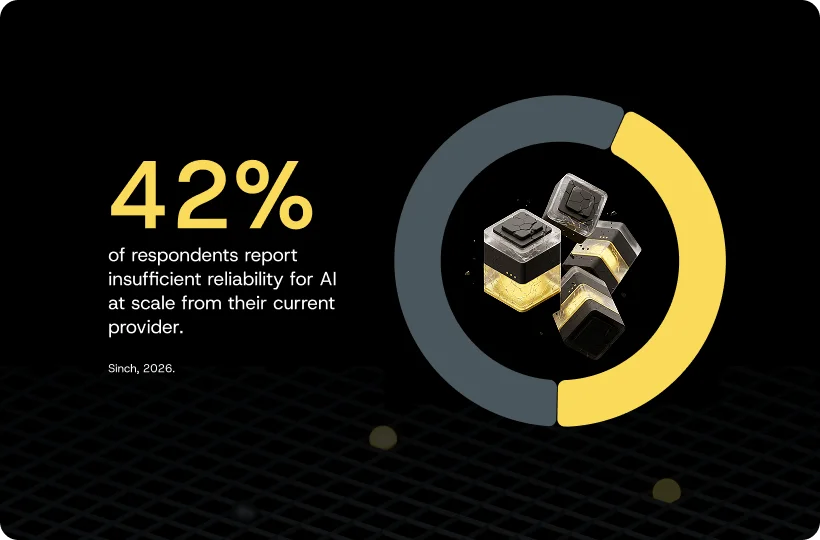
Our report, The AI Production Paradox, found that 42% of enterprise respondents say their current communications provider lacks sufficient reliability for AI at scale, while nearly a third say their current provider is lacking AI platform integrations.
Choosing your next provider lets you fix those gaps before they block a new deployment. It’s also a chance to find a partner whose investment in voice supports your own plans for the channel.
The risks of staying on legacy voice infrastructure
Whether it’s a legacy telephony system or a replacement with limitations, your team could face similar problems under a new contract. Depending on your current setup, you could run into:
- Integration work that slows progress: Limited connections to AI and business platforms can force your engineers to build and maintain custom workarounds.
- A customer experience that falls short: Unreliable connections and interruptions undermine the voice conversations your customers depend on to get help.
- Security and compliance gaps mean more work: Older infrastructure can leave your team adding controls and checking to assure protections meet changing requirements.
- Aging equipment: Legacy networks are built on equipment that’s no longer being manufactured and people who know how to maintain it are dwindling.
- Another migration sooner than you’d like: A provider that isn’t investing in voice could leave you searching again when your needs outgrow it.
Meanwhile, your competitors are putting AI agents to work resolving customer requests and completing transactions over the phone. If your team has to rebuild connections before it can add those features, you lose time while they move ahead.
The right migration strategy can head off these risks. Start by choosing an enterprise voice provider that makes switching from Lumen straightforward in a few key ways.
Migrating to Sinch is easier than you think
Yes, migrating to a new provider can come with some headaches. But managing it boils down to three questions: What needs to change? Who handles the work? How will you know the new service is ready to replace Lumen?
When you choose Sinch as your next voice partner, you can:
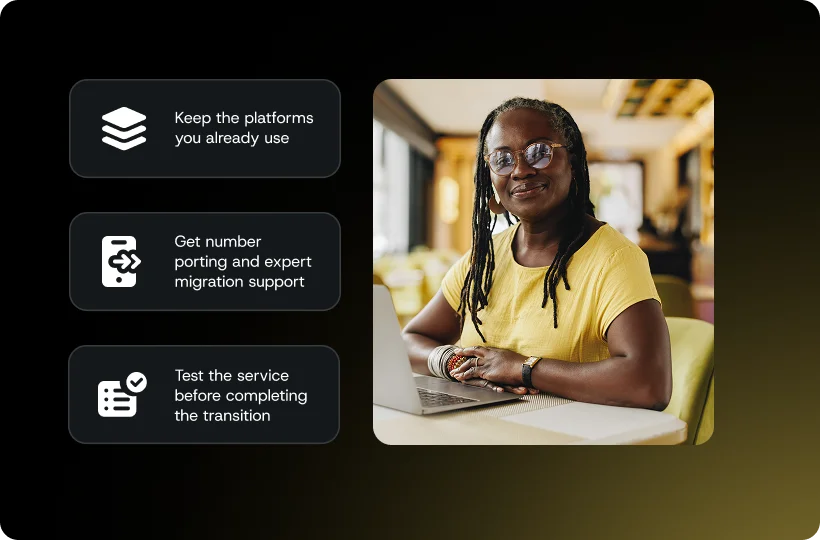
Keep the platforms your teams already use
Moving from Lumen doesn’t have to mean replacing the phone system or contact center platform your teams already know. Our Bring Your Own Carrier (BYOC) options let you connect compatible platforms to its voice network. You modernize the service underneath and keep the tools and workflows you’ve invested in, swapping out the carrier to Sinch.
We provide options to easily integrate with your favorite IP-PBXs and SBCs and guides to show you how. Each one connects your platform to the public switched telephone network (PSTN), so employees and support reps to make and receive external calls using familiar tools.
The right connection depends on your platform, licensing, and current architecture. For compatible environments, your team can focus the migration on carrier connectivity and keep its investment in the applications employees already know.
Get number porting and expert migration support
Moving business phone numbers takes coordination, especially when those numbers serve multiple locations, departments, and platforms.
Worried about keeping a local presence across all your locations? Our network supports more than 160 million phone numbers, so you can consolidate voice services with one provider without giving up your reach.
We assign dedicated specialists to help with number porting and onboarding, with additional resources for large-volume requests. Our team works to keep your calls flowing and limit interruptions while you move.
We also connect directly to the contact center environment. Through Bring Your Own Carrier (BYOC), you can pair Sinch’s voice network, numbering, and messaging with your existing CCaaS platform, upgrading your carrier quality without disrupting the tools your contact center staff uses every day.
You’ll see the work happen, too. In our portal, you can track order status, get automated email or webhook notifications, exchange comments directly with our porting operations team, and route numbers to the voice applications or SIP trunks that handle your calls. And for large or complex moves, our LNP specialists are there to help guide the port from submission to cutover.
Test the service before completing the transition
You shouldn’t have to wait until you’ve fully migrated, or until your Lumen contract expires, to find out how a new voice provider performs.
You can evaluate Sinch alongside your current environment, giving your team time to validate call quality, routing, and integrations. We can help you spot and fix any potential issues before you move more traffic.
Our commitment to reliability continues after the cutover. We own and operate our U.S. Super Network, which gives us direct control over routing and troubleshooting. Our SIP trunking service is backed by a 99.99% uptime SLA.
For business communications provider Vested Networks, that reliability is central to the service it offers to customers:

“We rely on Sinch for stability, scale, and support across every channel we deliver. Voice, messaging, numbering, dynamic E911 — practically everything we offer runs through Sinch. The platform is rock-solid, and we hardly ever have issues.”
Your next provider should be investing in voice
Lumen’s exit from voice shows how much a provider’s priorities shape your options. Whichever Lumen alternative you choose should keep investing in enterprise telephony, contact centers, and AI-powered voice.
We’re investing in voice to help you do more with the channel. Take Voice Relay, which connects text-based AI agents to live phone calls. We handle speech recognition, voice synthesis, and interruptions during the conversation, so your developers have less voice infrastructure to build and manage themselves.
“Voice remains one of the most powerful channels for customer engagement, and enterprises are increasingly looking to bring AI into those interactions. Voice Relay allows developers to connect AI agents to the global telephone network quickly and reliably…”

You also need a dependable foundation. We support STIR/SHAKEN caller ID authentication, E911 capabilities supporting Kari’s Law and RAY BAUM’s Act, and TLS/SRTP encryption for call signaling and audio. These protections help your team meet security and emergency-calling requirements as your voice environment evolves.
Find a voice partner you can trust
Your next voice provider will influence how quickly your business can launch new capabilities and respond to changing customer expectations. Use the move from Lumen to choose a partner with the infrastructure, expertise, and commitment to support your plans.
Sinch carries more than 250 billion voice minutes annually, and our U.S. voice network reaches 95% of the population. Tier 1 carriers trust us with their traffic, too. That scale supports the everyday conversations your business depends on and gives you a solid foundation for what comes next.
Across our communications portfolio, we serve more than 200,000 businesses, including Google, Uber, PayPal, and Visa. Gartner also named Sinch a Leader in its 2026 Magic Quadrant for Communications Platform as a Service (CPaaS) for the fourth consecutive year.
You already have a reason to move. Make it a step toward what your business needs the voice channel to do next.
Ready to talk through your environment and migration timeline? Talk to a Sinch voice expert. Not there yet? Explore your options for moving from Lumen.

Author: