Insights, Products
RCS security: Is RCS encrypted, and is it safe to use?
Is RCS secure? Yes – and it is a major upgrade on the plain SMS it replaces. Is RCS end-to-end encrypted? That one depends entirely on who is texting whom. That single distinction is the heart of RCS security, and it is where most explanations online get it wrong.
Here is how it actually breaks down. Person-to-person chats in Google Messages have been end-to-end encrypted for years, cross-platform encryption between iPhone and Android started rolling out in beta in May 2026, and business messages – the branded texts your bank or airline sends you – are encrypted in transit but not end to end. Three situations, three different answers.
If you are a marketer or product owner weighing Rich Communication Services (RCS) for customer messaging, that nuance decides what you can and cannot send over the channel. In this guide, we’ll break down what RCS security actually protects, the three states of RCS encryption, how RCS compares to SMS, what RCS for Business does and doesn’t secure, and how verified sender profiles keep your customers safe from spoofing.
What RCS security actually protects
RCS is the GSM Association (GSMA) standard built to modernize SMS and MMS, delivered to the native messaging inbox on a phone rather than through a separate app. Google is its biggest implementer – Google Messages is the default RCS app on Android – but the standard belongs to the mobile industry, not to any single company. RCS now reaches around 1.5 billion users globally, including 250 million in the U.S., where more than a billion RCS messages are sent every day.
Security in messaging really comes down to three questions:
- Can anyone read the message while it travels? This is where encryption in transit and end-to-end encryption (E2EE) come in.
- Do you know the message is really from who it claims to be? This is sender identity – verification and anti-spoofing.
- Is the content handled and stored in line with the rules? This is compliance – GDPR, industry certifications, and data-handling policy.
SMS, the technology RCS builds on, was never designed for any of these: it travels unencrypted, its sender IDs are easily spoofed, and it has no verified branding. RCS improves every one of them, while SMS remains the universal fallback underneath. How much it improves the first – encryption – is the part worth slowing down for.
The three states of RCS encryption
There is no single yes-or-no answer to “is RCS encrypted,” because RCS behaves differently depending on the devices at each end and whether the message is a personal chat or a business message. Here are the three states as of July 2026.
| Scenario | Encryption | Status |
| Personal chat, Android ↔ Android (Google Messages) | End-to-end encrypted | Live for years – default in Google Messages |
| Personal chat, iPhone ↔ Android (cross-platform) | End-to-end encrypted via Universal Profile 3.0 / MLS | Rolling out in beta following iOS 26.5 (May 2026), carrier dependent |
| RCS for Business (A2P) – branded messages from a company | Encrypted in transit (TLS), not end to end | Standard today; E2EE does not extend to business messaging |
The first state is old news: person-to-person RCS chats between Google Messages users default to E2EE, marked with a lock icon on the send button and next to the timestamp.
The second is the big 2026 change. In March 2025, the GSMA published RCS Universal Profile 3.0, the first version of the standard to define end-to-end encryption based on the Messaging Layer Security (MLS) protocol. It made RCS the first large-scale messaging service to support interoperable E2EE across different providers’ apps. Then, in May 2026, Apple began rolling out end-to-end encrypted RCS in beta for iPhone users on iOS 26.5 with supported carriers, and Android users on the latest Google Messages. Encryption is on by default and switches on automatically over time for new and existing conversations, provided both people are on a carrier that supports the latest RCS version. Digital-rights advocates called it a genuine privacy win, because it closes the gap that SMS left open between the two platforms.
The third state is the one businesses need to internalize, and it is covered in its own section below.
Is RCS encrypted?
For personal messaging, increasingly yes. Between two people, RCS is either end-to-end encrypted already (Android to Android) or getting there fast (iPhone to Android, in beta). E2EE means the message is scrambled on the sender’s device and can only be unscrambled on the recipient’s – not by the carrier, not by Google, and not by anyone intercepting it along the way.
For everything else, RCS is at least encrypted in transit. Google Messages uses Transport Layer Security (TLS) to protect messages as they move between the device and Google’s servers, even when full E2EE is not in play. That is stronger than SMS, which sends content in the clear, but it is not the same as E2EE: in-transit encryption protects the message on the wire, not from the systems handling it. Metadata – who is messaging whom, and when – can still be visible to the intermediaries in the path.
So the accurate one-line answer is this. RCS is encrypted; whether it is end-to-end encrypted depends on the two ends and whether a business is involved. For a fuller walk-through of how a message actually travels, see our guide to how RCS works.
RCS security vs SMS: a major upgrade
If you are moving a messaging program from SMS to RCS, security is one of the clearest reasons to make the jump. Set the two side by side:
- Encryption: SMS content travels unencrypted and can be intercepted. RCS is encrypted in transit at minimum, and end to end for personal chats.
- Sender identity: An unverified SMS sender ID can be spoofed or imitated. RCS for Business only lets verified brands send branded messages, so recipients can trust the name and logo they see.
- Spam and phishing resistance: SMS is a favorite vector for smishing – phishing over text. RCS layers verification and Google’s spam detection on top.
- Analytics: SMS gives you a delivery receipt and little else. RCS adds read receipts and engagement data that also help flag suspicious activity.
The result? A channel that looks and feels like texting but behaves far more like a modern, secure app experience. That is exactly why 59% of consumers say they prefer RCS over SMS or MMS for verification messages. For the full feature-by-feature breakdown, see RCS vs SMS.
RCS security for business: compliance and its limits
This is the part vendors tend to gloss over, so it is worth being precise.
RCS for Business messages are encrypted in transit, not end to end. When a verified brand sends an RCS message, it is encrypted between the brand’s agent and the RCS for Business platform, scanned for spam and malware compliance, then encrypted in transit again on the way to the recipient. But because the message passes through Google’s infrastructure and carrier networks, Google and aggregators can technically access the content. The cross-platform E2EE rolling out for personal chats does not extend to brand-to-consumer business messaging.
That does not make RCS for Business insecure – it makes it appropriate for some use cases and not others. On the compliance side, RCS for Business carries a strong set of credentials: ISO 27001, SOC 2, SOC 3, GDPR, and PSD2. Google’s expectation is that every brand and aggregator complies with local data laws and publishes a privacy policy covering how end-user data is used, so GDPR responsibility ultimately sits with the business sending the messages.
“RCS for Business shares the same security framework as RCS, but the business solution also includes an additional layer of protection focused on business verification, which helps establish trust between businesses and consumers.”

The practical guidance: RCS for Business is an excellent fit for marketing, promotional campaigns, order and delivery notifications, appointment reminders, and branded messages – the vast majority of what brands send. It is not the right channel for confidential data. If your use case involves the kind of information that falls under HIPAA, PCI-DSS, or similar regimes, keep the data behind an authenticated login rather than in any message body. Even WhatsApp Business, whose personal chats use Signal-Protocol end-to-end encryption, processes business messages inside Meta’s and your provider’s systems. We compare the two channels in depth in RCS vs WhatsApp.
Pro tip: match the channel to the sensitivity of the data. Use RCS for Business for engagement and notifications, and reserve default-E2EE channels for anything genuinely confidential.
Pro tip: match the channel to the sensitivity of the data. Use RCS for Business for engagement and notifications, and reserve default-E2EE channels for anything genuinely confidential.
Verified sender: RCS’s built-in trust layer
Encryption protects the message. Verification protects the identity – and for business messaging, identity is where most fraud happens.
Only verified businesses can send branded RCS messages. To get verified, a brand submits identification and business details, and the application is reviewed by some combination of Google, the carriers, and regional verification providers before an RCS Agent is approved. Once approved, the brand’s name, logo, and a verified checkmark appear in every message – so a customer can tell a real message from a spoof at a glance. Because a bad actor cannot send from a branded, verified agent without passing that review, the channel is far more resistant to the spoofing and smishing that plague SMS.
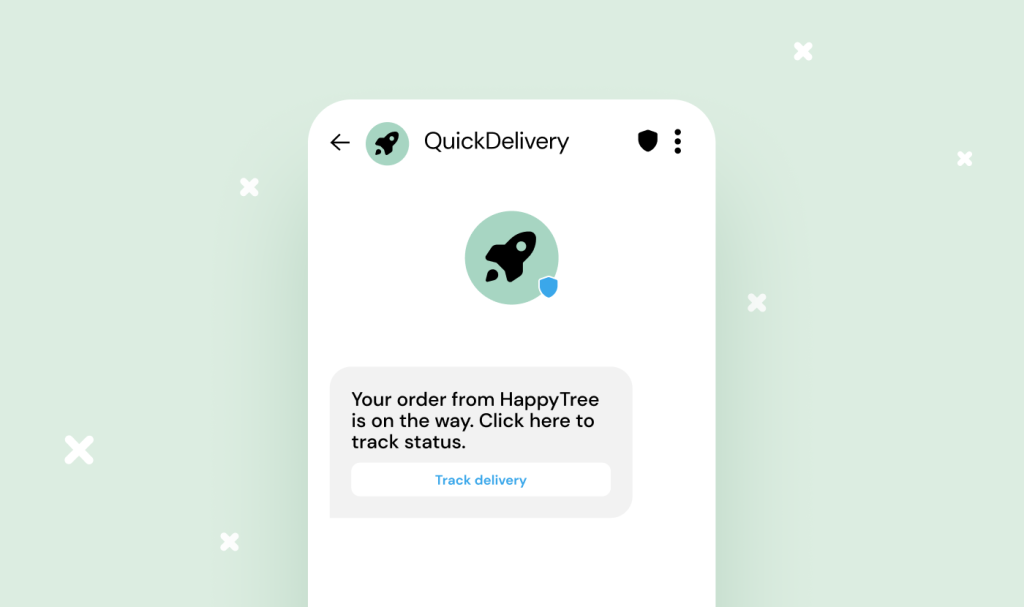
This matters because trust is fragile. 53% of consumers say they have received legitimate brand messages that felt suspicious, and nearly 80% say visual indicators like a logo and checkmark increase their trust in a sender’s identity. Google has also leaned in hard on spam: at Mobile World Congress, its RCS for Business team described applying insights from Gmail’s spam-protection systems to keep unwanted messages out of RCS.
Verification also underpins secure use cases like RCS one-time passwords (OTPs), where the branded, verified profile reassures users that a login code really came from their bank and not a scammer. Learn more about how the checkmark works in our guide to RCS verified senders.
Of course, security also depends on consent. Customers opt in to RCS the same way they opt in to other business messages – often a checkbox on a form – and rules differ by region, with the U.S. enforcing strict opt-in standards. If a customer replies “STOP” or asks to be removed, the business must stop messaging them, and Google requires senders to prove that opt-in consent was obtained and opt-out is available.
Frequently asked questions about RCS security
Yes. For personal messaging, RCS is safe and increasingly private, with end-to-end encryption already standard between Google Messages users and rolling out in beta between iPhone and Android. For business messaging, RCS is safe for the vast majority of use cases – marketing, notifications, and verification – thanks to in-transit encryption, verified sender profiles, and Google’s spam detection. It is not built for exchanging highly confidential data.
WhatsApp has the simpler story for personal chats, which use the Signal Protocol for end-to-end encryption by default. On the business side the gap narrows: WhatsApp business messages are decrypted for automated processing at Meta and your provider, while RCS for Business messages are encrypted in transit, not end to end. For most marketing and notification use cases, both are a major upgrade over SMS. For strict-compliance data (think HIPAA or PCI), keep the sensitive details behind an authenticated login rather than in any message body. See the full comparison in RCS vs WhatsApp.
RCS for Business carries GDPR among its compliance credentials, alongside ISO 27001, SOC 2, SOC 3, and PSD2. That said, Google places responsibility for GDPR compliance on the business sending the messages – you need to comply with local law and publish a privacy policy explaining how you use end-user data. Check with your own legal and compliance team before launching any new messaging program.
In Google Messages, you will see a lock icon on the send button and next to the message timestamp when a conversation is end-to-end encrypted. On iPhone running iOS 26.5, a similar lock indicator appears in eligible RCS chats. If there is no lock, the conversation is not end to end encrypted – it may be encrypted in transit, or it may have fallen back to SMS.
You should not. RCS for Business is encrypted in transit but not end to end, and messages pass through Google and carrier infrastructure that can technically access the content. Use it for marketing, order and delivery updates, appointment reminders, and verification prompts. For data governed by HIPAA, PCI-DSS, or similar regimes, use a channel with default end-to-end encryption such as WhatsApp Business.
Get started with secure RCS messaging
RCS security is not a single switch – it is encryption in transit as a baseline, end-to-end encryption for personal chats, verified sender identity to stop spoofing, and real compliance credentials for business messaging. Understood correctly, it is one of the strongest reasons to move beyond SMS. Understood carelessly, it is how a brand ends up sending the wrong data over the wrong channel.
The safest RCS program is one built on the right channel for each message. Sinch has been building RCS since 2017, with deep partnerships across Google and mobile operators worldwide.
Ready to launch secure, verified RCS messaging? Reach out to our team and we’ll help you design a program that fits your compliance needs. Or, if you want to run RCS alongside WhatsApp and SMS with automatic fallback, explore the Sinch Conversation API and build once to reach customers on whichever channel they can receive – experiences your customers will trust.

Author: