Insights, Products
RCS use cases and examples: 12 ways brands drive results
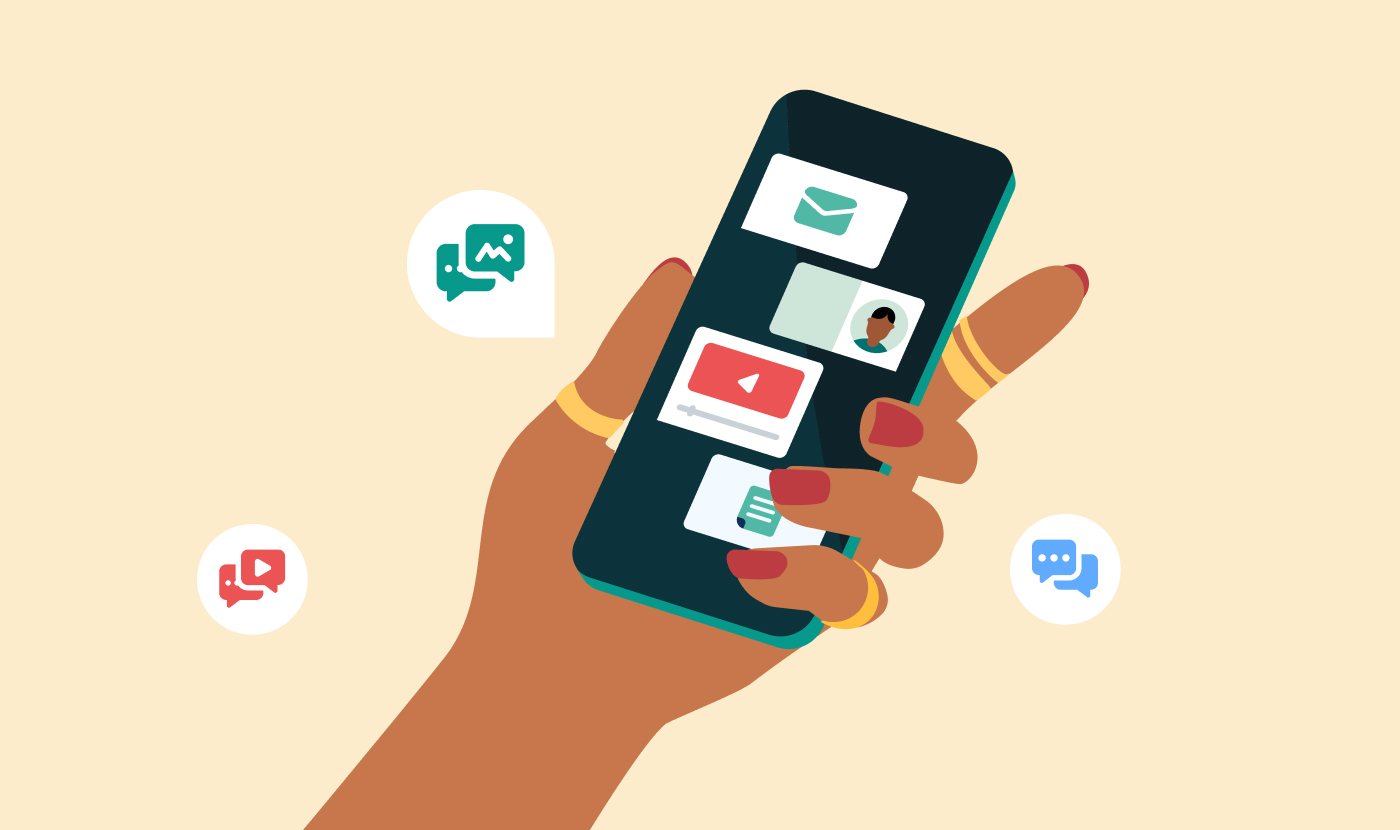
RCS use cases are the ways businesses put Rich Communication Services to work – branded promotions, order and delivery updates, one-time passwords, appointment reminders, and conversational support, all delivered to a customer’s native messaging inbox. In practice, that means the same texts you already send, upgraded with your logo, high-quality images, carousels, and tappable buttons – plus automatic SMS fallback so nothing gets lost.
The reason to care is simple: RCS (Rich Communication Services) reaches around 1.5 billion users globally, including 250 million in the U.S., where over a billion RCS messages are sent every day. It’s the native-inbox channel your customers already open – and Apple added RCS support in iOS 18, so the audience is only growing.
You don’t need a new app, a new habit, or a new inbox to reach people. You need to know what to send. So in this guide, we’ll walk through the most valuable RCS use cases – first grouped by business function, then by industry – with real examples and hard numbers from brands like Picard, Clarins, EasyPark, Macif, and Doctolib.
What are RCS use cases?
RCS use cases are the specific jobs the channel does for a business, from marketing campaigns to secure verification. What makes them possible is a set of capabilities that plain SMS simply can’t match. Think of RCS as SMS that grew up: same reach, but now with app-like features baked into the message.
Five capabilities do most of the heavy lifting across every use case:
- Verified sender profiles: Your brand is vetted by Google and carriers, so customers see your name, logo, and a checkmark – not a random number. Nearly 80% of consumers say those visual indicators increase their trust in who sent a message.
- Branded messages: Your colors and logo appear in every message, turning a text thread into a recognizable brand experience.
- Rich media and interactivity: High-quality images, videos, GIFs, carousels, suggested replies, and buttons let customers browse, buy, confirm, or reschedule without leaving the conversation.
- Read receipts and analytics: You see delivery, open, and read rates message by message – a huge upgrade over the delivery-only data of SMS.
- Automatic SMS fallback: When a device can’t receive RCS, Sinch delivers an SMS instead, so every customer gets the message regardless of their phone.
Those features are why RCS performs. Sinch data shows RCS marketing campaigns deliver 3 to 7 times higher click-through rates than Rich SMS, and interactive campaigns can lift average order value by nearly 10%. During the 2024 holiday season, RCS usage grew 111% year over year, with brands seeing 53% open rates. The channel supports dozens of message types – but the point isn’t the technology. It’s what you do with it.
RCS use cases by business function
Most RCS programs start with one job and expand from there. Here are the four functions where the channel earns its keep, each with a real brand result.
1. Marketing and promotions
This is where RCS shines brightest. RCS marketing turns a flat promotional text into an interactive storefront: rich cards, swipeable product carousels, and buttons that let shoppers browse deals and buy without ever leaving their inbox. It’s especially powerful for Black Friday and Cyber Monday, when standing out in a crowded inbox is everything.
Clarins, the luxury skincare brand, used RCS for its holiday campaign, sending branded messages with rich media and action buttons linking to gift sets and an Advent calendar. Customers could browse and add to cart without leaving the messaging app. Clarins saw click-through rates jump 2.5x compared to Rich SMS, with a 79% read rate and 35 times more redirections to its site.
Sneaker retailer Courir built a holiday campaign around an animated GIF and a button to its sale page, and earned a 70% read rate and a 137% return on investment compared to Rich SMS.

“With RCS, we have more metrics to analyze than with standard SMS or Rich SMS. The results were very promising, and they sparked ideas for further tests and optimization opportunities.”
And Micromania-Zing, part of the GameStop family, saw a 7x higher click rate, 120% higher website redirection rate, and doubled its brand visibility.
Pro tip: You don’t need a developer to start. Sinch Engage is a ready-to-use platform that lets small teams and enterprises launch RCS campaigns almost immediately, with native integrations for Salesforce, HubSpot, and Shopify.
2. Notifications, OTPs, and verification
Transactional messages – order confirmations, shipping updates, appointment reminders, fraud alerts, and one-time passwords (OTPs) – are the highest-trust messages you send. RCS makes them safer and more useful. Because they come from a verified sender, customers can instantly tell a real message from a phishing attempt. And 59% of consumers say they prefer RCS over SMS or MMS for verification messages.
EasyPark Group, a global leader in digital parking, is a textbook example. It sends branded, verified RCS messages – parking reminders, expiry alerts, and verification – to customers on RCS-capable devices, and falls back to SMS everywhere else. That dual approach means no customer misses a time-sensitive update, and it delivered 97.4% delivery rates in Germany.
RCS OTPs work the same way: the code arrives from a branded, verified profile with no extra steps for the user, but far less room for a scammer to impersonate you. One important caveat, though: RCS for Business messages are encrypted in transit, not end to end, so for genuinely confidential data with strict compliance needs, weigh your options carefully (more on that below).
3. Customer service and support
Nobody likes repeating themselves. RCS keeps support in one continuous, branded thread: a customer taps “Contact support,” chats with an AI bot for quick troubleshooting, and hands off to a live agent who already has the context – no app-switching, no starting over. It’s a natural fit, given that 76% of consumers say they’re open to handling returns and exchanges directly in their phone’s messaging app, rising to 92% among Gen Z. There’s a quiet economic argument here too: compliance rules already require brands to monitor their outbound numbers for incoming STOP requests – so the inbound channel is being paid for whether you use it or not. Leaving it closed to everything except opt-outs is wasted spend; opening it to FAQs, intent capture, and routing turns a compliance cost into a service channel.
In Brazil, iFood scaled driver and restaurant support with a conversational AI assistant on WhatsApp – the bot handles 45% of incoming inquiries, cut delivery-service costs by 70%, and earned a 91% satisfaction score from onboarded delivery staff. The playbook is channel-agnostic: the same AI-plus-agent handoff now runs over RCS, right in the native inbox, for audiences where texting is the default.
4. Conversational commerce
The line between “marketing” and “shopping” blurs when a customer can complete a purchase inside a conversation. This is conversational commerce, and RCS is built for it: personalized recommendations, product carousels, and a chatbot that answers questions and closes the sale, all in one thread.
French frozen-food retailer Picard built a holiday menu planner in RCS. Customers shared their dietary needs, budget, and cooking time, then received a custom menu with product images and buy buttons – without leaving their messaging app.

The result? Customer engagement rose 42%, and click-through rates tripled compared to Rich SMS. Cdiscount, one of France’s largest e-commerce platforms, took a similar path with rich, guided holiday offers and saw a 9% increase in average basket size. When shopping feels like a conversation, customers buy more.
RCS use cases by industry
The same capabilities land differently depending on who you serve. Here’s how four industries put RCS to work – and where to go deeper.
Retail and e-commerce
Retail is RCS’s proving ground, from promotions to post-purchase. Our State of RCS research found that 26% of U.S. retailers already use RCS for Business and another 35% plan to invest, and 54% of consumers said they’d rather get an abandoned-cart notification as an RCS message than an SMS or MMS.
The retail playbook covers the whole journey: personalized promotions, dynamic product catalogs, abandoned-cart recovery, visual order tracking, loyalty programs, and real-time support. Chronodrive, a French grocery drive-thru chain, launched its new loyalty program over RCS and earned a click-through rate three times higher than its classic SMS campaigns. Even outside pure retail, personalized rich messaging converts: automaker Nissan has seen 80% conversion rates from its Rich SMS campaigns – the same personalization playbook RCS extends with richer formats. The pattern repeats: rich, branded, interactive messages outperform plain text at every step.
Banking and financial services
Trust is the whole game in finance, and verified sender profiles are RCS’s strongest card here. When a customer gets a fraud alert or account notice from a verified sender with your logo, they know it’s really their bank – not a smishing attempt. Our research shows 49% of financial-services organizations already use RCS, and another 45% plan to implement or expand it.
Interactivity pays off too. French insurer Macif used RCS to re-engage millions of policyholders and saw a 200% increase in click rates compared to its email campaigns. Belgian bank Belfius nearly doubled submitted insurance claims – an 87.5% increase in completed claims versus its web forms – with its conversational AI assistant, and Argenta reached a 95% customer-satisfaction score with its chatbot. For the full playbook – from actionable fraud alerts to verified banking OTPs – see our guide to RCS in banking and financial services.
One accuracy note that matters for this sector: RCS for Business is encrypted in transit, not end to end. It carries strong compliance credentials (ISO 27001, SOC 2, SOC 3, GDPR, and PSD2) and is well suited to alerts, marketing, and notifications – but it isn’t the right channel for the most sensitive confidential data.
Healthcare
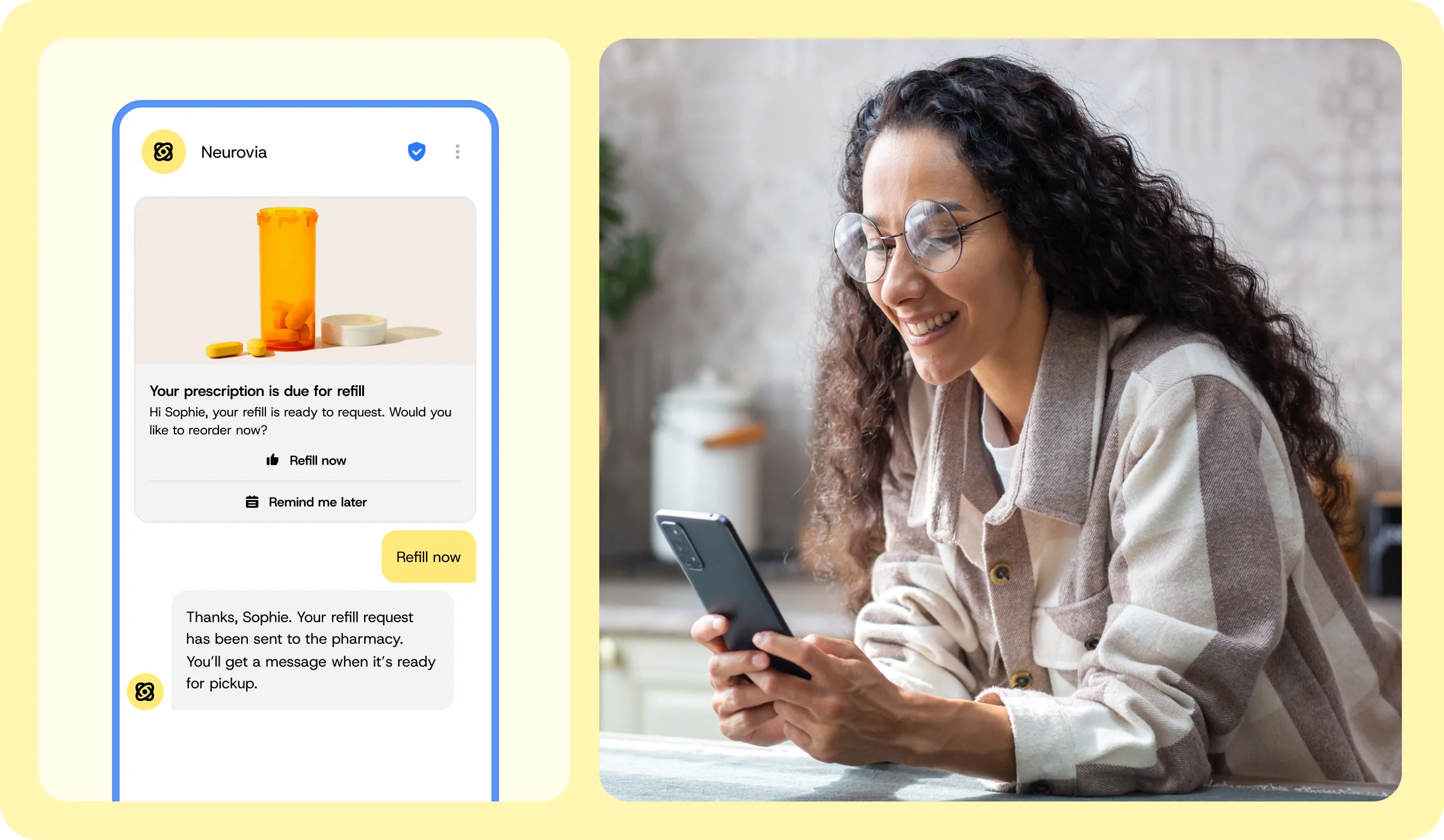
Healthcare communication runs on trust and timeliness. RCS supports appointment reminders with confirm, reschedule, and cancel buttons, preventative-care nudges, prescription-refill flows, and verified messages that protect patients from smishing. Our research found 36% of healthcare organizations currently use RCS and 45% plan to invest.
Doctolib, which connects over 90 million patients with 500,000 healthcare professionals across Europe, transitioned SMS traffic to RCS using Sinch’s RCS Upscale service. The team validated its RCS agent in just 72 hours and rolled out in Germany, scaling from 5% to 60% of traffic. Today Doctolib sends over 140,000 RCS messages a day at a 94% average delivery rate. For deeper patient-communication use cases, read RCS in healthcare.
A quick compliance reminder for this sector too: because RCS for Business is encrypted in transit rather than end to end, organizations with HIPAA or similar requirements should keep genuinely sensitive clinical data off the channel and compare it against alternatives built on end-to-end encryption.
Travel and logistics
Travel and mobility brands live and die by real-time updates, and RCS turns them into interactive experiences: rich boarding passes with QR codes, consolidated itineraries, one-tap room or seat upgrades, live delivery tracking with maps, and verified travel advisories for weather or strike disruptions.
EasyPark, which we met earlier, is a mobility example worth revisiting here: verified, branded parking alerts with SMS fallback kept millions of drivers informed and hit 97.4% delivery rates in Germany. The same model – timely, visual, actionable, with fallback for reliability – applies whether you’re confirming a flight, a hotel stay, or a parcel out for delivery.
Frequently asked questions about RCS use cases
The most common RCS use cases fall into four buckets: marketing and promotions (rich campaigns with carousels and buttons), notifications and verification (order updates, appointment reminders, fraud alerts, and OTPs), customer service (AI chatbots and live-agent handoff in one thread), and conversational commerce (browsing and buying inside the conversation). Most brands start with one and expand as they see results.
Retail and e-commerce lead adoption, but banking and financial services are close behind – 49% already use RCS. Healthcare, technology, travel, and logistics are all growing fast. Any business that sends transactional or promotional messages and wants richer, more trusted engagement is a good fit.
RCS for Business messages are encrypted in transit and come from verified, vetted sender profiles, and RCS carries strong compliance credentials (ISO 27001, SOC 2, SOC 3, GDPR, and PSD2). That makes it well suited to alerts, reminders, marketing, and notifications. However, it is not end-to-end encrypted, so for the most sensitive confidential data – think HIPAA or PCI-regulated information – you should evaluate a channel with end-to-end encryption. See RCS vs WhatsApp for a fuller security comparison.
Real numbers from brands: Picard grew engagement 42% and tripled its click-through rate, Clarins lifted click-through rates 2.5x with 35 times more site redirections, Courir earned a 137% return on investment, Chronodrive tripled its click rate, Macif saw a 200% increase in click rates versus email, and EasyPark hit 97.4% delivery rates in Germany. Across campaigns, Sinch data shows RCS delivers 3 to 7 times higher click-through rates than Rich SMS.
Increasingly, yes. Apple added RCS support in iOS 18 (September 2024), and RCS for Business is rolling out on iOS in key markets, subject to Apple and carrier support. Cross-platform end-to-end encryption for person-to-person RCS chats between iPhone and Android is also rolling out in beta following iOS 26.5. And because RCS falls back to SMS automatically, your message reaches every customer regardless of device.
Put these RCS use cases to work
The through-line across every example here – Picard, Clarins, Courir, EasyPark, Macif, Doctolib – is the same: they took messages they were already sending and made them richer, more branded, and more interactive, without asking customers to change a thing. That’s the opportunity RCS puts on the table.
Rich, conversational messaging is how modern brands engage, convert, and support at scale. With Sinch Conversation API you get full programmatic control across RCS, SMS, and more from a single integration. Or, if you’d rather launch campaigns without code, Sinch Engage gets you sending RCS in a matter of clicks.
Want to go deeper first? Explore these resources:
- What is RCS messaging? The complete guide
- Types of RCS for Business messages and how to use them
- RCS marketing: What it is and how to get started
- How RCS OTPs strengthen authentication
- Why tech and SaaS leaders are choosing RCS
Ready to build RCS experiences your customers will trust? Reach out to our team – we’re here to help you send the right message on the right channel, every time.
Last updated by Drew Wilkinson on the 16th of July 2026

Author:

Co-author: