Insights
RCS vs SMS: What’s the difference and when to use each?
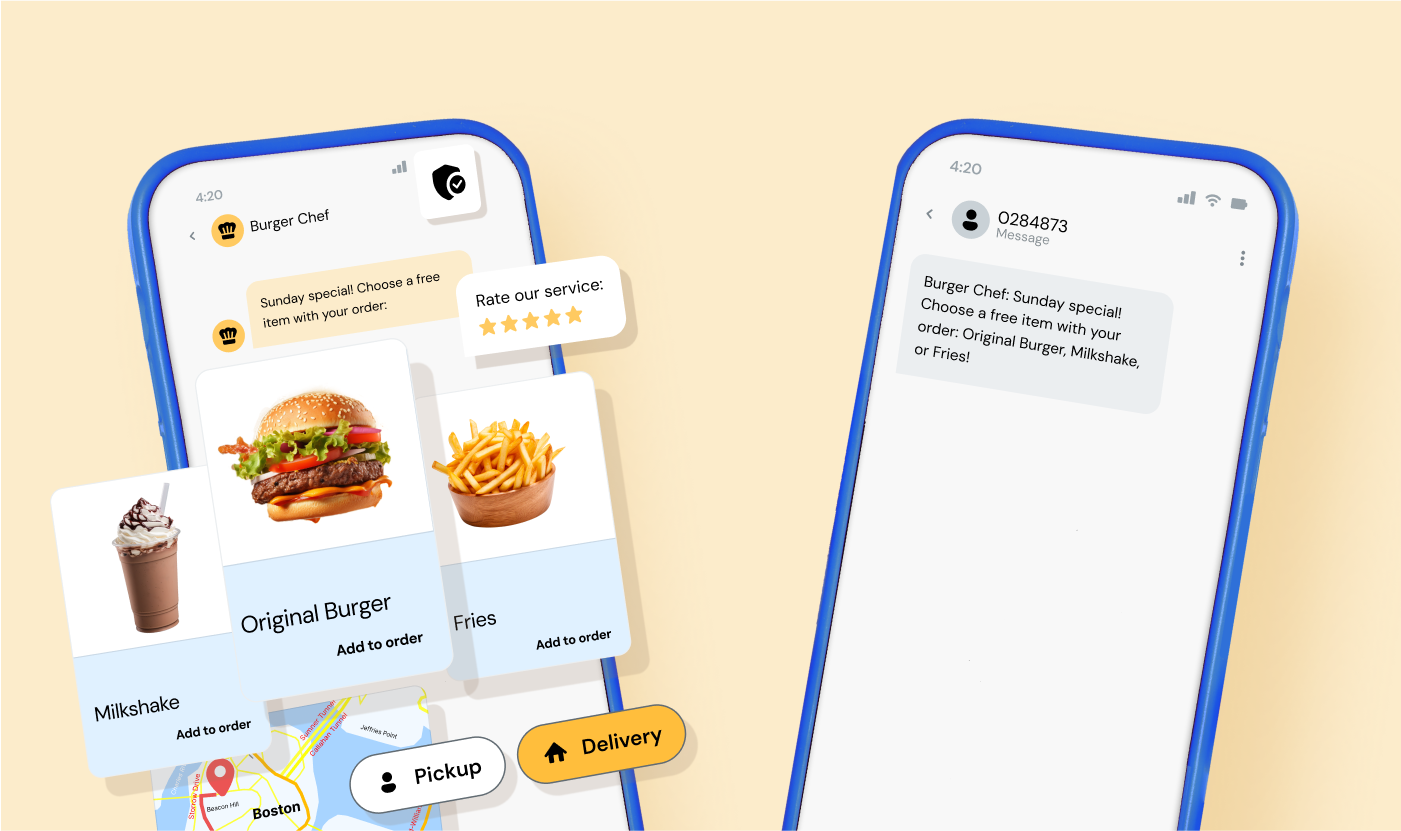
RCS and SMS aren’t competing for the same job – they’re two halves of one messaging strategy. SMS (Short Message Service) is the universal baseline: it reaches virtually every mobile phone on the planet, with no app, Wi-Fi, or data connection required. RCS (Rich Communication Services) upgrades that same native inbox with verified branding, rich media, and tappable buttons – wherever the device and carrier support it. RCS extends SMS rather than replacing it – and SMS fallback is the bridge between the two.
If you’re deciding where your messages – and your budget – should go, the ground has shifted fast: iPhones have supported RCS since iOS 18, and the RCS market is projected to grow from around $3 billion in 2025 to $9 billion by 2030.
In this guide, we’ll break down what each channel does best, compare RCS vs SMS side by side – including the cost and security questions most comparisons skip – and show you how to run both together so every message lands.
What is SMS? The universal messaging baseline
SMS is the most established texting technology in the world. Because nearly every mobile device is SMS-compatible, you can use SMS to reach almost anyone – no Wi-Fi or data network required. Messages travel over the mobile carrier network, which is why SMS stays reliable when other channels fail, and why it’s the standard fallback when richer messages can’t get through.
That reliability is the whole point. For business communication, SMS is the channel you trust with one-time passcodes, fraud alerts, and urgent notifications – a passcode that depends on a data connection isn’t a passcode you can count on.
The trade-off is simplicity: a single SMS carries up to 160 characters of plain text from a phone number. Its multimedia sibling, Multimedia Messaging Service (MMS), adds images, audio, and video over the same carrier rails, but stays a one-way format with no verified sender.
What is RCS? Branded, interactive messaging in the same inbox
Rich Communication Services (RCS) is the messaging standard created by the GSM Association (GSMA) to modernize SMS and MMS. Google is its biggest implementer – Google Messages is the default RCS app on Android – but the standard belongs to the mobile industry, not to any single company. And unlike WhatsApp or iMessage, RCS needs no separate app: it works in the messaging app your customers already have.
Reach has grown quickly. RCS now counts around 1.5 billion users globally – including 250 million in the U.S., where over a billion RCS messages are sent every day. Since iOS 18 (September 2024), iPhones support RCS too, and RCS for Business is rolling out on iOS in key markets (Apple- and carrier-dependent).
Key benefits of RCS for Business
The business implementation, RCS for Business (previously called “RCS Business Messaging” or “RBM”), turns the one-way text blast into a two-way brand experience:
- Verified sender profiles: Your name, logo, and a verification checkmark replace the anonymous number.
- Rich cards and carousels: High-resolution images, video, and swipeable message formats showcase products in the thread.
- Suggested replies and actions: Tappable buttons let customers confirm, track, or reply without typing.
- Read receipts and analytics: RCS reports reads and engagement – data SMS can’t give you.
- Built-in fallback: When a device doesn’t support RCS, the message falls back to MMS or SMS.
“One of the benefits you’re going to see with RCS is that as a consumer, when you interact with a brand, you’re going to see the brand’s logo and name… [and as an end consumer], I’m going to trust the brand more because I’m seeing it’s the actual brand. Instant brand recognition.”

RCS vs SMS: The key differences
Here’s the side-by-side view, MMS included. Notice the pattern: every step up in richness adds a condition – data, device, carrier – that plain SMS never needs.
| SMS | MMS | RCS | |
|---|---|---|---|
| How it’s delivered | Cellular network – no data needed | Cellular network | Wi-Fi or mobile data; falls back to MMS or SMS |
| Reach | Virtually every mobile phone | U.S., Canada, and Australia (A2P); elsewhere carrier-dependent | ~1.5 billion users globally; Android plus iPhone (iOS 18+), carrier-dependent |
| Message length | 160 characters | Up to 5,000 characters | Long-form, rich layout (up to 3,072 characters of text) |
| Media | None | Images, GIFs, audio, video, PDFs, vCards (carriers may compress) | High-resolution images, video, rich cards, carousels; files up to 100MB |
| Sender identity | Phone number | Phone number | Verified name, logo, and checkmark |
| Interactivity | Two-way replies, no buttons | None | Suggested replies, buttons, carousels, chatbots |
| Read receipts and analytics | Delivery only | Delivery only | Delivery, read receipts, engagement analytics |
| Encryption | None | None | Business messages encrypted in transit, not end to end; personal chats can be end-to-end encrypted |
| Cost | Per message | Per message, typically more than SMS | Per message or per session; basic messages typically comparable to SMS |
| Best for | Universal reach, passcodes, alerts, fallback | Picture messaging where supported | Branded, interactive, two-way conversations |
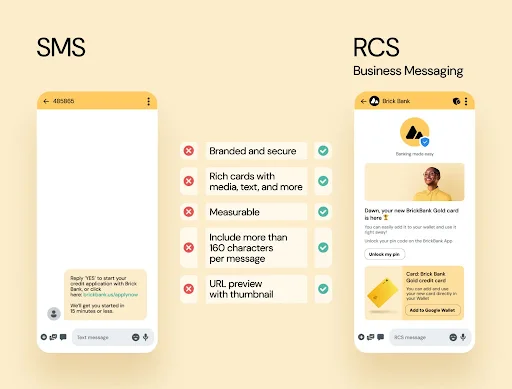
SMS and RCS offer customers different experiences when they’re communicating with businesses.
The division of labor is plain: SMS trades features for reach nothing else matches, while RCS trades universal reach for identity and interaction. For adjacent match-ups, see RCS vs MMS, SMS vs MMS, and RCS vs iMessage.
Is RCS more secure than SMS?
Mostly, yes – but “RCS is encrypted” means three different things, and mixing them up is the most common mistake in this comparison.
- Personal chats between Android users are end-to-end encrypted via Google Messages.
- Personal chats between iPhone and Android are getting end-to-end encryption too – it’s rolling out in beta following iOS 26.5 (May 2026), built on the GSMA’s Universal Profile 3.0.
- Business messages sent through RCS for Business are encrypted in transit only – not end to end. They pass through Google’s infrastructure and carrier networks, so Google and aggregators can technically access content. The channel carries strong compliance credentials – ISO 27001, SOC 2, SOC 3, GDPR, and PSD2 – but the consumer encryption rollout does not extend to brand-to-consumer messaging.
SMS, for its part, isn’t encrypted at all, and an unverified sender ID can be spoofed or imitated – which is why smishing thrives there. What RCS for Business adds isn’t secrecy, then, it’s identity: 53% of consumers have received legitimate brand messages that felt suspicious, and a verified sender that carriers and Google have vetted makes impersonation dramatically harder.
For genuinely sensitive data, regulated industries use the authenticated handoff: the message carries the alert plus a secure link into an authenticated session, so nothing confidential rides in the message body. And where message confidentiality is a hard requirement – think HIPAA- or PCI-grade – no mainstream business channel clears that bar alone: even WhatsApp business messages, which carry stronger encryption guarantees, are decrypted for automated processing at Meta and your provider – so the handoff pattern applies there too. Our guide to RCS security goes deeper.
Is SMS or RCS better for marketing?
For marketing, RCS has the edge wherever it can reach – marketing is exactly where branding, media, and interactivity pay off. Our 2025 State of customer communications research, surveying over 2,800 global consumers, found that 54% chose RCS as the most engaging message format – ahead of SMS (24%) and MMS (22%). And 79% said the logos and checkmarks RCS provides make messages appear more trustworthy.
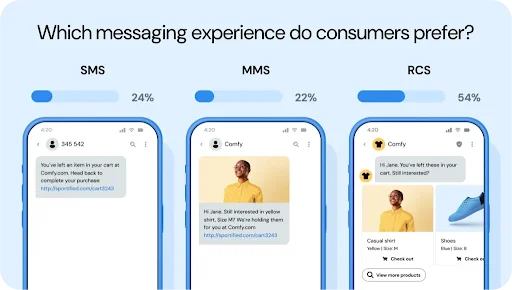
Over 2,800 global consumers said they prefer rich, interactive messages: 54% found RCS messages with branding and buttons more engaging than basic SMS or MMS.
The results show up in real campaigns. BUT, a leading French home furnishing retailer, used RCS for its promotions and reached a 13.5% click-through rate, generating €61,000 in additional turnover – tripling the previous year’s results. And Picard turned its holiday campaign into a conversational menu planner inside the native inbox. The result? A 42% increase in customer engagement – plus campaign data SMS could never surface.
“Unlike traditional SMS campaigns, RCS provides insights into delivery and open rates, allowing for better campaign monitoring.”

Pro tip: Prove the ROI before you scale your RCS marketing. Send your RCS campaign (with SMS fallback) to one group and the identical content as plain SMS to a control group you’ve confirmed is RCS-eligible. Since both groups could have received RCS, any lift is attributable to the channel itself.
That said, SMS remains a marketing workhorse – universal, cheaper at baseline, and effective for short, urgent offers. The smart plan uses both.
RCS vs SMS: Which should your business use?
There’s no one-size-fits-all messaging channel – and that’s a good thing. Here’s the framework we use.
Use RCS if:
- You want rich media and buttons for interactive use cases like promotions, reminders, or conversational support
- Sender trust matters – for verification messages like one-time passwords, 59% of consumers prefer RCS over SMS or MMS
- You need read receipts, engagement analytics, or two-way conversation
Use SMS if:
- You need universal reach, including older devices and customers without a data connection
- Your message is short, urgent, and text-only – a passcode, a fraud alert, a delivery window
- You need guaranteed delivery rather than advanced features
Use both if:
- You want the richest experience each phone supports, with reach you never think about – RCS where it lands, SMS everywhere else
The SMS side isn’t hypothetical. When the American Automobile Association (AAA) rebuilt its roadside assistance flow on two-way SMS, messages reached drivers even off-road or without data.
conversion rate to roadside assistance
in cost savings
How to switch from SMS to RCS (without giving up reach)
Adding RCS doesn’t mean migrating off SMS – the two run as one program, connected by fallback.
With Sinch Conversation API, the platform performs a capability check on every send: if the recipient’s device and carrier support RCS, the message is delivered as RCS; if not, it automatically falls back to MMS or SMS. No second version of the campaign to maintain. Our guide to sending RCS via API walks through setup, including registering your verified RCS Agent.
Already running SMS with Sinch? RCS Upscale connects RCS capability to your existing SMS numbers – Sinch checks each device and delivers RCS when it’s supported, SMS when it isn’t, with no new integration required.
EasyPark Group, a leader in digital parking, shows the pattern at scale. Parking reminders have to arrive reliably, so SMS remained the backbone – and RCS was layered on for users in Germany with compatible devices. The result? A 97.4% delivery rate, with 40% of messages arriving over RCS.
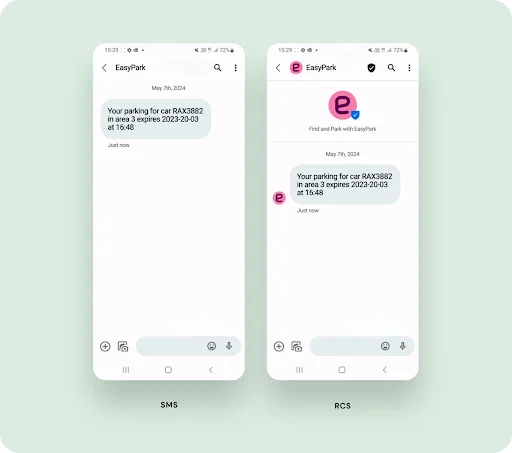
EasyPark relies on both SMS and RCS to deliver important notifications.
Frequently asked questions about RCS vs SMS
Neither is better in general – they do different jobs. RCS wins when a message benefits from verified branding, rich media, and a tappable reply. SMS wins when the message has to reach every device with no data connection required, like a one-time passcode or a critical alert. Most businesses use both, with SMS as the fallback.
SMS is plain text, capped at 160 characters, sent from a phone number over the cellular network – and it works on virtually every mobile phone. RCS adds a verified sender name and logo, high-resolution media, and interactive buttons in the same native inbox, but needs a data connection and a supported device and carrier.
Basic RCS messages are typically priced comparably to SMS, with richer or conversational RCS priced per message or per session depending on market and provider – our RCS pricing guide has the full breakdown. The bigger difference is usually performance, not price per message.
Your phone uses RCS when your device, your carrier, and the person you’re messaging all support it and you have a data connection. Most modern Android phones and iPhones on iOS 18 or later enable it by default. When any of those conditions drops, the conversation quietly continues as SMS.
There’s usually no need. If you’re having delivery issues or want to reduce data usage, you can toggle it off in your messaging app’s settings, and conversations default back to SMS/MMS.
RCS needs a data connection, a supported device, and carrier coverage, so it can’t guarantee delivery the way SMS can – that’s why fallback matters. Business messages are also encrypted in transit but not end to end, so confidential data belongs behind an authenticated link.
Get started with RCS and SMS
The RCS vs SMS question was never really a versus. SMS gives you reach nothing else matches; RCS gives that reach a face, a checkmark, and a reply button. The brands getting the best results – Picard, AAA, EasyPark, BUT – matched each message to the channel it needs and let fallback connect the two.
If you’re ready to explore RCS, download our comprehensive guide to learn how to make the case for it in your organization.
Or, jump straight in: check out Sinch Engage to run RCS campaigns no-code, or if you’d rather build with an API, reach out to our team – with 600+ direct carrier connections, we’re here to help you create messaging experiences your customers will trust.
Want to go deeper first? Explore these resources:
- What is RCS messaging? The complete guide
- RCS vs MMS: What’s the difference and when to use each
- RCS vs WhatsApp: Which channel is best for business messaging?
- RCS vs iMessage: What’s the difference?

Author: