Insights
RCS pricing: How business messaging costs really work

There is no single price for an RCS message – it is set by mobile operators, priced by the type of message you send, and billed either per message or per 24-hour session. That is the short answer to how Rich Communication Services (RCS) pricing works. The longer answer is what turns a line item into a strategy, because the same features that push an RCS message above the cost of an SMS are the ones that make customers actually respond.
If you have tried to get a straight number for what RCS costs, you have run into the same wall every marketer and product lead does: it depends on the market, the carrier, the kind of message, and how your account is set up. That is not evasion – it is genuinely how the channel is priced, and once you understand the moving parts, budgeting for RCS gets a lot less mysterious.
In this guide, we’ll break down what RCS pricing is, who sets it, the message types and billing models that shape your bill, how RCS stacks up against SMS and WhatsApp, and how to think about the return, not just the cost.
What is RCS pricing?
RCS pricing is what a business pays to send RCS for Business messages – and it is driven by what each message can do, not a flat per-message rate. RCS for Business (previously called “RCS Business Messaging” or “RBM”) is the application-to-person (A2P) channel that delivers branded, verified-sender messages straight into a phone’s native inbox, with rich media, suggested replies, and interactive buttons.
Those capabilities are exactly what shape the price. A plain text notification is priced differently from an image-rich carousel with buttons, and a one-way alert is priced differently from a two-way conversation. You also get engagement data – opens, clicks, reads, and replies – that SMS simply cannot return. That added value is why some RCS messages cost more than a text, and why the right way to read RCS pricing is against the results it drives, not against SMS alone.
With the global RCS market worth around $3 billion in 2025 and projected to reach roughly $9 billion by 2030, pricing is maturing fast – which makes understanding the model now a real advantage.
Who sets RCS pricing?
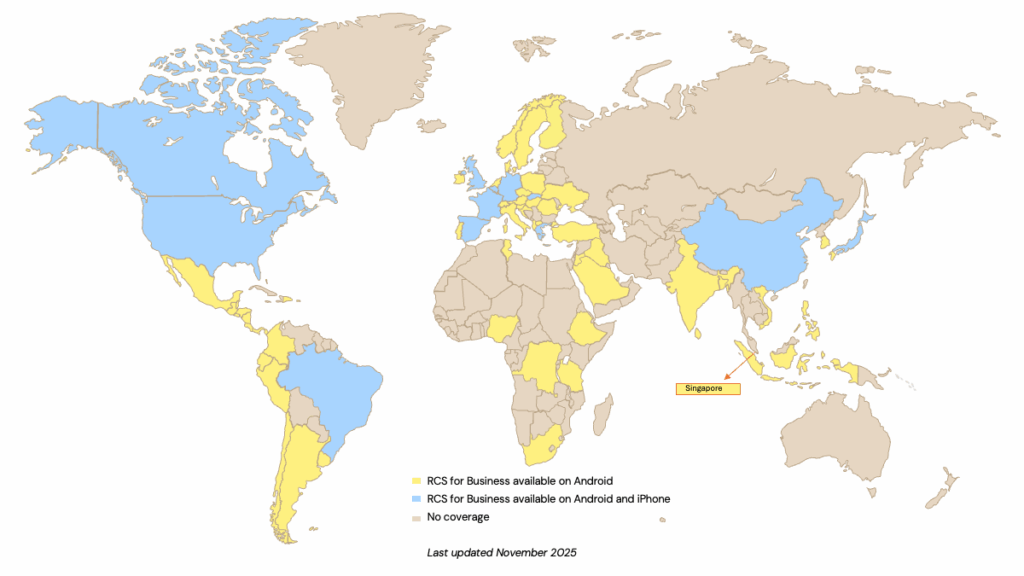
Here’s the first thing that trips people up: RCS for Business pricing is not set by a single global entity. It is managed by mobile operators (the carriers), so there is no one worldwide price for an RCS message. Instead, the cost varies with carrier agreements, market conditions, and the volume you plan to send.
That is a real difference from an app-based channel like WhatsApp, where one company sets the rate card. With RCS, the price reflects a patchwork of operator agreements in each market you message into. One more distinction worth keeping straight: the cost of delivering an RCS message is set by carriers, but the price your messaging provider charges can differ.
The practical takeaway? If you are planning an RCS strategy, check pricing with your provider for the specific regions you operate in – a campaign that is inexpensive in one market can be priced quite differently a border away.
RCS message types – and what you pay for
Because price follows capability, the RCS for Business message types you send are the biggest lever on your bill. The category names differ by destination country, and they fall into two schemes.
Outside the United States, carriers typically classify messages as:
- Basic messages: Simple, text-only messages up to 160 characters. They work much like SMS but carry a verified, branded sender profile and URL previews – ideal for one-way updates like one-time passwords (OTPs) that do not need a reply. Basic messages are usually priced closest to SMS.
- Single messages: Plain text over 160 characters, plus all rich content – images, videos, GIFs, buttons, and carousels. Best for marketing campaigns and product showcases, and priced above Basic to reflect the richer experience.
In the United States, carriers use two parallel categories:
- Rich messages: Text-only under 160 characters, optionally with suggested replies and simple actions like opening a URL or dialing a number. Messages over 160 characters bill as two or more, just like SMS.
- Rich Media messages: Everything content-heavy – images, videos, files, and advanced actions like opening a webview inside the message. The 160-character limit does not apply.
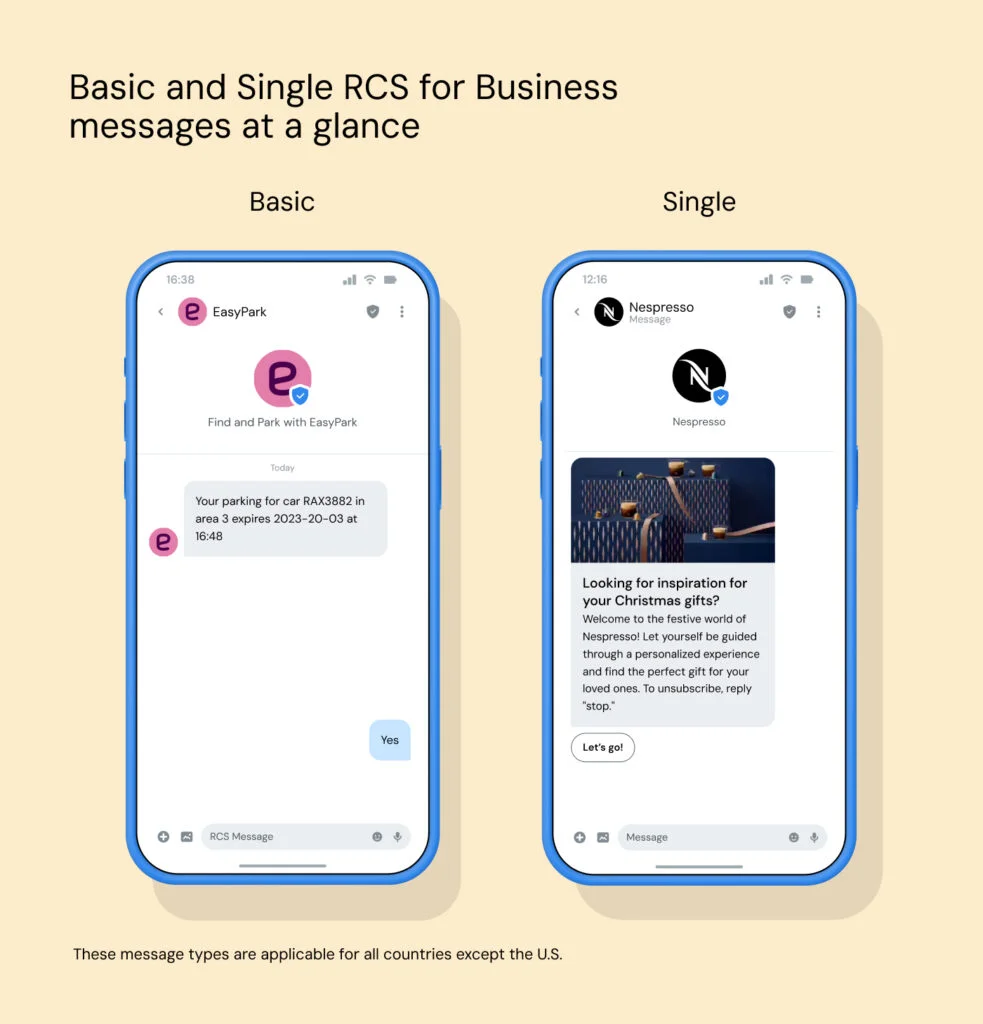
The rule of thumb holds everywhere: the closer a message is to plain text, the closer its price is to SMS; the richer and more interactive it gets, the more it costs.
How RCS billing models work: per message vs per session
The message type tells you what you are sending. The billing model tells you how it is counted – and that comes down to how your RCS Agent (your verified business identity in the RCS ecosystem) is configured. There are two models.
Non-conversational: per-message billing
With a non-conversational RCS Agent, each message is billed separately, much like SMS, and the price is set by the message type. Two-way exchanges are still possible – but every message in the back-and-forth is charged individually. In the United States, all RCS Agents are non-conversational, whether you send Rich or Rich Media messages.
Conversational: session-based billing
Outside the United States, businesses can use conversational RCS Agents for real-time, two-way messaging. Here is the mechanic:
- The first message is billed per message, at the rate for its content tier.
- If the recipient replies, a 24-hour conversation session opens, and every message inside that window is covered by a single flat conversational rate.
The result? If a customer never responds, each message is charged by its type. The moment they reply – or a customer messages you first and you answer within 24 hours – pricing shifts to the session-based model. For support and chatbot use cases with lots of exchanges, that flat session rate is where RCS gets genuinely cost-efficient.
| Feature | Non-conversational | Conversational |
| Billing method | Per message | Session-based |
| Availability | Standard in the United States | Available outside the United States |
| Best for | One-way notifications like OTPs and promotional alerts | Two-way or ongoing conversations like support and chatbots |
| Pricing structure | Each message billed individually by type | Flat session rate covers all messages in a 24-hour window after the user replies |
| Two-way interaction | Possible, but each message is charged separately | Encouraged and cost-effective inside the 24-hour session |
One clarification worth keeping straight: the message-type names (Basic/Single or Rich/Rich Media) are set by the destination country, while the availability of the conversational model itself is geographically limited.
What drives the cost of an RCS message
Pull it together and a handful of factors decide what any given RCS message costs:
- Message type: Basic or Rich text sits near SMS; Single or Rich Media costs more.
- Billing model: Per message versus a flat 24-hour session rate.
- Market and carrier: Operator agreements vary widely by country – the single biggest source of price variation.
- Volume: Some carriers offer volume-based pricing, so higher send volumes can change your effective rate.
- Agent configuration: Whether your RCS Agent is conversational or non-conversational.
One more detail on who pays: unlike SMS, RCS is not available as Free to End User (FTEU) messaging. Because RCS relies on Wi-Fi or mobile data, recipients receive messages through their own data plans – the same as WhatsApp or iMessage.
How RCS pricing compares to SMS and WhatsApp
The question behind most RCS pricing searches is really a comparison: is it more expensive than what I send today? Here is how the three channels compare for most businesses.
| Channel | Pricing model | How cost compares |
| SMS | Per message, by destination and volume | The baseline. Simple, universal, cheapest per message – but text-only with no branding or interactivity |
| RCS for Business | Per message (non-conversational) or per 24-hour session (conversational), by message type | Basic/Rich messages are typically comparable to SMS; Single/Rich Media cost more. Session billing can beat SMS for high-exchange conversations |
| WhatsApp Business Platform | Per delivered message template since July 1, 2025, priced by category (marketing, utility, authentication) and market | Often cheaper than SMS for authentication and transactional messages – over 70% cheaper for OTPs in markets like Brazil. Note: Meta has paused marketing-category templates to U.S. numbers since April 2025 |
The big 2026 shift is on the WhatsApp side. On July 1, 2025, WhatsApp retired its old conversation-based pricing and moved to charging per delivered message template, priced by template category and destination market. That makes cross-channel budgeting easier, because SMS, RCS, and WhatsApp can now all be reasoned about on a per-message basis (with RCS adding the session option on top).
So which is cheapest? It depends on the job. For a plain WhatsApp OTP in a WhatsApp-first market, it can be dramatically cheaper than SMS; for a branded promotion in a texting-first market, RCS reaches the native inbox with no app required. The smartest programs do not pick one on price alone – they route each message to the channel that delivers the best result per dollar, with SMS fallback underneath.
What RCS costs vs what it returns
Here is where the early worry about RCS pricing – “will it be too expensive to bother?” – meets 2026 reality. When Sinch first surveyed the industry, businesses expected to pay modestly more than SMS for the richer experience, and they were willing to, because the engagement upside was obvious. Years of live campaigns have proved them right.
The efficiency case is strong. RCS marketing campaigns deliver 3 to 7 times higher click-through rates than rich SMS, and interactive campaigns can lift average order value by nearly 10%. A slightly higher per-message cost that converts several times better is not an expense – it is leverage.
The customer results make it concrete:
- BUT, a leading French home-furnishing retailer, ran an RCS campaign that hit a 13.5% click-through rate and generated €61,000 in additional turnover – tripling the previous year’s results.
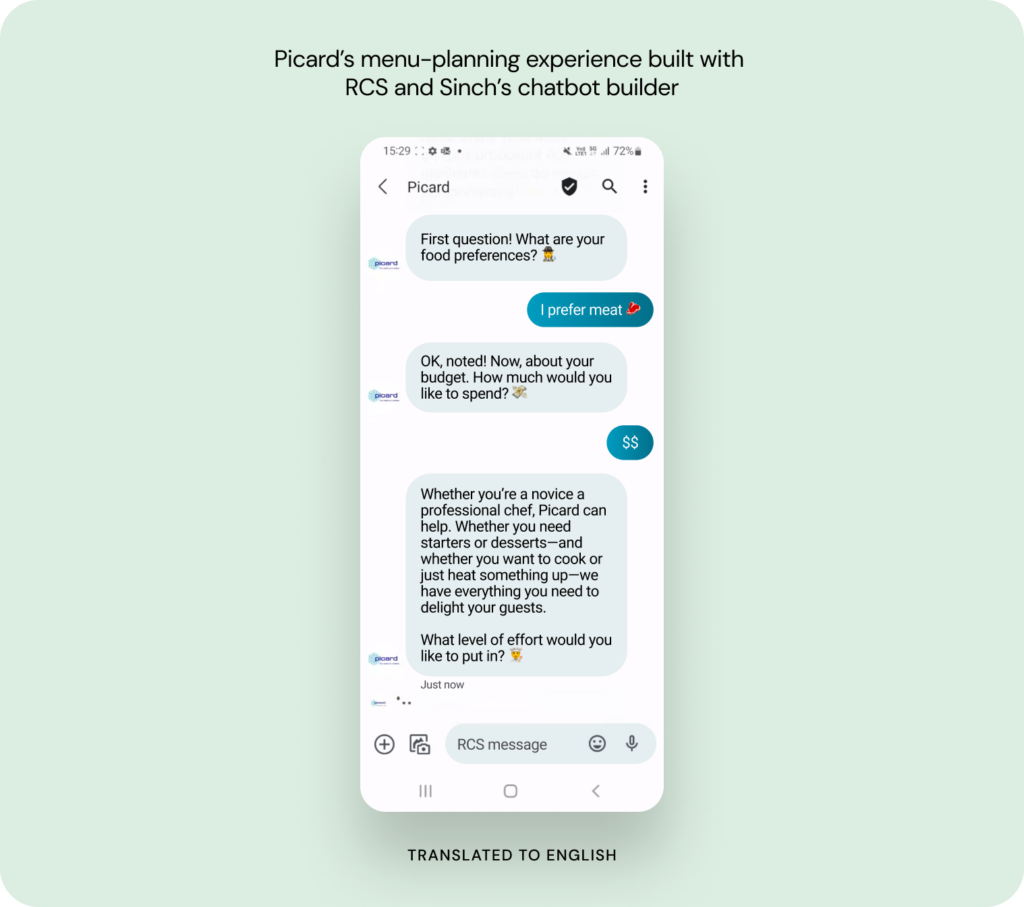
- Picard built a conversational RCS menu planner and increased customer engagement by 42%.
- EasyPark Group sends RCS where supported and falls back to SMS everywhere else, reaching 97.4% delivery rates in Germany.
The lesson from every one of these? Evaluate RCS on value, not just per-message cost. A channel that gets seen and acted on changes the math on what a message is worth.
How to get started with RCS – and keep costs down
If your business already sends SMS, moving to RCS can be refreshingly simple. Many brands start by sending RCS through the same API and pricing they already use for SMS: an automatic capability check delivers RCS when the device supports it and falls back to SMS when it does not – upgrading the experience without re-architecting your stack or your budget.
A few ways to keep spend efficient:
- Match the message type to the job. Send Basic/Rich for simple alerts and reserve Single/Rich Media for campaigns where the richness earns its keep.
- Use conversational agents where available for support and chatbot flows, so a 24-hour session covers the whole exchange instead of billing each reply.
- Lean on fallback. SMS fallback protects deliverability so you are never paying for messages that do not land.
Pro tip: With Sinch Engage, you can launch branded RCS campaigns with no code, or use Conversation API for full programmatic control across RCS, SMS, and WhatsApp from a single integration. You can also review current RCS pricing details directly.
Frequently asked questions about RCS pricing
There is no universal price. RCS costs vary by carrier, region, message type, and volume, and some carriers offer volume-based pricing. Because operators set the rates, the best way to get accurate numbers is to check with your messaging provider for the specific markets you send into.
Sometimes. Basic and Rich text messages are typically priced comparable to SMS, while Single and Rich Media messages cost more because of their rich content. For ongoing two-way conversations, the session-based conversational model can actually be more cost-effective than paying per SMS.
WhatsApp charges per delivered message template (since July 1, 2025), priced by template category and market. RCS is priced by message type and billed either per message or per 24-hour session, depending on how your RCS Agent is configured and where you send.
Mostly, yes. There is no per-message charge for receiving RCS – messages travel over Wi-Fi or mobile data rather than your SMS allowance, so the only cost to the recipient is a small amount of data when off Wi-Fi. What RCS lacks is a Free to End User (FTEU) option: unlike SMS, businesses cannot sponsor the recipient’s data cost – similar to WhatsApp and iMessage.
For most engagement-driven use cases, yes. RCS marketing campaigns deliver 3 to 7 times higher click-through rates than rich SMS, and brands like BUT and Picard have turned RCS into measurable revenue and engagement gains. Evaluate it on return, not per-message cost alone.
Get started with RCS pricing that works for your business
RCS pricing looks complicated from the outside, but it comes down to three questions: what type of message are you sending, how is it billed, and in which market? Answer those, and the cost stops being a mystery and starts being a plan.
The brands seeing the strongest returns – BUT, Picard, EasyPark – did not chase the lowest per-message price. They matched the right message to the right channel and let the results speak.
Ready to see what RCS could cost and return for your programs? Reach out to our team and we’ll help you build a pricing plan for your markets. Or, if you want to launch branded messaging right away, explore RCS in Sinch Engage – our team is excited to help you create messaging experiences your customers will love.
Last updated by Drew Wilkinson on the 4th of August 2026

Author:

Co-author: