Insights
A brief history of RCS messaging

Rich Communication Services (RCS) might be making headlines today with end-to-end encryption arriving for cross-platform chats and Apple supporting both peer-to-peer and business messaging, but the story of the communication protocol started years ago. Its founding story is grounded in the race to modernize SMS – and in how Google played a major role in shaping its future.
In 2005, Google acquired a small startup called Android for an undisclosed price (but estimated at $50 million). Over the next three years, Google transformed Android into a mobile operating system that would shape the future of smartphones.
Around the same time, mobile operators worldwide were looking to upgrade SMS, which had been the default messaging standard for years, to something that would better compete with over-the-top (OTT) channels. In 2007, they began developing RCS, which they envisioned as something that would handle images, videos, and better security than traditional SMS.
The idea for RCS was simple: take text messaging to the next level. But like all great stories, the road to success wasn’t without its challenges.
Founding to growth: 2008 to 2022
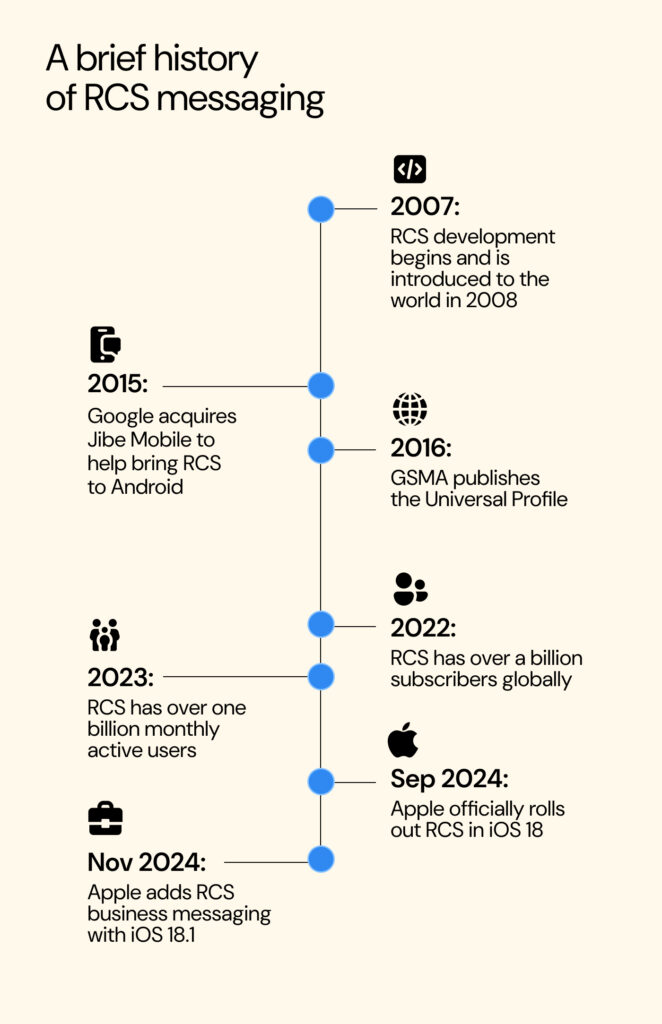
While text messaging had been around for decades, RCS messaging was introduced to the world in 2008. It was created by the GSM Association (GSMA) and a few major mobile operators to offer more features than SMS. At first, it wasn’t a messaging standard, but rather a set of tools that could be implemented in different ways, like for payments.
In early 2011, Europe’s five biggest mobile operators championed RCS by backing a simplified version of the spec called RCS-e. The GSMA unveiled the consumer brand “joyn” at Mobile World Congress in 2012. The idea was to roll it out across Europe as an SMS replacement, but it didn’t catch on widely. For years, RCS struggled to find its footing, and SMS remained the default way people sent text messages.
A turning point came in 2015 when Google acquired a company called Jibe Mobile, which specialized in RCS backend technology, to help bring RCS to its Android products. Mike Dodd, an Android Software Engineer at the time, explained in Google’s Jibe announcement, reported by *TechCrunch*, that the acquisition was made to help roll out RCS as a global messaging service.
“We’re also very excited to announce that the Jibe Mobile team is joining Google to help us bring RCS to a global audience. Jibe is a leading provider of RCS services and they’ll continue helping carriers easily deploy RCS to their users. We can’t wait to work with them and build on the great work that they’ve already done.”
In November 2016, the GSMA published the Universal Profile, a set of guidelines that made RCS interoperable across carriers and easier for mobile operators to scale. This addressed one of the main challenges RCS had faced in its early years: compatibility across networks. By 2020, Google was actively rolling out RCS chat as Android’s primary texting platform.
By 2021, Samsung had adopted the Google Messages app as the default messaging app on its phones in some regions. Around the same time, U.S. mobile operators dropped their independent RCS efforts to use Google’s system, making RCS more accessible than ever.
And by 2022, RCS had over a billion subscribers globally – a number that has kept growing. Today, most mobile operators rely on Google as a service provider to enable RCS on their network, and Google Messages has become the primary app where RCS messages appear on nearly all Android phones.
By this time, many notable brands had started to use RCS in creative ways, like Picard’s holiday promotion in France. These campaigns showed how RCS could elevate customer interactions with branded, personalized communications.
Quick growth years: 2023 to 2024
Someday, we’ll refer to 2023 and 2024 as the breakthrough years of RCS. By 2023, Google reported that RCS had over one billion monthly active users.
Then the biggest news arrived in November 2023, when Apple announced it would support RCS. For the first time, iPhone users would be able to use RCS to text Android users and vice versa – a far better experience than falling back to SMS.
Businesses had already taken note. By mid-2023, RCS Business Messaging adoption had grown around 40% year over year (per industry estimates), far outpacing other messaging channels, and by November 2023, Sinch saw the number of RCS messages sent by brands skyrocket to 25,000 times more than in early 2022.
Apple officially rolled out RCS in iOS 18 in September 2024, making it easier for people on any device to connect. Later in 2024, Apple added RCS business messaging support with iOS 18.1 in select markets, allowing brands to reach iPhone users through the channel for the first time.
Business reach expanded accordingly: in 2024, Sinch saw an impressive 111% growth in RCS messaging across Black Friday and Cyber Monday compared to 2023.
2025 to 2026: The encryption era
The two years after Apple’s rollout brought the changes RCS had been waiting on for a decade.
In March 2025, the GSMA published Universal Profile 3.0, the biggest upgrade to the standard since 2016. Developed with contributions from both Google and Apple, UP 3.0’s headline change was end-to-end encryption based on the Messaging Layer Security (MLS) protocol. (The quality-of-life features users had been asking for – editing and deleting sent messages, reactions, and inline replies – had arrived a year earlier, in Universal Profile 2.7.)
Then, in May 2026, the encryption promise became real: with iOS 26.5, end-to-end encryption began rolling out in beta to person-to-person RCS conversations between iPhone and Android on supported carriers. The result? For the first time in the history of text messaging, the default inboxes of the world’s two major mobile platforms could exchange end-to-end encrypted messages – something SMS never achieved in more than 30 years. (Business messaging remains encrypted in transit rather than end to end – a distinction that matters for regulated industries.)
Meanwhile, adoption kept compounding. RCS now reaches around 1.5 billion users globally, including 250 million in the U.S., where more than a billion RCS messages are sent every day. And the business channel is following: the global RCS market is valued at roughly $3 billion in 2025 and projected to reach ~$9 billion by 2030.
“Sinch has been leading the way in RCS adoption, and the momentum we’re seeing now has been a long time coming. Brands are already using RCS to transform how they communicate with customers in exciting and innovative ways. We’re proud to have been at the forefront of this shift and are ready to help even more businesses deliver richer, more engaging, and interactive messaging experiences in the years to come.”

The stage is set for RCS to become a cornerstone of how the world communicates – and this time, the infrastructure, the platforms, and the standard are finally pulling in the same direction.
Get started with RCS
RCS has come a long way since its early days in 2008, and with support from both Apple and Android devices, it’s finally living up to its promise RCS has come a long way since its early days in 2008. With support from both Apple and Android, interoperable encryption arriving, and adoption in the billions, it’s finally living up to its promise. For businesses, that means the ability to engage iPhone and Android users alike through messaging that’s interactive, branded, and inherently personal.
Whether it’s personalized campaigns, interactive customer experiences, or simply a better way to verify customers, RCS offers real possibilities today. Check out these resources to learn more:
- RCS marketing: Your complete guide to trusted, interactive messaging
- RCS statistics: The numbers that actually hold up
- RCS security: Is RCS encrypted, and is it safe to use?
- 10+ RCS use cases and messaging examples for your business
Want to bring RCS to your own messaging? Talk to our team to get started. Or, download our guide to building the business case for RCS – template included.

Author: