Insights
Healthcare must overcome more than compliance to scale AI communications
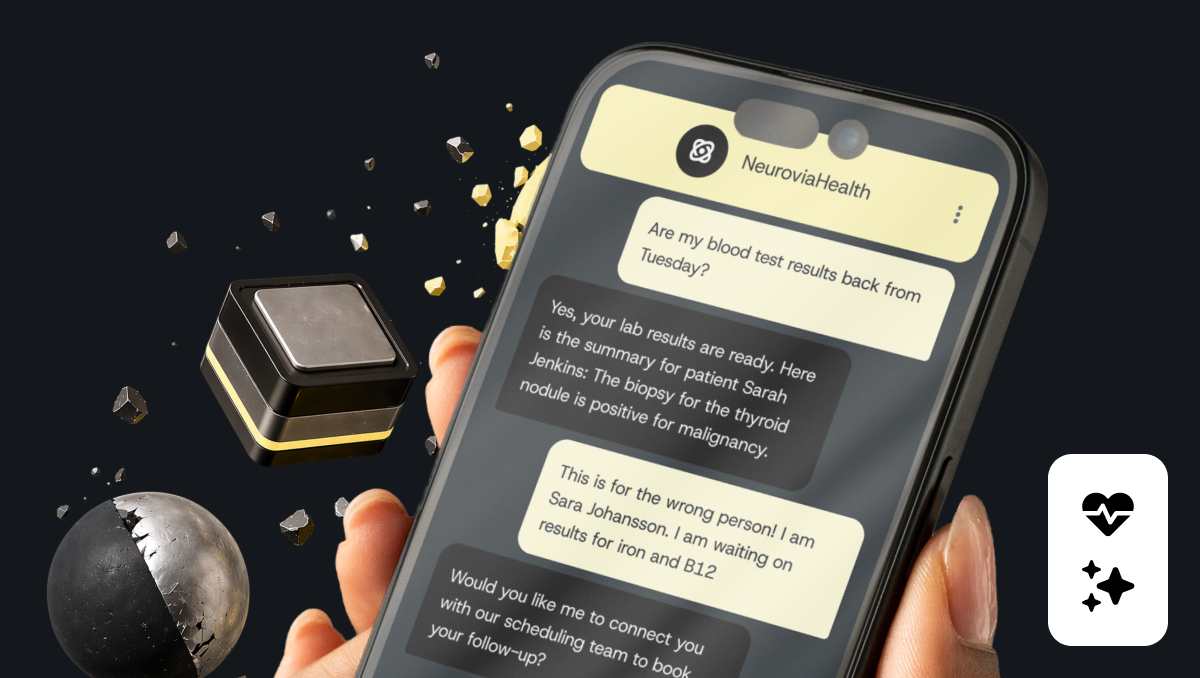
It’s a couple of days before your doctor’s appointment and, “Ding!”, your phone pings with a reminder text. A few days later, you get a notification that your prescription is ready for pickup. Then, another one comes through saying your test results are ready in the app.
The healthcare industry generates exactly the kind of high-volume, repetitive communication that AI agents were built to handle, and it’s already putting them to work.
But scaling AI gets complicated in an industry ruled by data privacy and compliance concerns. Medical providers have a moral duty to protect their patients, including their data, and failure to do so is as serious as it gets. Leaked medical records can easily fall into criminal hands, lead to hefty legal fines, and result in a permanent breakdown in patient trust. And yet, the risks haven’t put the industry off.
Sinch’s AI Production Paradox report asked over 450 healthcare leaders across 10 regions about how they’re already using, or planning to use, AI in their customer communications. What we found goes against what you might expect from such a regulated industry. While compliance makes it harder for healthcare to go live with AI, it isn’t why live agents keep failing.
Healthcare has big AI ambitions
The case for AI in customer communications has moved from “what if” boardroom conversations into those same organizations’ annual investment strategies. Across industries, as many as 98% of organizations are increasing AI communications spend in 2026. Healthcare is among the most likely to plan investment increases of 50% or more in AI agent-powered customer communications, at 16% against 13% overall. That ambition points at a clear opportunity: patient engagement at scale.
Every day, healthcare providers send patients a high volume of time-sensitive updates, from appointment reminders to follow-ups after a missed visit. It’s repetitive, constant, and, honestly? Often beyond what a call center can keep up with.
22% of healthcare leaders see outbound voice agents for appointments, reminders, and proactive outreach as the biggest voice AI opportunity, 5 points above the overall average (17%). Identity verification is healthcare’s other big opportunity. Before a patient can check a test result or confirm a prescription, they have to prove who they are, which is why 41% put it near the top of the list for AI agents to take on.
Which areas of customer communication is your organization prioritizing for AI agent deployment? (Select up to three.)
Healthcare providers have gone live with AI but the path to production is slow
For a long time, we’ve heard about how organizations are failing to realize their AI ambitions because they get stuck in the pilot phase. Our latest research found that this is no longer the case in customer communications. Across every industry, AI agents have made it into production, and healthcare is no exception, with 55% of organizations now live.
Yet, it’s the slowest mover in the study. Healthcare’s deployment rate sits 7 points below the overall average, and its pilot-to-production conversion rate is also the lowest of any industry.
Patient consent, clinical data, and HIPAA raise the bar higher than most industries face, and the guidance on AI specifically is still murky. Only 37% of healthcare organizations report clear guidance on AI disclosure, one of the lowest rates in the study.
That caution shows up in how ready teams feel. Just 42% of healthcare leaders call themselves very confident about deploying at scale.
How confident are you that your organization is ready to deploy AI agents that autonomously communicate with customers at scale?
Regulatory compliance doesn’t explain the failure rate of live AI agents
It turns out that getting into production is just the first part of the challenge. 75% of healthcare organizations running AI agents in production have been forced to roll one back or shut one down due to governance failures.
When the top reason is PII or data leakage, in 33% of cases, alarm bells start ringing. The industry knows all too well how expensive it is when sensitive data gets into the wrong hands. IBM found that for 13 years running, healthcare has recorded the highest average breach cost of any industry at $6.64 million. And of course, any data leak is also a breach in patient trust – something that can’t be fixed with money.
It’s tempting to blame compliance complexity for AI agent failures, but our research finds that’s not the case. Once a healthcare organization is in production, it tracks with every other industry across all 19 compliance and privacy measures in the study, and its failure rate is only 1 point higher than the overall average.
Compliance pressure slowed healthcare’s path to production, but once live, the industry’s disadvantage seems to become a non-issue Something else is triggering the failures and it’s not always easy to spot.
The people funding the program and the people building it aren’t seeing the same thing
One problem our research uncovered is that not everyone is sharing the same view of the AI program. Technical leaders consistently report rollbacks at a higher rate than business leaders within the same organizations.
In healthcare, a significant disconnect exists when it comes to guardrails. 36% of healthcare C-suite leaders report fully mature guardrails, against 18% of the Directors building them. We’ve all seen it happen: A problem that looks smaller from the top gets funded like it’s smaller, so the work that would prevent the next rollback doesn’t happen.
A similar visibility gap applies to cost expectations: 34% of C-suite executives in healthcare expect AI to cut costs by more than half, a number that drops to 12% among the Directors responsible for delivering it.
The people signing off on maturity and the people responsible for it are describing two different programs. And the further from the build, the more optimistic the picture.
“As a C-level leader, you’re often not involved in every detail of making technology, but that’s precisely the point. Executives need to operate at a different altitude, with a longer horizon. You see how the technology behaves, and more importantly, you can anticipate where it’s heading and what it will unlock next. One thing every leader needs to internalize is that the AI we have today is the worst AI we will ever have. From this point forward, it only gets better, faster, and more capable. That’s the lens C-level leaders bring — the ability to see past the near-term friction and recognize where it’s going. And that trajectory is only accelerating.”

So why are healthcare AI programs failing?
Our study found that across the board, the strongest predictor of AI deployment success is the communications infrastructure that runs underneath the agent.
In healthcare, that’s exactly where the failures trace back to. A third of healthcare’s rollbacks were triggered by data leakage or PII exposure. That means sensitive clinical data surfacing where it shouldn’t. A test result sent to the wrong patient or a medication record pulled into a message that was only supposed to confirm an appointment time.
These are infrastructure failures. PII exposure and audit-trail gaps both originate a layer below the rulebook, in the infrastructure the agent runs on. The data surfaced because the platform didn’t stop it.
Healthcare already senses where the fix is
The good news is healthcare providers are already funding the right thing. Trust, security, and compliance tops their list of investment priorities at 75%, as it does everywhere. But healthcare also prioritizes communications infrastructure at 64%, 3 points above average and 6 points above AI agent development itself. For an industry this careful, it’s a clear statement of where they think the problem lives.
And what they want from a partner reflects this. The capabilities healthcare respondents value most all point to the platform underneath the agent: reliability, compliance, accountability. This is a specification for better infrastructure.
Which capabilities would you most value in an infrastructure partner supporting AI agent-powered customer communications? (Select up to 3)
The AI Production Paradox: See how healthcare compares
Healthcare providers have navigated a complex landscape of HIPAA, patient consent, and clinical data to make it to production with AI. But once live, it’s not the reason things are failing. These failures stem from one layer below, in the infrastructure that the agent runs on. And that story holds across every industry in the study.
The AI Production Paradox combines insights from 2,527 enterprise leaders to look at what happens after organizations go live with their AI agents, the cost of failure, and the importance of a strong foundation. See how healthcare compares, and what makes an AI program successful.

Author: