The 17-point gap shaping AI confidence
In customer communications, most C-suite leaders feel very confident in their AI readiness. But confidence drops significantly with middle managers. That gap highlights two views of the same program, and bridging it takes more than just a dashboard.
Guest-edited by Matt McRoberts, VP of Business Development, AI at Sinch
The long read
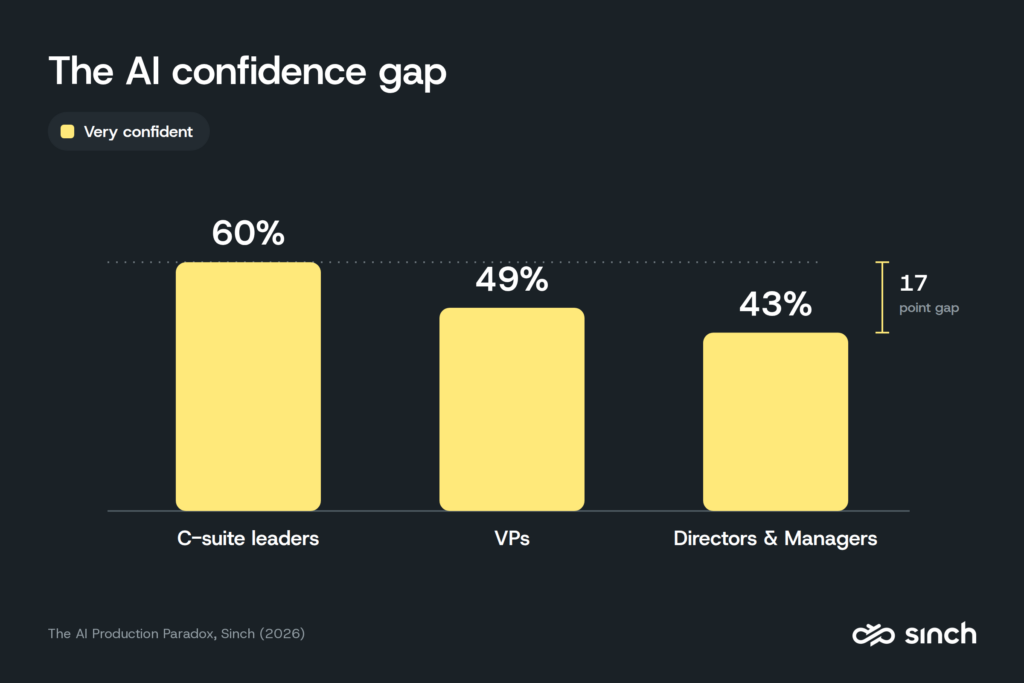
AI confidence goes up the further you sit from delivery. 60% of C-suite leaders say they’re very confident in their organization’s AI readiness. For VPs? Only 49%. And for the directors and managers shipping the agents, it goes down to 43%. A 17-point gap that’s consistent across the board.
That’s because no one’s looking at those programs through the same lense. Leadership is looking at where the technology is heading, while those building it are focused on that failure the team spent last night patching.
Shipping an AI agent is hard, but production is where things get uncomfortable. That’s where these agents meet the reality of customer data: it’s messy, and full of gaps and inputs that no existing prompt is ready to address. Those are the challenges hiding in the 74% rollback rate Sinch’s AI Production Paradox study reported last May.
And when those rollbacks happen, they hit AI teams harder than they hit their leaders. It’s the late-night call, the race to trace down the root cause, the work to fix it. By then, the roadmap everyone felt confident about is set, way before production could teach anyone anything.
Both sides have the numbers, yet they’re looking at them from different perspectives. The C-suite’s confidence is high, but they’re not the ones rebuilding the agent after a rollback. Proximity to the consequences lowers confidence. That’s how the confidence gap gets baked in. It’s not something a new dashboard can fix.
The market is turning to a person to bridge the confidence gap
In June, AWS invested $1 billion into forward deployed engineering (FDE), the hottest new role in tech. Microsoft made the same move in July: $2.5 billion and 6,000 industry and engineering experts went into its Frontier Company.
The role is in high demand, and it’s not limited to tech giants. The number of job postings for FDE roles is exploding, and some companies have even started building the role internally. Uber’s CTO had 30 of its top AI engineers sit in cross-departmental “Agentic pods”, so they could get closer to the processes they were aiming to automate.
The idea underneath the hiring is simple: Someone who can ground the leadership view in the reality of production and also support the 2 a.m. rebuild when something breaks. Someone to force both perspectives into one room.
Is part of the FDE craze just froth meant to justify AI capex? Probably. But people make people feel comfortable. Having a person in the middle, someone to have the uncomfortable conversations the AI failure rate forces, doesn’t sound like a bad idea.
Whether brought in or in-house, what a shiny job title alone can’t earn is trust. Trust gets built from both sides believing that person is actually working toward the same goal. The moment the builders suspect the FDE is just there to grow the vendor’s bill or sell the board on something new, that trust breaks.
And that person alone can’t make up for broken data, infrastructure that lets AI agents leak personal information, or rollbacks that can’t get diagnosed because there was no audit trail.
Infrastructure is the thing you have to fix regardless. That’s what defines what your AI can do next week, or next year. But closing a confidence gap is something only a human can own, no matter how they’re labeled. Right now, in most organizations, nobody does.
Matt McRoberts is VP of Business Development, AI at Sinch. Connect with him on LinkedIn.
Matt’s take
“The confidence problem is really a gap between two directions. There has to be a top-down element, and there has to be a bottom-up one. You’ve got massive investment across organizations, real pressure to have a vision… And then someone has to actually get it done. People make people feel comfortable. We all feel a little bit safer when we’ve got a lot of smart people around. So, maybe the conduit that minimizes that gap is a person, something like forward deployed engineering, sitting between both sides.”

From the field
“As a C-level leader, you’re often not involved in every detail of making technology, but that’s precisely the point. Executives need to operate at a different altitude, with a longer horizon. […] One thing every leader needs to internalize is that the AI we have today is the worst AI we will ever have. From this point forward, it only gets better, faster, and more capable. That’s the lens C-level leaders bring – the ability to see past the near-term friction and recognize where it’s going.”

Go deeper
This issue’s question
Where is the distance widest right now between what your leadership expects from AI and what your team thinks it can deliver? Reply and tell us.
Email us and share your story with us.
In Production is a monthly editorial newsletter on AI in customer communications, written and published by Sinch. Read past issues on Sinch.com and catch the newsletter on LinkedIn.
Author:

Co-author:

Co-author: