Two failures, two disciplines

An AI agent fails in one of two ways, and they aren’t fixed the same way. The first job is telling them apart, the second is building so one kind can’t happen and the other can’t hide.
Guest edited by Pinar Kahraman, Product Manager at Sinch
The long read
When an AI agent breaks in production, everyone’s instinct is to ask how to fix it. But that’s the wrong first question to ask. The right one is: Which kind of break is this? Because there are two types of failures, and they’re ultimately nothing alike.
The single biggest cause of a rollback isn’t the model at all, it’s PII exposure, at 31%. A customer’s account details surfacing when they shouldn’t is an infrastructure failure. Or their history vanishing the moment they move from web chat to email, forcing them to start over.
Hallucination and off-brand answers, the failure everyone braces for, come in behind at 22%. That’s a model failure. The agent misreads what the customer wants, or answers confidently and wrong under your brand’s name.
These failures have different causes that require different fixes. Tune the prompt on what was really a data-scope problem, and the leak will still be there.
But telling them apart is harder than it sounds. Between the moment an agent takes something in and the moment it acts, there’s a gap you can’t see into. Just like Gunnar Grosch explained in last month’s issue of In Production, you can monitor what goes in and what comes out, but not the reasoning in between. So, when it breaks, your logs hand you the result, but they don’t tell you the cause.
Here’s why the split is important. The two failures live on opposite sides of one line: what you control, and what you don’t. A model is probabilistic. That means you can steer it and shrink its error rate, but you’ll never get it to zero, because its output is never fully nailed down.
Everything outside of the model is the opposite. What data goes in, what the agent is allowed to do, which gates are open. Somebody decides all of that… or forgets to. That is not probabilistic. It is a design choice.
You can rule some failures out before the model ever runs.
You can ask an agent to mask a credit card number in its reply, and it usually will. Or you can make sure the number never reaches the model. If you mask it upstream, in the data you choose to pass along, it can’t leak… because it was never there.
One is a request. The other is a fact. Infrastructure failures are the ones we can design out at the platform level, so the model is never in a position to get them wrong.
The model failures you can’t eliminate, so you need to build to contain them. First, give the agent one narrow job and a short list of things it’s allowed to do. The shorter that list, the fewer ways a probabilistic decision turns into a real consequence, and the faster you can spot which move went wrong.
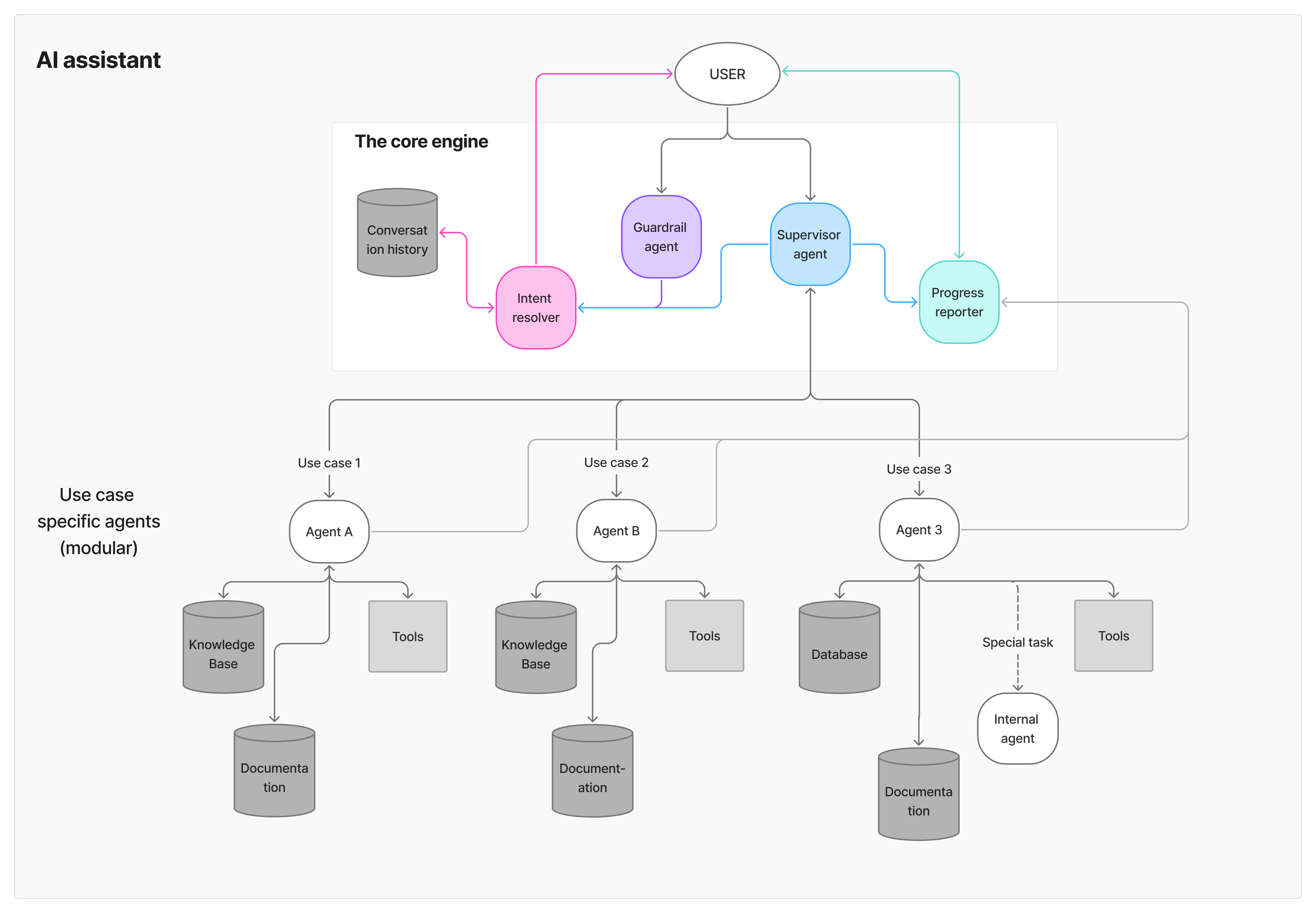
Next, put a guardrail check before each action, not only at the end. Monitor the two points you actually can see, the input and the output, and build a database of “low confidence” outcomes for a human expert to check and answer.
Then, close the loop. Feed the expert’s answers back to the model for further training, because a mistake the system doesn’t learn from comes back in the same shape next week.
But there’s a cost that we need to consider: If we constrain too far (withhold too much data or scope it too narrowly), the agent starves because context is what makes it useful. So, where that line sits and where the right balance lies is a judgment you can’t hand off.
Two failures modes, two disciplines. Design out what you own; box in what you don’t. The teams that can do neither are usually the ones that can’t tell the two failure modes apart to begin with. Sinch research shows that for 16% of organizations, a failure leaves no record of what the agent decided or touched, so every break becomes a full rollback and a rebuild of the same fault. A recent Sinch poll on LinkedIn showed similar results.
None of it is magic. Every time we build an agent, someone defines the data, the actions, the gates. The only question is whether it’s you, on purpose… or the model, by default.
Pinar Kahraman is a Product Manager at Sinch. Connect with her on LinkedIn
Pinar’s take
“IT processes are deterministic. They run on “if/else” commands that we define. Whereas machine learning and AI are probabilistic by nature. I can tell the AI agent to mask the data in its output, but I can never be 100% sure it will. What I can do instead is mask the input data, or I simply don’t send it. That way, I’ll be 100% sure I control what can come out. Things aren’t that magical. We control a lot on what the agents can reach out to and see by defining the gateways, tools, and processes the agent can use. The more specific the scope of the agent, the better; the more guardrails, the better.”

From the field
“The market is not yet ready for this probabilistic approach. It is still in the mindset of the deterministic approach. People want answers to be: ‘If I ask this, the agent should respond this. If I ask that, the agent should do this action.’ But in the agentic world, there’s nothing 100%. There is always the risk of getting hallucinations. I think the future will be a combination of the deterministic and probabilistic approaches together, because otherwise it will not fulfil the enterprises’ needs. If I want to handle a critical refund operation, which is super critical for me, I can’t accept any failures. The agent has to manage that, and also manage the probabilistic part of it: If I say ‘hi’, I need the agent to respond ‘hi’ back.”

Go deeper
This issue’s question
Where’s the line in your system between the data that has to reach the model and the data that should never leave the platform, and who decided it?
Email us and share your story with us.
In Production is a monthly editorial newsletter on AI in customer communications, written and published by Sinch. Read past issues on Sinch.com and catch the newsletter on LinkedIn.
Author:

Co-author:

Co-author: