👋 Vous cherchez Sinch Engage ? Vous êtes maintenant sur le site principal de Sinch. Retourner à Sinch Engage

GIVE AI AGENTS A VOICE

Voice Relay for AI agent phone calls

Your text-based AI agent is great in chat. Giving it a voice means building real-time infrastructure most teams cannot spare.

Voice Relay connects your AI agent to live phone calls through a single WebSocket. Sinch Programmable Voice handles the real-time audio, speech-to-text, text-to-speech, and conversational flow. 

Trusted by 200,000+ customers around the world

WHY VOICE RELAY 

Move beyond IVR without rebuilding your AI

Your AI agent is customer-facing in chat, but voice is still stuck on a scripted IVR. Voice Relay changes that. Your existing AI connects to live phone calls with natural conversation from day one. 

Real conversations, not IVR scripts. Intelligent barge-in and sub-second responses replace rigid menus with natural back-and-forth conversations. 

Give your AI a voice quickly.

Connect your existing text-based agent through a single WebSocket and skip months of audio engineering. 

Bring your own AI.

Voice Relay is model-agnostic, so you keep the LLM or platform you already chose. 

Part of Sinch Voice API.

Phone numbers in over 90 countries, a 99.99% SLA, and infrastructure distributed across five AWS regions.

CONVERSATIONAL FLOW 

Callers get a conversation, not a script

Traditional voicebots follow rigid turn-based patterns. Interruptions get ignored, pauses feel unnatural, and customers notice. 

Voice Relay is engineered for low-latency conversation. Intelligent barge-in lets callers interrupt mid-response, and your AI agent decides whether to yield the turn. Sub-second response times close the gap between human speech and AI reply. 

Image pour Callers get a conversation, not a script

DEVELOPER EXPERIENCE 

Turn one WebSocket into live voice

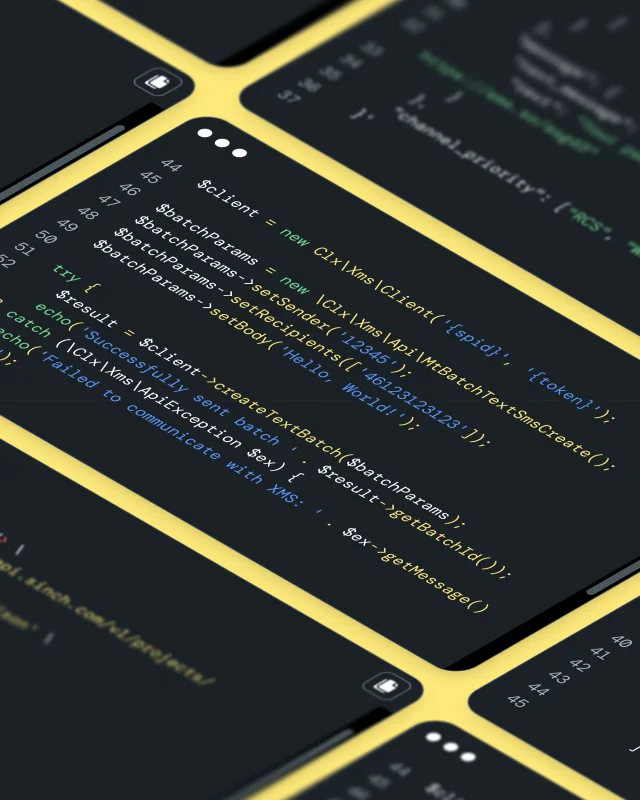
Building real-time voice integrations means wiring up separate vendors for speech-to-text, text-to-speech, and voice activity detection. Voice Relay replaces that with a single WebSocket connection and a few SVAML commands.

  • WebSocket endpoint for your AI agent

  • SVAML command to bridge a live call

  • Real-time speech-to-text conversion 

  • Voice synthesis for AI responses 

  • Voice activity detection and barge-in management 

  • Latency optimization across the conversational loop 

Image pour Turn one WebSocket into live voice

MODEL-AGNOSTIC

Bring your chosen AI to voice

Most voicebot platforms lock you into their AI. Your model choice, your prompts, and your conversation design have to fit their box.

Voice Relay is model-agnostic. Connect any text-based AI agent or LLM that communicates over a WebSocket. Your agent stays yours, and your investment in conversation design carries over to voice. 

Image pour Bring your chosen AI to voice

USE CASES 

Where Voice Relay earns its keep

Intelligent IVR and self-service 

Let callers describe what they need in natural language. The AI agent handles support, billing, and account tasks without menu trees or transfer loops. 

AI-powered customer support 

Offer first-line support around the clock. Your AI agent handles routine inquiries and escalates to a human only when the 
situation needs one. 

Interactive outbound campaigns 

Run voice-based surveys, reminders, and personalized notifications that respond to the caller’s answers in real time. 

Lead qualification and sales automation 

Qualify and screen inbound leads with an AI agent before they reach a human salesperson. 

CAPABILITIES

Voice Relay capabilities for AI calling

Intelligent barge-in 

Callers can interrupt the AI mid-response, and the agent decides whether to yield the turn. 

Sub-second latency 

Low-latency architecture delivers responses fast enough to feel like natural conversation. 

Unified orchestration 

A single WebSocket connection handles speech-to-text, text-to-speech, and audio streaming

Bring Your Own AI 

Voice Relay integrates with any text-based AI agent or LLM that communicates over a WebSocket. 

Natural voice synthesis 

Voice Relay converts AI text responses into natural-sounding speech delivered to the caller. 

SVAML call control 

Developers control call flow through Sinch’s Voice Application Markup Language (SVAML). 

Call handling decisions 

Your AI agent decides whether to accept an incoming call and how to handle interruptions. 

Global phone numbers 

Phone numbers available in over 90 countries. 

99.99% SLA 

Sinch backs Voice API availability with a 99.99% Service Level Agreement. 

Globally distributed 

Voice infrastructure distributed across five AWS regions. 

ISO 27001 and GDPR 

Voice Relay inherits ISO 27001 certification and GDPR compliance from the Sinch Voice platform. 

GET STARTED

Connect, converse, and control every call

  • Connect. Use SVAML commands to bridge a live call to your AI agent’s WebSocket endpoint. 

  • Converse. Sinch converts caller speech to text and feeds it to your agent. Your agent’s text responses come back as natural-sounding speech. 

  • Control. Your AI agent decides whether to accept the call, how to handle interruptions, and when to end the conversation. 

Image pour Connect, converse, and control every call

FAQ 

Common questions about Voice Relay

Voice Relay is a real-time service that connects a text-based AI agent to live phone calls. It handles speech-to-text, text-to-speech, and conversational flow so your agent can hold a natural voice conversation. Sinch Voice Relay is delivered through the new Sinch Voice API.

Traditional voicebots are bundled platforms with their own AI, audio engine, and scripted flows. Voice Relay is an orchestration layer. It connects any AI agent you choose to the voice channel without locking you into a specific model or platform.

Voice Relay is model-agnostic. You can connect any text-based AI agent or LLM application that communicates over a WebSocket. The choice of model, prompt design, and conversation logic stays on your side. 

Voice Relay includes intelligent barge-in. Callers can speak over the AI mid-response, and your agent decides whether to stop, continue, or adjust. This matches the turn-taking behavior of natural human conversation. 

Voice Relay is a premium per-minute feature charged on top of standard Sinch voice calling rates. Additional fees apply for other Voice API features such as Recording, Transcription, and Answering Machine Detection. 

Implementation is straightforward for developer teams. You need to develop a server that accepts incoming WebSocket connections and can receive and respond with text messages. These messages are then relayed to and from your AI chatbot, while Sinch handles all the real-time audio and speech processing. 

You need three components. A Sinch dashboard account, a text-based AI agent or LLM, and a backend service hosting a WebSocket endpoint. Voice Relay works with any combination of those components.

Yes. Voice Relay runs on Sinch Voice API with phone numbers available in over 90 countries. Sinch backs availability with a 99.99% SLA. 

You can connect your live call to an AI agent by using SVAML instructions to bridge the call to your agent’s WebSocket endpoint.