Insights
Make your calls stand out from AI voice scams

Spotting an AI voice is getting harder and is no longer the instant red flag it used to be for consumers now that legitimate businesses are starting to bring AI into their voice communications.
Americans reported losing $665 million to phone call fraud in the first half of 2026, according to Federal Trade Commission data as of June. Nearly $128 million of that total was attributed to scammers impersonating a business.
With the advances in AI, voice scams are getting harder to detect, and familiarity with AI tools is no protection. Meanwhile, our survey found that nearly half of North American companies are already running AI on their phone lines, further blurring the lines between legitimate and fraudulent calls for consumers.
This means every call a business places now arrives into a climate of suspicion. Below, we look at why customers can no longer tell the difference between legitimate and fraudulent calls, and what businesses can do to give them the reassurance they need to pick up the calls that matter.
Scam calls are running on AI, and AI awareness is no protection for consumers
Most people have seen voice cloning scam reports in the news: a grandchild calls needing bail money, or a sister in distress, stranded overseas. The voice sounds familiar, and before the victim knows it, their money is gone. Microsoft researchers showed already in 2023 that a system could reproduce someone’s voice from a three-second recording, down to their emotion and the acoustics of the room they were in. Anyone who’s ever posted a video on social media has already supplied what a criminal needs to defraud their relatives. And that number on the screen? It can be spoofed.
And of course, it doesn’t stop at relatives… nor at audio. In 2024, a finance employee at the engineering firm Arup joined a video call with people he believed were his colleagues, including the chief financial officer, and authorized transfers worth $25.6 million. Hong Kong police later confirmed all other participants on the call were deepfakes.
of recorded audio is all it takes to clone a voice
lost by one finance employee after a deepfake video call
Voice scams themselves are decades old, but what deepfakes add is believability, and scalability. Some scam operations run like businesses, and staffing them used to cap how many calls they could make, but AI is lifting that cap.
As demonstrated in 2025 research from Rutgers University, AI can now handle the tricky part of scam conversations: fielding an unscripted question, absorbing pushback, staying plausible when the person on the other end turns suspicious, all without human intervention. In a test environment, the system the researchers built ran a whole scam script successfully between 43% and 74% of the time.
AI scams are getting easier and cheaper to produce, and therefore more widespread. The question is whether people can spot them. It’s easy to believe that frequent AI use provides some level of protection against AI scams, but research suggests it isn’t the case. According to 2026 research from Harvard and Meta, nearly a third of AI voices went unrecognized in an experiment asking participants to judge whether recorded scam calls were using voices from a person or a machine, and frequent AI users did no better at spotting a synthetic caller than people who never use it.
But with AI now starting to handle calls on behalf of legitimate businesses, an AI-sounding voice on its own has stopped being a meaningful fraud signal.
AI voice has already earned its place in customer communications
Ready or not, fully autonomous voice is stepping into business calls. Our survey found that 64% of enterprises in North America already have AI communications agents in production, and 97% were planning to increase their AI communications investment in 2026.
On voice specifically, the survey found 41% of enterprise leaders globally named fully autonomous AI call handling as the single biggest opportunity in voice, and 17% cited outbound AI voice use for appointments, reminders, and proactive outreach. In North America, 46% stated they already run AI in their voice communications.
What do you see as the biggest opportunity for voice-based AI agents in your customer communications?
Consumers are quite evenly split on whether they want an AI on the other end when they call a company. In our survey of 2,501 shoppers conducted ahead of the 2026 holiday season, 48% said they’d trust a human over a voice AI agent for resolving issues, while 52% were open to AI voice provided they could be handed to a person if needed.
But being open to an AI agent when you call a company is one thing. A call arriving the other way, unannounced, is another.
How businesses are building trust directly into the call experience
If consumers can no longer reliably tell who’s really calling, the businesses initiating the call have to make it clear. Solutions exist to prove a caller’s identity before the recipient picks up.
It starts with verifying the number. In the U.S. and Canada, under a framework called STIR/SHAKEN, the phone company placing a call digitally signs it, and the phone companies along the way check that signature to confirm the call really comes from the number on the screen. Phone companies, and the analytics firms they work with, weigh that check alongside calling patterns and complaints to decide how to handle the call. One that arrives unsigned, or with a weak signature, is more likely to be blocked before it rings or labeled as spam on the recipient’s screen.
The system isn’t perfect. It only works on modern, internet-based phone networks, so some legitimate calls still arrive unsigned. Legitimate calls can also be labeled as spam because of how they’re placed, such as many calls in a short burst or calls from a brand-new number. Businesses can add another layer by marking numbers they only use to receive calls, such as a customer service line, as “do not originate,” so any outgoing call claiming to come from one of those numbers is blocked. While this framework doesn’t prevent spoofing entirely, it makes it significantly harder.
Then, there’s what consumers actually see. A separate system called CNAM lets a business register its name so it can appear on the recipient’s screen instead of a bare number. The recipient’s phone company looks the name up when the call comes in, but not every phone company does this on every call, so the name doesn’t always appear. And because the name is looked up by number, a scammer who spoofs a company’s number will show that company’s real name. On its own, a name on the screen isn’t proof of who’s calling.
A standard called Rich Call Data takes it further, letting businesses send their logo and a short reason for the call inside the signature that verifies the number. Those details appear on the recipient’s screen before the call is answered, offering some reassurance about who’s calling.
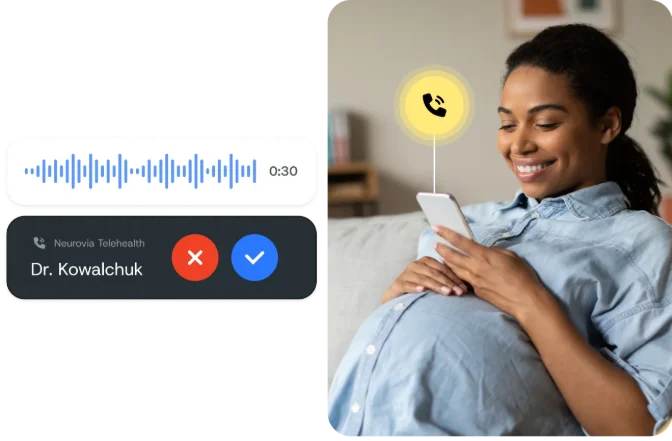
Support for this capability, however, is uneven across handsets and carriers, so many calls don’t display these elements. Plus, a call with no branding isn’t evidence of fraud, because most legitimate calls are still that way.
What businesses should be telling their customers about AI scam calls
When scammers impersonate a business on a call, the damage hits the customer, but also the brand. Whether you’re a bank, a delivery company, a clinic, or a retailer, helping customers recognize a suspicious call protects them and your brand name alike.
A few other tips worth sharing with your customers:
- When in doubt about an incoming call, the most useful thing your customers can do is also the simplest: hang up, or not pick up at all, and call back using a trusted number. Not the number that called, but the one on a business card, a bill, or an official app. Scammers can still spoof a legitimate number, but they can’t redirect a call a customer places themselves.
- Tell them to treat urgent demands for money via cryptocurrency, wire transfers, or gift cards as a massive red flag.
- A legitimate recorded or artificial-voice call has to identify itself. FCC rules require these calls to say who is calling at the start of the message and to give a callback number during or after it, and the Commission confirmed in 2024 that AI-generated voices count as artificial. Ensure your customers know that a synthetic voice that never says who’s calling isn’t following these rules.
- Share your official call numbers with your customers and encourage them to turn on the blocking tools already sitting on their phone. Most carriers and handsets have them built in at no extra cost, and in September 2026 the FCC published step-by-step guides for iPhone, Android and the major US carriers in one place at fcc.gov/blockit.
- Clearly communicate with your customers about what they can and can’t expect from you. Remind them that a legitimate business won’t call and ask them to read out their full card number, a one-time code, or a password. A caller asking for any of these is an instant warning sign, regardless of what they sound like.
- Encourage them to report any suspicious activity at reportfraud.ftc.gov. Every business day, the FTC releases the phone numbers people have reported, so phone companies can use them to help block unwanted calls.
Tackling voice fraud is a combined effort
Beyond financial losses, voice scams wear away trust in the calls that matter: a doctor contacting a patient about a prescription, or a bank that really is calling a customer about a suspicious charge. When customers stop answering, the cost lands on both ends.
Anti-fraud measures and the people working around them will always be racing each other, and no single fix can tackle voice scams altogether. But businesses don’t have to leave customers guessing. Sinch builds call authentication, encryption, and protection against number spoofing into its voice solutions and works with partners to bring verified branding to business calls, helping businesses keep pace with evolving threats.

Author: