👋 Looking for Sinch Engage? You’re now on Sinch’s main site. Go back to Sinch Engage

SINCH AGENT TOOLS · MCP

Sinch MCP Server: Connect your AI agents to live APIs

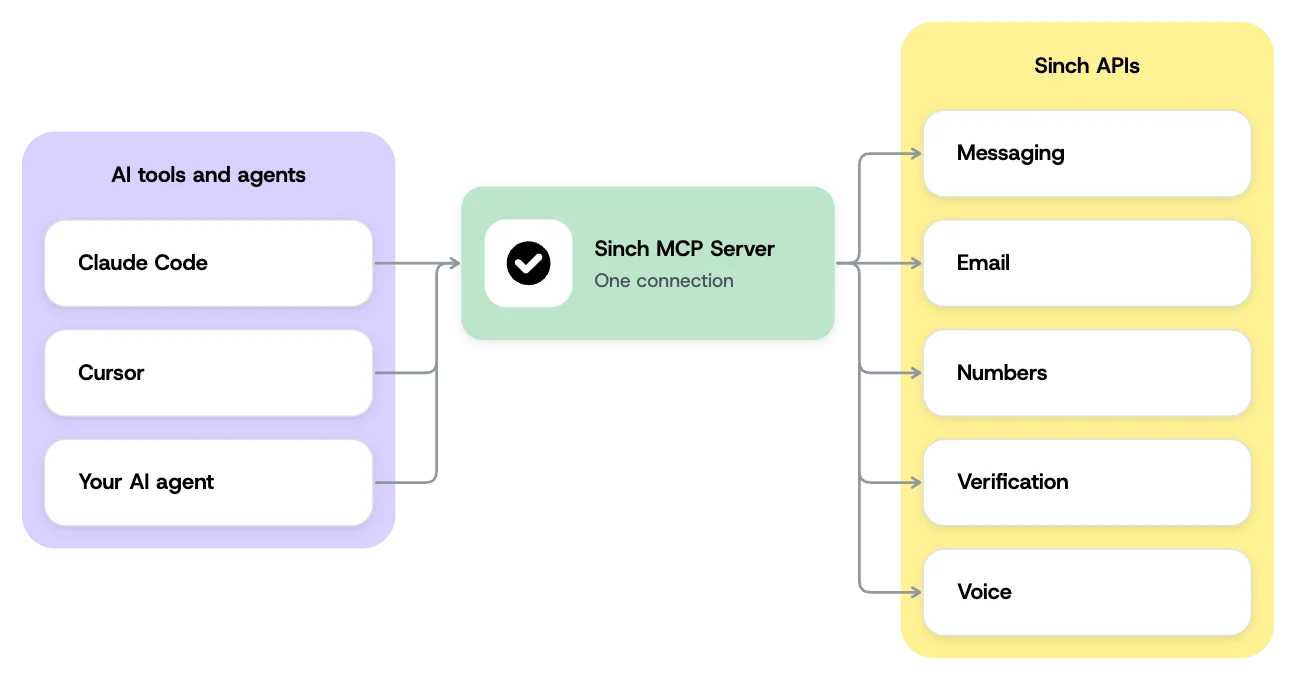
The Sinch MCP Server connects AI agents and coding tools directly to Sinch’s communications APIs – Messaging, Email, Numbers, Verification, and Voice – through the Model Context Protocol. Equip your agents with production-ready, schema-validated tools for seamless, native execution.

Live API calls need a Sinch account.

Image for Sinch MCP Server: Connect your AI agents to live APIs
Join over 200,000 businesses, including 8 of the 10 largest tech companies in the world

MCP AND THE DOCS MCP

Two tools, two jobs.

The Sinch MCP server and the Docs MCP do different things. Reach for the MCP server when you want your agent to take and test real actions on Sinch APIs. Reach for the Docs MCP when you want your AI coding assistant to generate correct Sinch code.

A locally run server for developer workstations and private infrastructure, built for regulated industries that need data sovereignty, and for IDE-native workflows in Cursor, Claude Code, and VS Code. Connect once, and reach Messaging, Email, Numbers, Verification, and Voice through the same protocol. Install it directly, or get it bundled with Sinch Skills through the Cursor Marketplace.

A read-only reference layer, that gives AI tools real-time access to Sinch’s API reference and code patterns. It handles discovery and code generation, not execution. Add developers.sinch.com/mcp as an endpoint in any MCP-compatible AI tool, with no account or API key needed. Paired with Skills, it keeps generated code accurate while Skills guide the approach.

Image for Two tools, two jobs.

THE MCP TOOLSET

Purpose-built tools your agent can trust

Think of the self-hosted Sinch MCP Server as a direct line between an AI assistant and Sinch APIs. It ships clearly named tools for each task – send a message, verify a number, place a call, rent a number – rather than a generic wrapper that leaves an agent to improvise arbitrary calls. Fewer, sharper tools make agent behavior more predictable.

Try prompts like:

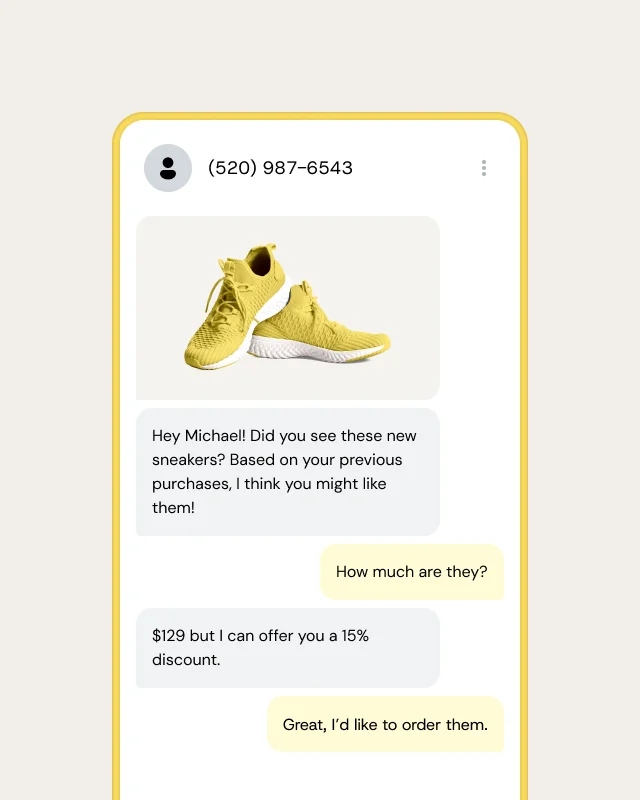
  • ‘Send the customer a tracking number when an order ships’

  • ‘Check if this phone number is valid to send messages to’

  • ‘Place a reminder call for tomorrow’s appointment’

  • ‘Rent a local number for our support line’


                                    # Add the Sinch MCP Server to Claude, Cursor, or your AI tool of choice

npx -y @sinch/mcp


MCP USE CASES

Where teams use the Sinch MCP Server

Each deployment model fits a different situation.

Regulated, data-sovereign builds

A developer at a bank, hospital system, or government agency runs the server locally with npx -y @sinch/mcp, so their agent can call and test Sinch APIs while credentials and customer context never leave their environment.

Fewer review cycles, more shipped code

An engineering team building on Sinch adds developers.sinch.com/mcp to their shared coding setup, so every AI-generated pull request already matches the current API schema, cutting the back-and-forth code review usually catches.

IDE-native agent workflows

A developer working in Cursor, Claude Code, or VS Code runs the self-hosted MCP server alongside their agent, so it can call and test Sinch APIs directly inside the editor they already use, without switching to a separate dashboard or tool.

MCP AND THE REST OF AGENT TOOLS

Part of the Agent Tools suite

MCP is one of six Agent Tools components, handling execution and discovery. Skills add the operational patterns your agent needs to use each API correctly. The CLI, SDKs, and Functions then carry that code to a deployed workflow. Each works on its own, and they work better together.

Frequently asked questions about the Sinch MCP Server

Quick answers on what the Sinch MCP Server does, which deployment model fits your build, and where to start.

A server that connects AI agents and coding tools directly to Sinch’s communications APIs through the Model Context Protocol, so an agent can take real actions like sending a message or verifying a number.

Messaging, Email, Numbers, Verification, and Voice, through a single connection.

The MCP server runs in your own environment and lets your agent call and test Sinch APIs; it does not write code. The Docs MCP is a read-only reference layer that helps your AI coding assistant generate correct code, with no account needed.

A read-only reference layer at developers.sinch.com/mcp that gives AI tools current API schemas and code patterns. No account or API key is needed – it’s for discovery and code generation, not for executing actions.

It’s one component of Sinch Agent Tools, the developer layer for building on Sinch APIs. Agent Tools sits inside a broader set of AI capabilities spanning messaging, voice, email, and verification.

Install from GitHub, get the Cursor Marketplace listing, add the Docs MCP endpoint to your AI tool, or grab it bundled in a Sinch plugin for your editor.