Sinch Functions is serverless compute for Voice and Messaging. Deploy your code and Sinch APIs route live calls and messages to it, with no containers, load balancers, or capacity planning to manage.
Sinch Agent Tools · Functions
Sinch Functions is serverless compute for Voice and Messaging. Deploy your code and Sinch APIs route live calls and messages to it, with no containers, load balancers, or capacity planning to manage.
Runs on Node.js or C#, from a starter template or an empty project
Triggers on voice callbacks, Conversation API webhooks, or your own HTTP endpoints
Ships to production in under a minute with one deploy command
Scaffold from a template in minutes. Live traffic needs a Sinch account.
No infrastructure
Automating a communications workflow usually means standing up hosting, load balancing, and capacity planning before you write a line of logic. Functions removes that overhead. Write the code that should run when a call comes in or a message arrives, then deploy it. Sinch Functions runs it in isolated containers that auto-scale with traffic.
The runtime
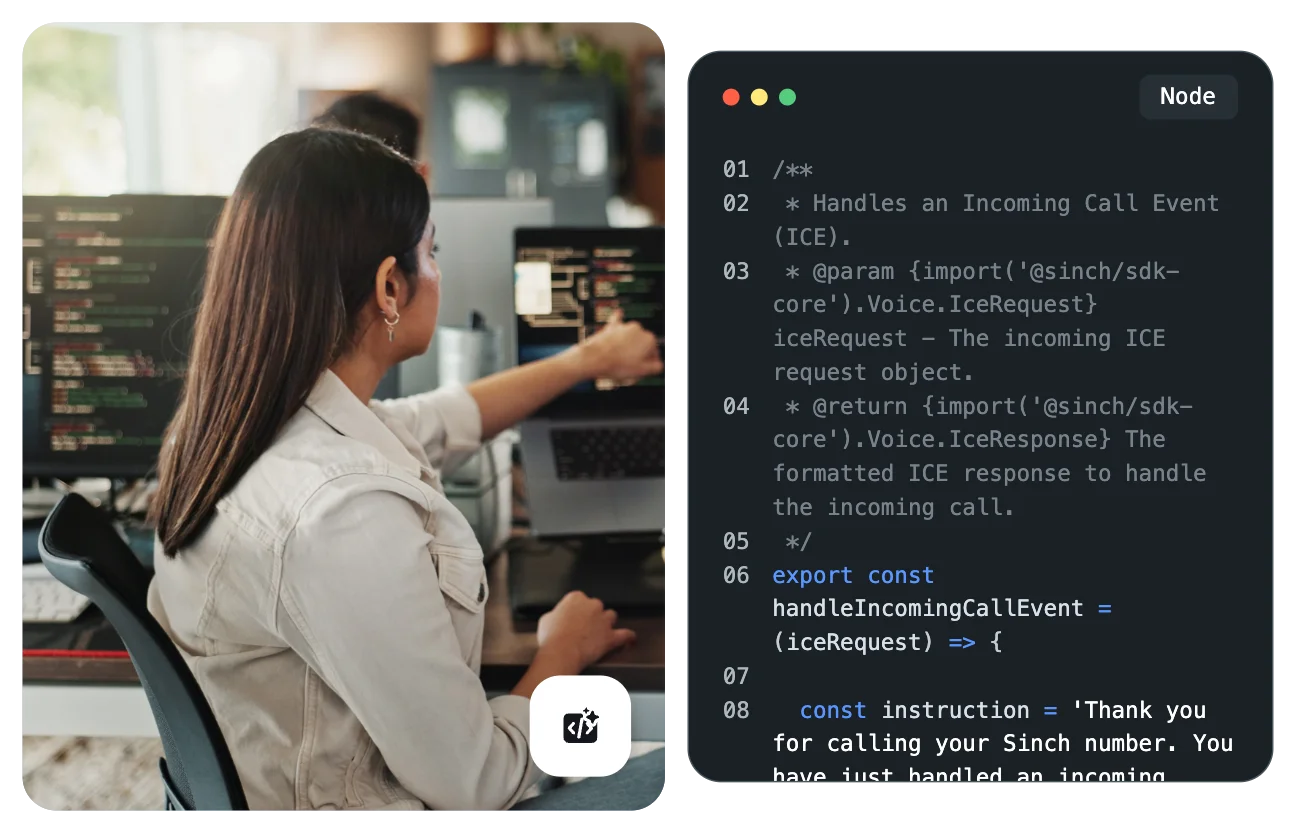
The Node.js runtime is Express with conventions: You export handlers, the runtime routes URLs to them, and you return a response. The C# runtime is ASP.NET MVC with controllers. Either way, the function on the right is complete and deployable.
Routes voice callbacks to the handler you export, with no wiring
Answers Conversation API webhooks from the same project
Exposes your own HTTP endpoints when you need a custom API
// function.ts — a complete, deployable voice function
import type { VoiceFunction } from '@sinch/functions-runtime';
import { createIceBuilder } from '@sinch/functions-runtime';
export default {
async ice(context, data) {
return createIceBuilder()
.say('Hello from Sinch Functions!')
.hangup()
.build();
},
} satisfies VoiceFunction;
What the runtime gives you
Most serverless setups make you add separate products for state, storage, and credentials. The Functions runtime injects them, so they are there the moment your code runs.
Cache for fast, temporary state
Blob storage for files, and a SQLite database for structured data
Environment secrets, injected by the runtime
Pre-wired SDK clients – context.voice, context.conversation, context.sms, and context.numbers – so credentials never appear in your code
From template to live traffic
The Sinch CLI takes a function from a starter template to production without opening the dashboard. Local development runs on your laptop behind a public tunnel, so live traffic can reach it while you iterate.
sinch functions init # scaffold from a template, or start empty
sinch functions dev # run locally with hot reload and a public tunnel
sinch functions deploy # ship to production in under a minute
sinch functions logs # monitor a live function
Functions builds
Every one of these ships as a starter template, so you begin from working code rather than an empty file.
Sinch Agent Tools
Sinch Functions is one of six Agent Tools components, and it is where the workflow lands. An AI agent uses Skills and the SDKs to write the communications code, and the CLI deploys it to Functions to run on live traffic. MCP and plugins connect your agent from the tools it already works in. Each works on its own, and they work better together.
Quick answers on what triggers a function, which runtimes are supported, and what the runtime includes.
Serverless compute for voice and messaging. You deploy your code, and live calls and messages route straight to it, with no infrastructure to manage.
Node.js and C#. The Node.js runtime works like Express with conventions, and the C# runtime like ASP.NET MVC with controllers.
Inbound voice callbacks, Conversation API webhooks, or a custom HTTP endpoint you expose yourself.
Cache, blob storage, a SQLite database, and environment secrets, all injected at runtime, plus pre-wired SDK clients for Voice, Conversation, SMS, and Numbers.
With the Sinch CLI: sinch functions init, then dev to test locally, then deploy – typically in under a minute.
Yes. sinch functions dev runs the function on your laptop with hot reload and a public tunnel, so real test events can reach it.
Functions is one component of Sinch Agent Tools, the developer layer for building on Sinch APIs. Agent Tools sits inside a broader set of AI capabilities spanning Messaging, Voice, Email, and Verification.
Deploy an IVR from a template in about five minutes, then swap in your own logic.