Insights
Retail AI is scaling on a foundation that puts customer trust at risk
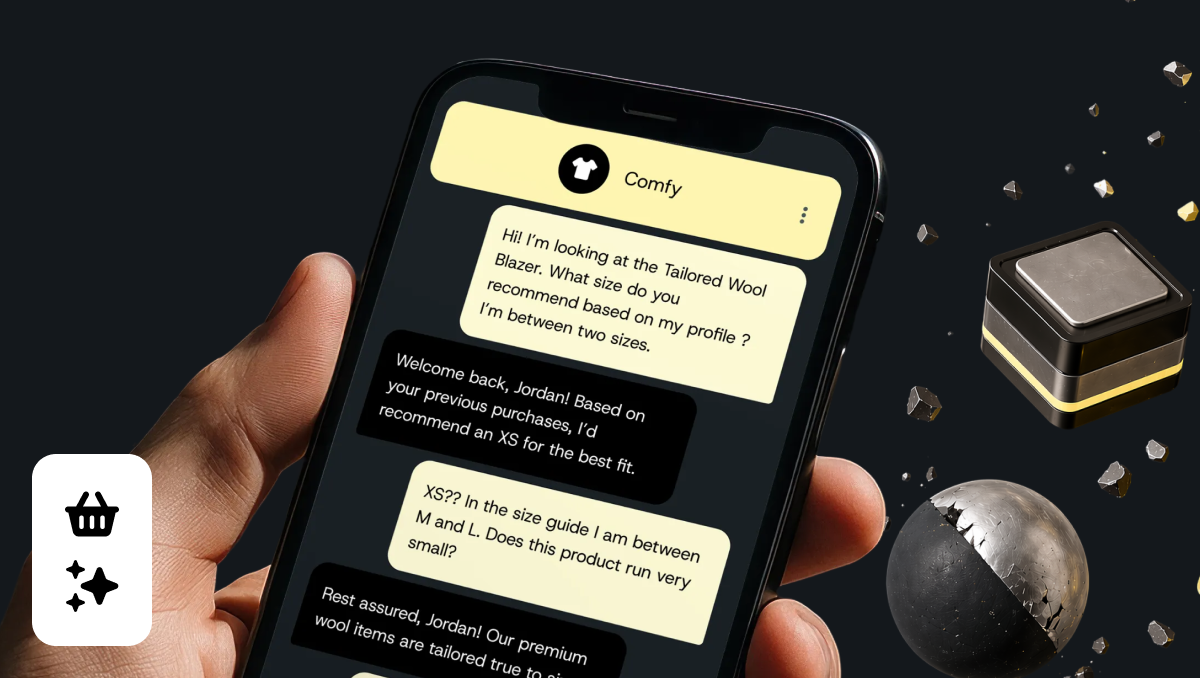
A customer gets an SMS: Their order’s been delayed. But when they open the chatbot the retailer built to help, it tells them, confidently, that the package shipped yesterday. Reluctantly, they call customer service, where a voice agent asks them for their order number, as if the chatbot conversation never happened. By the time they reach a human, they’ve stopped trusting anything the brand says.
This is the failure retail didn’t plan for. Retail’s whole case for AI rests on one thing: knowing the customer well enough to keep them. But the same intimacy that makes an AI agent valuable is also what makes its failures so expensive.
As part of Sinch’s new report, the AI Production Paradox, we surveyed over 400 retail leaders across 10 regions to find out what their AI goals are and what challenges they’re facing in their journey to deployment, and beyond. It turns out, the industry is learning the lesson the hard way.
Retailers are deploying AI at pace to get closer to the customer
The dominant story in enterprise AI is that organizations are struggling to deploy. But Sinch’s research has found that, in customer communications, that’s no longer true: 63% of retailers have already gone live with AI agents, slightly above the global average.
In retail, brands are deploying AI agents across a broad range of communications channels – including email, website chat, social messaging, SMS, WhatsApp, and voice – to support with everything from order queries to re-engagement to returns.
This ambition now extends to voice too, a channel that’s been traditionally overlooked in customer communications. 47% of retailers see voice call handling as their single biggest voice opportunity, six points above average.
Which customer communication channels does your organization plan to integrate with AI agents? (Select all that apply)
Sinch research (2026) shows top three channels to integrate with AI in retail are email (67%), web chatbots (66%), and social media (54%).
But running across that many channels at once is also what makes deployment hard. Two of the barriers most likely to stall an AI pilot are context loss across channels (24%) and integration friction with backend systems (20%) – and they’re two sides of the same problem. When channels aren’t connected at the infrastructure level, agents can’t hold context, and customers end up repeating themselves.
What do you see as the single biggest advantage of deploying agentic AI compared to traditional chatbots or automation?
Sinch research (2026) shows retail’s biggest barrier to production is the inability to maintain context across channels and sessions (24%).
Personalization at scale is retail’s big AI promise
What’s driving retailers’ AI pace and ambition is different from what’s driving efforts across other industries. Only 20% of retailers name autonomy as the top advantage of agentic AI – the lowest of any industry. Instead, 37% rate a deeper understanding of context and customer intent as the biggest advantage of AI agents.
For retail companies, the goal is distinctively focused on improving customer relationships. In fact, 27% name more personalized, dynamic customer experiences as their primary goal – the highest of any industry, and seven points above the global average.
What is the primary technical reason preventing your agentic AI pilots from moving to full-scale production?
Sinch research (2026) shows 37% of retailers rate a deeper understanding of context and customer intent as the biggest advantage of AI agents.
Retail has routed its most valuable asset, the customer relationship, straight through its AI agents. That’s the bet. But what happens when it breaks?
The problems don’t disappear once you’re live
Getting an agent into production is one thing. Keeping it there is another. Among retail organizations already running AI agents in production, 71% have had to shut one down after a governance failure. And the main failure modes causing these rollbacks – customer data exposure and hallucinations – are hitting brands exactly where they’re most exposed.
of AI agent rollbacks in retail are due to customer data exposure. (Sinch, 2026)
of AI agent rollbacks in retail are due to hallucinations or off-brand responses. (Sinch, 2026)
In retail, AI agent failures attack the same thing the agent was built to deepen – the customer relationship.
When an agent shares personal information that it shouldn’t, it breaks the agreement retail’s personalization model runs on (share your data, get a better experience) making the customer feel the exchange isn’t worth the risk. And when an AI agent with deep customer context confidently provides the wrong answer, it’s the brand shoppers will blame – not the agent.
“If I’m coming to you to buy a new product but you’re sending me to support, that’s going to have negative brand impact. Customers are experiencing your brand at a real point of failure, and that means loss of trust. And once you lose trust, it’s really tough to earn it back.”

Every failure adds to the backlog
But there’s a quieter cost underneath the visible one. Every time context breaks between channels, an engineer rebuilds it by hand. The omnichannel complexity that made the agent hard to launch is now sitting in the backlog instead.
Sinch’s research defines this as the guardrail tax. Across the study, 84% of engineering teams spend at least half their time building and maintaining guardrails. In retail, where 31% of engineering teams spend most of their time on safety controls, that capacity is going to defensive work instead of improving agent functionality to strengthen the customer experience.
of engineering teams in retail spend at least half their time building and maintaining guardrails. (Sinch, 2026)
of engineering teams in retail spend most of their time building and maintaining guardrails. (Sinch, 2026)
And it compounds. Every new channel and every new agent add another layer to build, maintain, and rebuild when something breaks.
Cross-channel context is where retail feels it most. More than half of organizations (55%) are custom-building the ability to carry a conversation from one channel to the next, because their platform doesn’t do it natively. And every one of those builds is another integration to keep alive, and another place a customer’s history can drop.
The features meant to win customer loyalty are competing for engineering time with the scaffolding that keeps the agent safe, and the scaffolding keeps winning.
Not everyone’s seeing the same failures
What makes this harder to address is that the people who could act on it have different views on how AI programs are performing. And this is consistent across verticals and regions.
Globally across the study, technical leaders report rollbacks at a higher rate than their business counterparts at the same organizations. In retail, C-suite executives are 2.3 times as likely as their own VPs and directors to say most AI communications pilots are succeeding.
This disparity in the data reflects different accounts of the same events and a visibility gap that puts the brand at risk.
Whether AI creates or breaks customer trust depends on the foundation
It’s tempting to read this as just a model problem or a budget problem. Budget pressure in retail is real. At 11%, retailers cite it as their top barrier more often than any other industry. And with hallucinations driving 18% of rollbacks, the model risk is also real. But on their own, they aren’t what’s breaking live agents.
The strongest predictor of AI deployment success across the study isn’t governance maturity or spend. It’s the communications infrastructure underneath the agent.
That’s why, when retailers say what they most want from an infrastructure partner, AI platform integration co-leads the list at 42%, tied with compliance management. The industry is shopping for a foundation that protects customer data and can hold an agent together across channels.
The tell is who’s shopping hardest: The most advanced retail operators – highest deployment, highest confidence, most mature guardrails – are the most active in evaluating new providers. Not because they’re unhappy, but because they understand better than anyone what the next stage of AI deployment actually requires from the infrastructure underneath it.
The retailers pulling ahead build their AI programs on a foundation that holds context across every channel, not one that forgets the customer the moment they switch.
The AI Production Paradox: See how retail compares
Retail bet its AI ambitions on the customer relationship. Every other industry made a version of the same bet, and each is hitting different walls. But throughout, there’s something that’s consistent: AI in customer communications is no longer stuck in pilot stage, but the real story starts when organizations hit production.
The AI Production Paradox draws on 2,527 enterprise leaders to show where the failures start, what they cost, and why the infrastructure underneath the agent decides who pulls ahead. See how retail compares, and what sets the brands keeping customer trust apart from the ones losing it.

Author: