Insights
When AI chatbots fail, here’s how you – and your customers – pay the price
Your AI chatbot is live in production. It’s handling customer interactions across email, chat, and WhatsApp. The volume it’s carrying would have required hiring 20 additional support agents. Everything is working as designed.
Then you get the alert. The chatbot is giving wrong information, or it’s exposed customer data, or it’s simply offline. Your support team — suddenly responsible for 100% of the load the AI was carrying — is about to have a very bad day. So are your customers. This is happening at major companies right now. And according to new research from Sinch, it’s far more common than most people realize.
Three in four deployed AI chatbots have already failed
It’s the norm, not the exception
Sixty-two percent of organizations have already deployed AI agents across their customer channels. By the end of 2026, 88% plan to have them live. But most of them have already hit a wall.
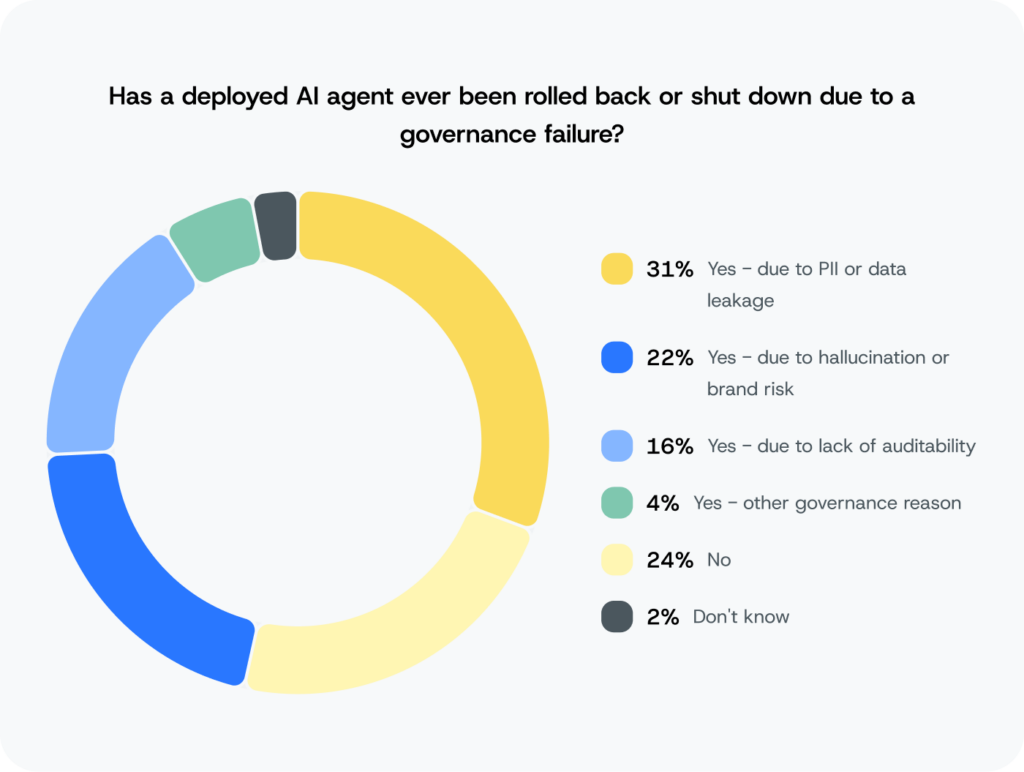
Seventy-four percent of those that deployed AI chatbots have had to shut them down or roll them back due to failures. That’s not a small percentage of early adopters hitting snags. That’s the norm.
And it isn’t unique to one industry or region. The pattern holds across every sector studied – financial services, healthcare, retail, technology – and across every geography from North America to Asia.
Interestingly, among organizations with fully mature guardrails and monitoring, the rate is even higher: 81%. More governance doesn’t prevent issues. It surfaces them.
of organizations have AI agents live across customer communication channels (Sinch, 2026)
of organizations will have AI agents live by the end of 2026 (Sinch, 2026)
Average rollback rate among organizations with deployed chatbots (Sinch, 2026)
Rollback rate among organizations with fully mature guardrails. (Sinch, 2026)
When an AI chatbot breaks, here’s what breaks with it
When a company’s AI chatbot fails in production, the impact splits in multiple directions.
The support queue surges
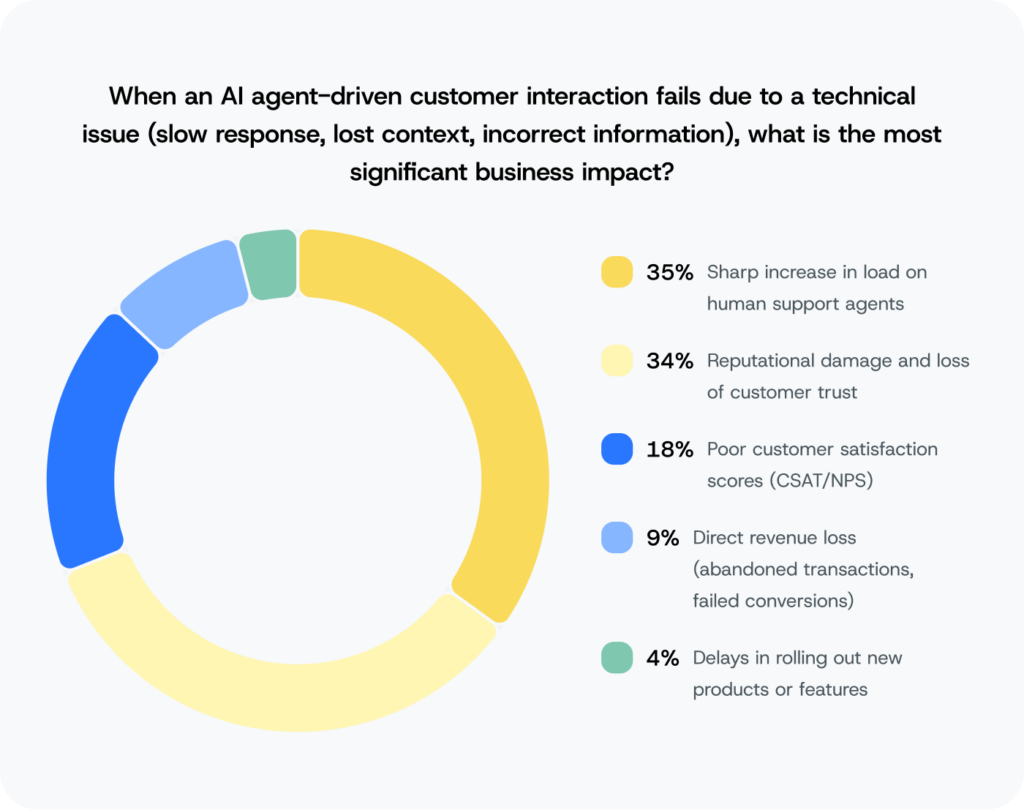
This is cited by 35% of companies as the primary impact of a chatbot going down. Support teams are suddenly responsible for 100% of the load the AI was carrying, and customers are stuck on hold or left with unanswered questions.
The brand takes a hit
Customers interact with a chatbot that’s still technically “live” but seriously broken. It gives them confidently wrong information about their account or order status, or responds in a way no human representative would. These “hallucinations” account for 22% of AI failure instances.
Even scarier, it might also disclose customer personal information during the interaction. This is what happens in 31% of AI failure cases.
When failures occur, 34% of companies report reputational damage and loss of customer trust that’s permanent or hard to undo.
Engineering teams are firefighting, not innovating
Our research found that 84% of AI engineering teams spend at least half their time rebuilding basic AI guardrails from scratch because their infrastructure doesn’t provide them natively.
Context preservation, for instance, is a capability that 55% of companies have to custom-build to ensure conversations flow seamlessly as customers move from channel to channel – AI chat to phone call to WhatsApp.
Companies invested in AI to improve customer experience and operational efficiency, but every hour an engineer spends rebuilding basics that should exist natively is an hour they’re not spending toward the features customers actually want.
The foundation AI relies on was never built for this
It’s not the AI. It’s the infrastructure underneath it.
Research shows that one factor predicts AI deployment success more reliably than anything else: the quality of the infrastructure underneath it, and businesses are well-aware: 87% rate high-performance communications infrastructure as essential or very important.
Yet 90% report theirs falls short in at least one meaningful area:
- 42% report insufficient reliability for AI at scale
- 37% can’t move conversations between channels smoothly
- 34% struggle to connect their chatbot to other business tools
This is where the high AI failure rate identified by the research originates. Most companies have been building AI on top of a foundation not designed for it.
of businesses rate high-performance infrastructure as essential or very important
report theirs falls short in at least one meaningful area
Patching and rebuilding AI safety features from scratch, no matter how carefully, isn’t fixing the real issue if the underlying layer can’t support AI production at scale. But companies aren’t blind to this reality, and the reset is coming.
86% of companies are exploring alternative solutions
AI success is in the foundation
Most companies understand that their AI ambitions have simply outgrown what their current systems can handle. Eighty-six percent report they’ve started exploring alternative vendors in the past year. Among companies that already had a chatbot failure, 91% are actively shopping around.
When evaluating new options, they’re focused on one thing first: reliability.
And when businesses rebuild on reliable ground, it can make all the difference:
- Chatbots stay live: no more failures that tank the support queue.
- Personal information stays private: security is built into the systems, not bolted on top of it.
- Conversations flow across channels: the AI remembers context.
- Better features, faster: with their engineers freed from endless firefighting, businesses can actually focus on improving what matters to customers.

“If governance was the fix, the most mature teams would roll back less. They don’t. What’s breaking isn’t the policy layer. It’s reliability in the real system: data, workflows, integrations, and edge cases. And the cost is real: 84% of AI engineering teams spend at least half their time on safety infrastructure instead of improving the customer experience. That’s the guardrail tax.”

When your chatbot goes down in production, the damage isn’t just operational. It’s engineering cycles you can’t recover, customer trust you can’t rebuild, and differentiating features you’re not shipping. The companies winning the AI race in 2026 and beyond will be the ones who stopped patching and started building on the right foundations.

Author: