Insights
Stop flying blind: 3 call center metrics to master outbound performance

If your outbound calling campaigns aren’t quite delivering the revenue or engagement you expect, you’re not alone.
Many contact centers across finance, healthcare, retail, and hospitality are investing heavily in outbound voice, yet still see a high percentage of calls abandoned before they even connect.
The result? Low connection rates, rising costs, and frustrated customers.
Here’s the hard truth: The problem may not be your agents, your scripts, or even your strategy. It’s your visibility. Too many teams are flying blind, relying on surface-level metrics while missing deeper signals determining whether calls connect, convert or fail.
And this has real consequences:
- Budget wasted on calls that never reach a human
- Poor brand perception driven by low-quality call experiences
- Customers blocking your numbers due to repeated failed attempts
- Revenue left on the table from lost opportunities caused by incomplete calls
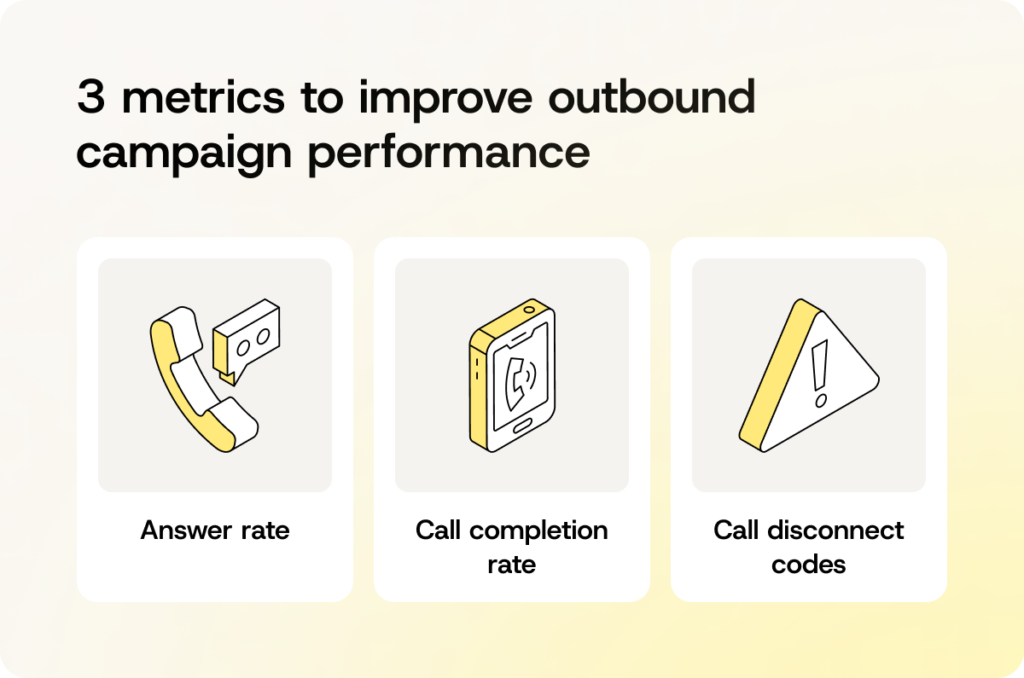
The good news? Fixing this doesn’t require a complete system overhaul. In fact, mastering just a few key contact center metrics can improve outbound campaign performance by 25-30%. (More on how to achieve this later!) Let’s break down the three metrics that matter most and how you can use them to start improving answer rates right away.
Improving performance starts with better data
Before we get into the metrics, it’s worth calling out a common mistake.
Most contact centers track activity, not outcomes. They measure the number of calls placed or average handle time, but neither of these can tell you whether or not your calls are reaching customers. If you don’t understand what’s happening between dialing a number and the customer answering on the other end, you’re missing the most critical part of the journey.
That’s where the right metrics come in.
1. Answer rate: the foundation of outbound success
Let’s start with the most foundational metric: Answer rate.
It measures the percentage of outbound calls actually answered by a person. While simple, it’s one of the clearest indicators of whether your outbound strategy is working.
Why it matters to your bottom line
Low answer rates directly harm campaign ROI. When answer rates drop, the cost per successful contact increases; agents waste time on unproductive calls, and campaign returns decline. Even worse, if customers repeatedly ignore or reject your calls, it can lead to number blocking — making future outreach even more difficult and expensive.
What to do next
Start segmenting your answer rates by geography, carrier, and campaign. This will help you pinpoint exactly where performance is breaking down and why calls are being abandoned before they connect.
2. Call completion rate: Where revenue is won or lost
Getting a call answered is step one, but it’s a wasted effort if the connection is unstable.
Call completion rate measures how many calls stay connected long enough to achieve their goal — whether that’s a conversation, a sale, or a resolution. A large gap between your answer rate and completion rate is a major red flag for network and infrastructure issues.
A call that connects but drops after a few seconds is just as expensive as a call that never connects.
Poor completion rates often point to deeper issues within your system:
- Network instability
- Routing inefficiencies
- Fragmented provider setups
Consolidating your voice infrastructure with a reliable SIP trunking solution can help eliminate connection issues by improving call routing, quality, and control.
What to do next
Track completion rates alongside answer rates. If you see a significant drop-off, it’s a clear sign your infrastructure — not your strategy — needs attention.
3. Call disconnect codes: your diagnostic superpower
If answer rate tells you what is happening, and completion rate tells you how often, then call disconnect codes tell you why. These codes provide detailed, technical insights into why a call failed, yet they’re one of the most underutilized contact center metrics.
Why disconnect codes matter
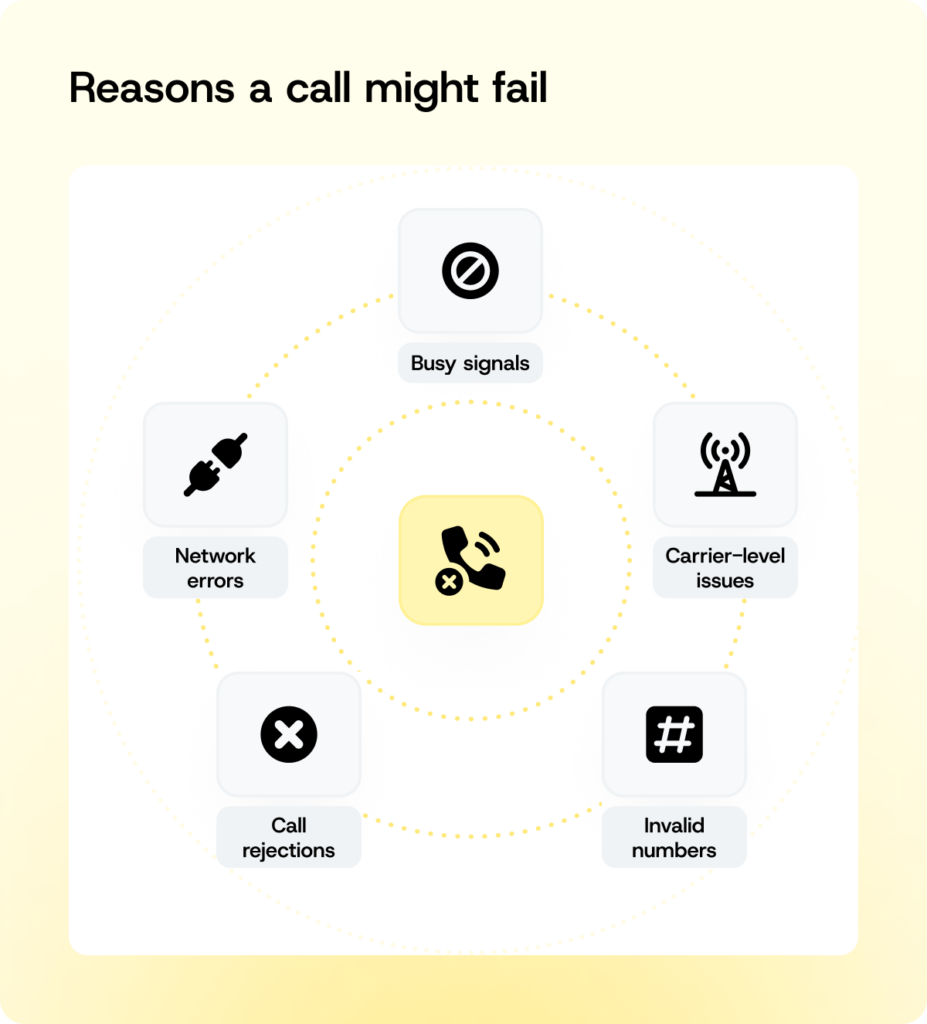
Without this data, every failed call looks the same. But in reality, failures happen for very different reasons:
- Busy signals
- Network errors
- Invalid numbers
- Call rejections
- Carrier-level issues
Understanding these differences is crucial because each one requires a different fix.
Turning data into action
Here’s how you can move from guesswork to precision:
- A high volume of invalid number responses points to a need for better list hygiene.
- A surge in “487 Request Terminated” codes can indicate customers are actively rejecting your calls, signaling brand reputation or number-flagging issues.
- Frequent “503 Service Unavailable” codes point squarely at carrier-level or network routing problems that need immediate technical intervention.
How outdated systems are holding you back
If you’re struggling to access or interpret these metrics, the issue may not be your team. It may be your tech stack.
Many contact centers are still operating with legacy phone systems, disconnected tools, and multiple providers with limited transparency. This creates blind spots that make it nearly impossible to diagnose performance issues.
And when you can’t see the problem, you can’t fix it.
Stop guessing, start optimizing
Outbound voice is still one of the most powerful ways to connect with customers. But without the right visibility, it becomes one of the most inefficient. By focusing on answer rate, call completion rate, and call disconnect codes, you can move from reactive trouble shooting to proactive optimization. That’s where real gains happen — in both revenue and customer experience.
Ready to improve your call performance?
Every missed connection is a missed opportunity to drive revenue, resolve an issue, or build trust with your customers. The difference between underperforming campaigns and high-impact ones often comes down to visibility and control.
That’s where the right partner makes all the difference. With Tier-1 direct connections and deep partnerships on a high-quality carrier-grade network, you gain the tools and actionable analytics to move beyond basic metrics. Sinch brings you the insights and expert support to improve answer rates, reduce failed calls, and deliver excellent customer experiences at scale.
Based on research and collaboration with a key group of customers, our experts helped identify underlying issues with poor number reputation and blast dialing tactics impacting high call failure rates. Effective planning, oversight, and tuning improved their call completion rates by 25-30%.
If you’re ready to stop guessing and start optimizing, it’s time to rethink your approach to voice.
Explore how Sinch Voice can help you connect more calls and drive better outcomes. Or, if you’d rather talk it through, connect with one of our experts and see what’s possible when your calls actually perform the way they should.

Author: