Customer Story
How Airguru turned two emails a day into $247 for every $1 spent
Overview
Challenge: Scale a high-frequency email strategy without losing engagement
Solution: Build on Omnisend, powered by Sinch Mailgun
Results: $247 return for every $1 spent on email
“We never needed fancy design features. We needed a platform that was clean, bold, and simple to use every day.“
Most email marketers would call two newsletters a day a risky bet. AirGuru, a Lithuanian online travel agency that aggregates package holidays across airlines and tour operators, calls it strategy — and the results agree: a $247 return on every dollar spent, 33% year-over-year email revenue growth, and a 70,000-strong subscriber list that keeps clicking and booking.
AirGuru isn’t a traditional travel agency. It operates more like a deals engine, surfacing the best available price for a destination so customers can book a full holiday in a few clicks.
Greta Valaikaite, AirGuru’s Marketing Manager, has run their email program on Omnisend since 2018. Omnisend uses Sinch’s Mailgun Send API and Mailgun Optimize API to power email delivery and maintain deliverability at scale — handling the infrastructure so AirGuru’s team can focus on strategy.
“We’ve been using Omnisend since 2018,” Greta says. “And we haven’t used anything else.”
Sending more to earn more
The conventional wisdom in travel marketing is simple: people only travel a couple of times a year, so don’t flood their inbox. AirGuru looked at actual behavior and saw something different.
“People don’t book often, sure, but they browse, dream, compare, and wait for deals constantly,” Greta explained. “Travel is an always-on interest, not a once-a-year thought. Limiting emails to ‘when people are about to buy’ means you miss 95% of the time when they’re casually interested.”
The data confirmed the instinct. Open rates didn’t collapse with higher frequency. Revenue per subscriber increased with more sends, as a fair share of bookings came from people who weren’t planning a trip — they just saw a deal and grabbed it.
“Fatigue isn’t about how often you send — it’s about how relevant and valuable each email feels,” Greta said. “We send because we strongly believe in what we send: deals they must see.”
A funnel disguised as emails
AirGuru’s content mix looks spontaneous, but it’s deliberate. Every email has one job: get someone closer to booking. The format changes depending on readiness.
Offer emails deliver prices, urgency, and destinations. Value emails answer the doubts that sit between interest and booking — is this legit? What if something goes wrong? And influencer content, reused from creators like travel journalist Orijus Gasanovas, acts as shortcut trust.
“Price is the entry ticket,” Greta said. “If it’s not competitive, people won’t even open. But price alone isn’t enough to convert. You need a good price plus clear urgency, strong destination appeal, or incredibly low friction.”
Subject lines are conversational and slightly urgent. CTAs are specific. And the first block always leads with the single strongest offer, because attention drops fast after the first scroll.
Automations finish what campaigns start
Beneath the daily sends, AirGuru runs a deep automation stack. Automations drive roughly 40% of Omnisend revenue; campaigns account for 60%. But the automations punch above their weight.
Product abandonment leads the pack: 53.7% of total automation revenue with a 51.9% open rate. Price drop alerts are another high performer, especially for repeat travelers waiting on a specific hotel in Turkey or Egypt.
A recent flow, built with the Omnisend team, solves a different problem. A post-trip sequence sends a gift coupon for the next holiday — but non-subscriber contacts must opt in to unlock it. It converts significantly better than standard signup forms, solving two issues at once: retaining post-trip customers and building a consented list.
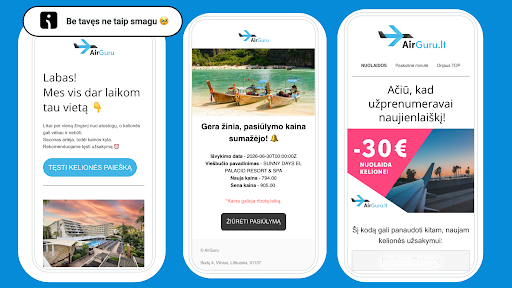
“For us, campaigns start interest. Automations finish the job,” Greta said.
Segmented sends already push click-to-open rates to 12–25% and above — the 20,000-strong family segment, for example, receives child-friendly deals with specific dates, driven by relevance alone. Looking ahead, AirGuru plans more automation and more real-time reactions to browsing behavior.
“We never needed fancy design features,” Greta said. “We needed a platform that was clean, bold, and simple to use every day.”