Insights
Your contact center has a hidden revenue leak. It’s your voice network.

You’re doing everything right. You’re tracking customer satisfaction scores (CSAT). You measure average handle time. You constantly optimize your return policies and shipping logistics.
But if you’re running an enterprise retail contact center, there’s a good chance you have a massive revenue leak hiding right under your nose. It’s not your agents. It’s not your prices.
It’s your voice network.
Most retail leaders rely on the voice carrier that came bundled with their contact center platform. They never formally evaluate it. But that network is usually the weak link behind your dropped calls, jittery audio, and frustrated customers.
Dropped calls don’t just annoy shoppers. They create repeat contacts, failed AI interactions, and invisible revenue loss that shows up in the numbers months later. Let’s take a look at the true cost of a dropped call in retail — and how to fix the leak for good.
A dropped call is an abandoned cart
You wouldn’t accept a checkout page that crashes 5% of the time. Yet, many retailers accept degraded voice performance as an inevitable cost of doing business.
And it isn’t. It costs you more than you think.
- 86% of customers will leave a brand after just two bad experiences.
- 1 in 3 customers will switch to a competitor after a single poor service
- 67% of customer churn is preventable if the issue is resolved on the first
A dropped call makes first-contact resolution impossible. When a shopper calls in to ask, “Where is my order?” (WISMO) and the line goes dead―that isn’t just a technical glitch. It is the exact moment they decide to take their business elsewhere.
You’re paying twice for failure
Beyond lost revenue, dropped calls actively drain your operational budget.
The average inbound customer service call costs between $8 and $15 to handle. When a call drops, the customer calls back. You just doubled your operational cost for that interaction, and you still haven’t solved the customer’s problem. You’re paying twice for failure.
The AI bottleneck is your network
This problem is getting worse as contact centers evolve. By now, you’ve likely invested in voice AI or bots to handle routine retail FAQs. But if your bot is experiencing high escalation rates and failures, don’t blame the AI right away. Check your plumbing.
Your network is likely the real reason your bot keeps failing. An AI model can only understand what it can actually hear. If your legacy network delivers compressed, choppy audio, the bot gets confused, fails, and routes the shopper to a live agent anyway. That’s not a problem with your bot – it’s a problem with your network.
The peak season penalty
Retail is seasonal. Your call volume during Black Friday or the holiday rush looks nothing like your volume in mid-July.
Legacy SIP providers don’t bend with you. Most force you to pay for peak capacity all year or charge steep fees every time too many calls come in at once. So, you either overpay for capacity you don’t use, or your call quality tanks the moment volume spikes.
Don’t just fix the leak. Rebuild the foundation.
You don’t need to rip and replace your entire contact center to fix this. Thanks to the Bring Your Own Carrier (BYOC) model, you can keep the platforms your team already uses — like Genesys, Five9, NICE, 3CX, or Avaya — but upgrade the network powering them.
Sinch has the largest owned and operated facilities-based network in the US. We’re not a reseller passing your calls through someone else’s pipes. That difference is what keeps your calls crystal clear.
Here’s how a stronger foundation with Sinch changes your retail business:
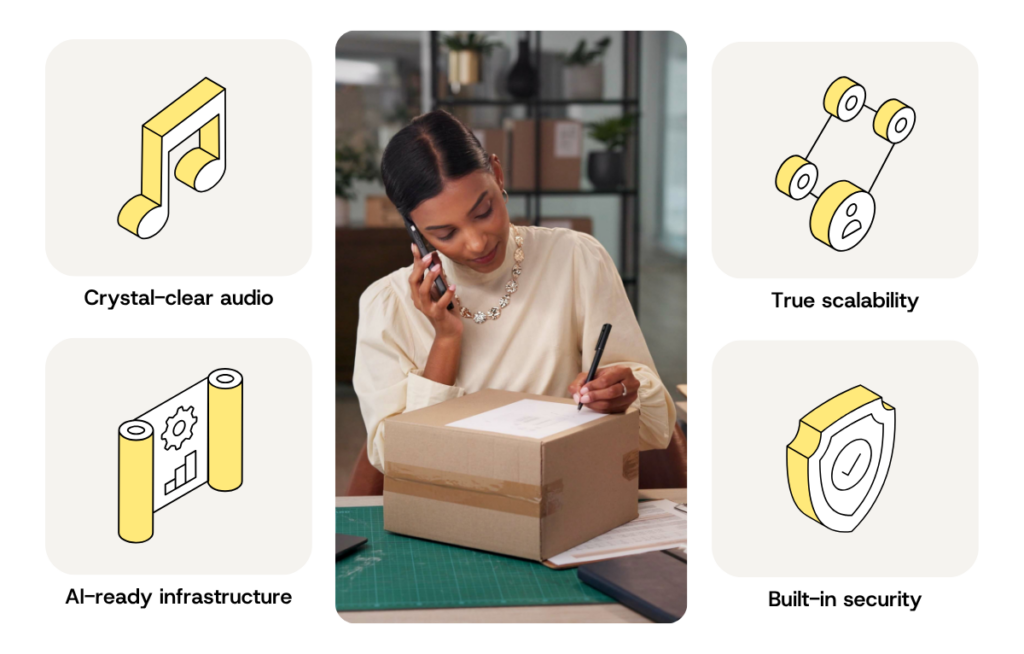
- Crystal-clear audio: Fewer hops mean fewer dropped calls. We keep over 95% of US calls on our network, across 12,800+ rate centers, instead of handing them off to someone else’s systems.
- AI-ready infrastructure: We deliver the clean, high-fidelity audio your voice bots need to actually understand your shoppers.
- True scalability: Flex with seasonal holiday demands. With no channel fees, you only pay for what you use.
- Built-in security: Encryption (TLS/SRTP) comes standard and our fraud protections (STIR/SHAKEN) keeps spoofed calls away from your agents, so their time goes to real shoppers with pressing issues.
A network built right does more than connect calls. It protects your brand, makes your AI smarter, and powers retail growth.
Stop patching, start performing
Dropped calls are frustrating for customers, but they’re also harmful to your business. They double your costs, break your AI, and cap your peak season performance. But you don’t need to swap out your contact center to fix it. You just need to upgrade the network underneath it.
Ready to plug the leak for good?
Every dropped call is a missed sale, a frustrated shopper, or a customer who won’t call back. The right partner changes that. With Sinch, you get a partner who owns their network — delivering clear audio, AI-ready infrastructure, flexible scaling, and built-in security, so your voice channel works as hard as the rest of your retail operation.
Explore how Sinch Voice can help you connect more calls and protect your retail brand. Or, if you’d rather talk it through, connect with one of our experts and see what’s possible when your calls actually work the way they should.

Author: