Insights
Are we ready to trust in AI to power the future of customer communications?
Ready or not, here it comes. Artificial intelligence is quickly changing the ways we interact with the world. That includes how businesses connect with people.
But how do your customers feel about AI? What are your expectations for how AI will transform customer experiences?
While using AI as part of a customer communications strategy isn’t exactly new, it is certainly expanding. Honestly, exploding might be a better word, and Sinch experts predict that will continue. Let’s explore what CX and communication leaders need to know as an increasingly AI-powered world becomes our reality.
Artificial intelligence and customer communications
Earlier this year, Sinch surveyed 2,800 consumers as well as more than 1,600 business leaders from retail, healthcare, technology, and financial services. We published the findings in our report The state of customer communications.
Here are some of the key findings from the research regarding artificial intelligence:
of all industries surveyed are either using or plan to use AI in customer communications.
of respondents from all industries planned to invest in AI voice bots in 2025.
of business leaders are concerned with how consumers perceive the use of AI in customer communications.
of consumers would trust AI trained on a company’s support documentation.
of Gen Z consumers are willing to use AI for customer support.
of all consumers would trust AI for basic answers, such as checking the status of an order.
These findings suggest that most businesses are going full steam ahead on AI solutions for customer communication. Yet, these leaders understand there are both advantages and risks associated with unleashing AI in customer-facing experiences.
At the same time, there are groups of consumers who are ready and willing to use AI-powered solutions to meet their needs. But there are also people who are uncertain or unwilling to do so.
How do you balance different opinions and possibilities in a world where everything related to AI is in a state of constant flux? Taking a closer look at this research will help you make the right decisions moving forward.
Where are businesses investing in AI?
For 98% of business leaders in healthcare, FinServ, retail, and technology, waiting on every consumer to be ready for AI isn’t an option. That’s why they’re betting on the transformative power of AI and implementing solutions now.
In 2025, AI solutions topped the list of emerging communications technologies that companies across industries are investing in.
of businesses surveyed plan to adopt AI voice assistant technology in 2025.
of business surveyed are adopting or investing in AI-driven chatbots.
For more than a third of the companies that Sinch surveyed (35%), AI and automation were part of their strategic investments in customer communications this year.
Digital transformation projects take significant time and effort. It starts with ensuring you have a solid foundation to build upon. Beyond the AI tool itself, enterprise organizations also need infrastructure that supports artificial intelligence in customer communication.
That means more than just adding a chatbot. It requires scalable messaging APIs, reliable delivery across global channels, and secure, compliant data handling behind the scenes.
What does this mean for AI investments in 2026?
No matter the industry, enterprise organizations will be on the lookout for API providers and infrastructure partners who can provide a framework that meshes with their AI solutions, data pipelines, and communication workflows.
This will enable systems that do much more than generate responses. That’s because innovators in customer communications have their eyes on what’s coming next – agentic AI.
Trust in AI for customer support
Let’s start with one of the most common use cases for AI in customer communication – providing service and support.
AI chatbots have been part of the customer communication mix for years now. That could include website chatbots that answer questions, in-app bots that help users understand the product, or SMS chatbots that deliver conversational support experiences via text messaging.
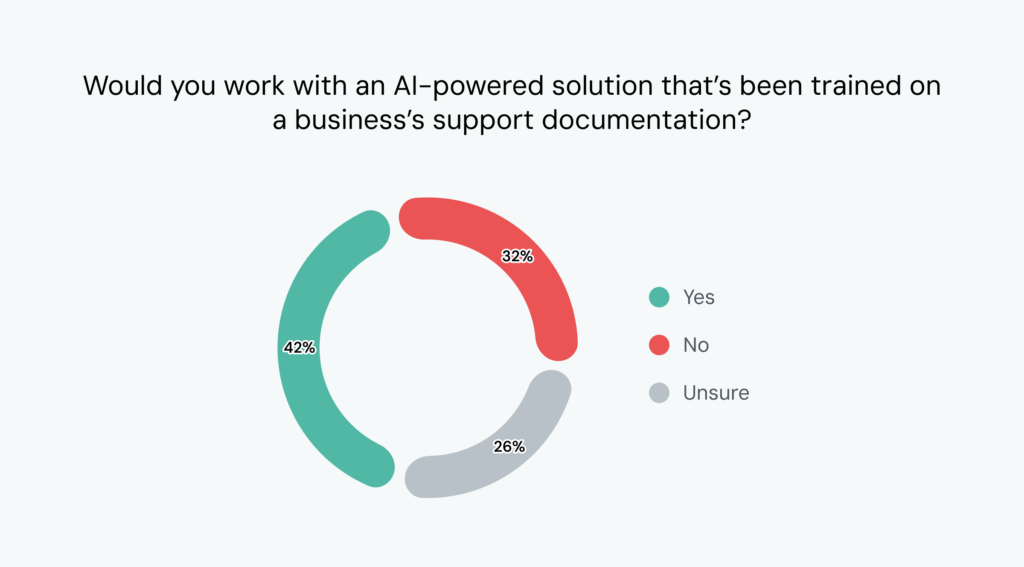
When we asked consumers around the world how they felt about using AI for customer support, 42% said they’re willing to use it while 32% would not be and 26% are unsure about the idea.
Throughout our survey, it became clear that younger generations are much more likely to place trust in AI than their older counterparts. The majority of both Gen Z (72%) and millennial consumers (58%) seem comfortable using AI for customer support. But that drops to just 39% of Gen X consumers and only 20% of baby boomers.
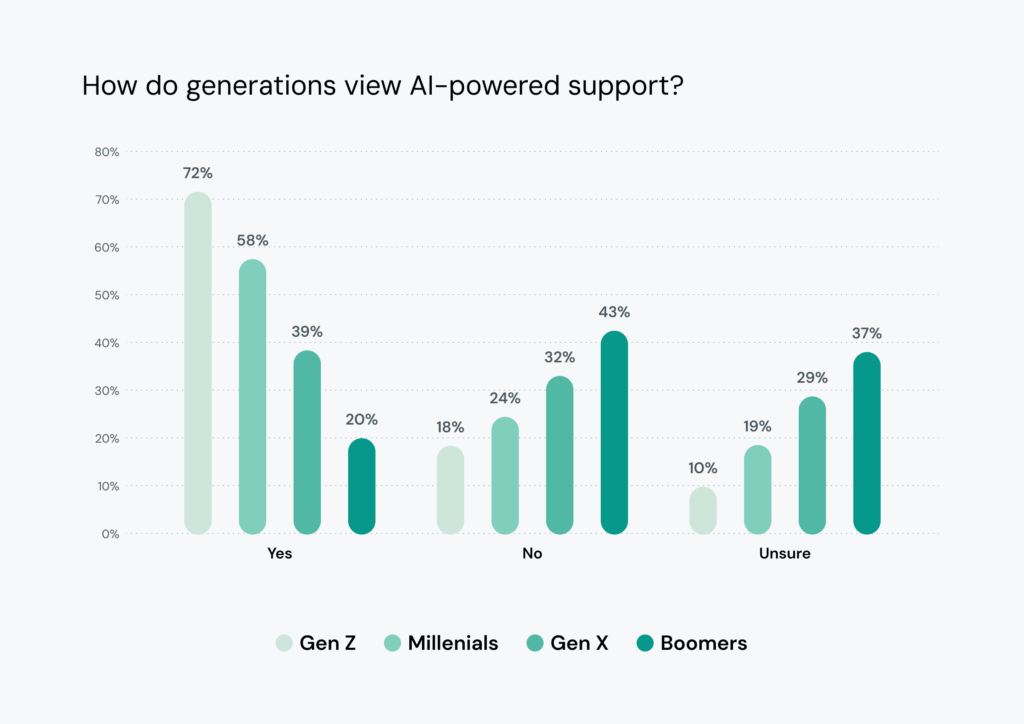
Keep in mind, young people are more likely to be early adopters of new technology. So, these findings are no surprise. But they may signal that older consumers will likely accept help from AI tools as it becomes more mainstream.
Automating responses via chatbots was one of the most popular uses for AI among all four industries. More than half of healthcare and FinServ respondents cited this use case along with around 45% of retail and technology respondents.
Even though there’s widespread adoption of AI chatbots for customer support, few consumers selected it as their first choice in customer service scenarios. In fact, just 5% chose AI chatbots. The top options were email (31%), chatting with a live agent (22%), or calling a live agent on the phone (19%).
What this means for AI and customer support
There are a host of advantages for businesses and benefits for consumers when AI is used to provide support. For your company, AI-powered support can improve efficiency, reduce labor costs, and enable human agents to focus on more pressing issues.
For consumers, AI chatbots can offer 24/7 support, reducing wait times and producing faster resolutions. A friendly chatbot never has a “bad day.” Expect hesitations around AI to dissolve as the convenience becomes clear.
The key is to keep customer satisfaction as your guiding light. That’s how you build trust in AI. If you’re improving efficiency at the cost of the customer experience, you’re likely doing more harm than good. The best AI chatbots understand when a customer needs to be transferred to a live representative.
AI-driven customer support should certainly be part of your customer communication strategy. But flexible, scalable support gives your customers the option to choose how they want to be helped. So, don’t ignore communication channels like email, voice, and messaging.
Trust in AI in for the healthcare industry
Among the 400+ healthcare business leaders we surveyed, just 2% claimed they have no plans to implement AI into patient communications. Among the other 98%, many are using the power of AI to help them deliver improved patient experiences.
say they’re automating patient communications through AI chatbots.
say they’re using AI for predictive communication, helping them anticipate patient needs.
say AI helps them analyze patient data.
These examples represent fairly advanced use cases for AI in healthcare communication. That’s a strong indication of trust in this evolving technology. But there may also be opportunities for AI to serve more utilitarian purposes.
For example, just 32% of healthcare companies are using AI to help with appointment scheduling and related questions. But 57% of consumers who are comfortable with AI in healthcare want to use it for that purpose.
While many healthcare brands are exploring ways to use AI to serve patients, business leaders in the space do have some trust issues. Here are the top concerns with AI in healthcare communication:
have concerns about data privacy and security when using AI.
are concerned with the accuracy and reliability of AI in communications.
worry about regulatory compliance when implementing AI.
These are all valid concerns, and it’s good to see that healthcare leaders are keeping them top of mind as AI solutions are introduced into the patient experience.
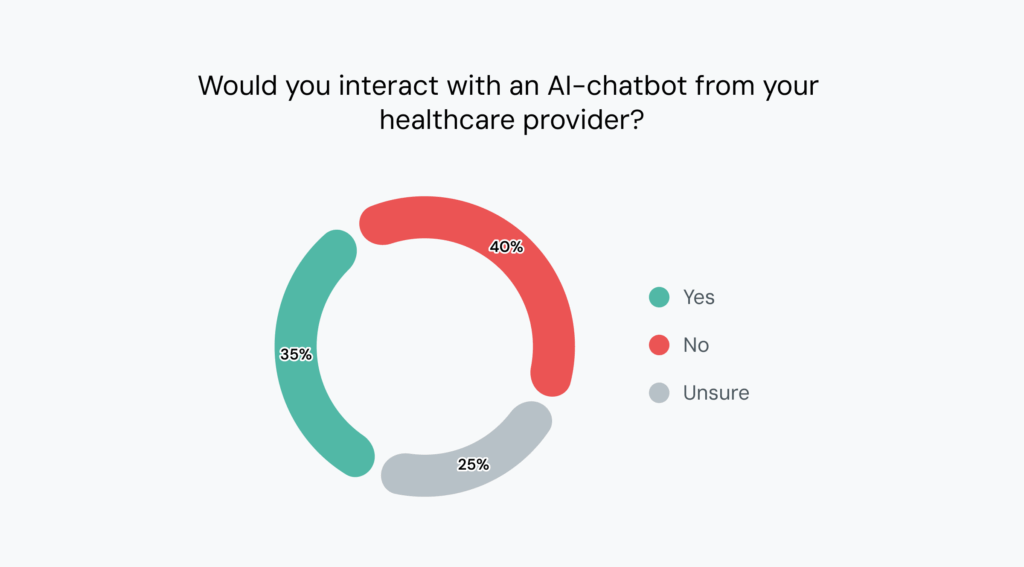
Patients have their own hesitations about interacting with AI when it comes to their health. While 35% of consumer respondents would use an AI chatbot from their healthcare provider, 40% don’t want to, and another 25% are unsure.
Patients with a lack of trust for AI in healthcare communication share some of the same concerns as business leaders. 64% don’t trust the accuracy of AI-generated answers, and 40% of patients are worried about privacy. Additionally, 43% say they feel that AI is too impersonal for use in healthcare communications.
What’s interesting is how the sentiment starts to shift once a benefit of using AI is introduced. Sinch’s research found that the number of respondents willing to use AI increased to more than 40% when they knew doing so meant they’d receive care faster.
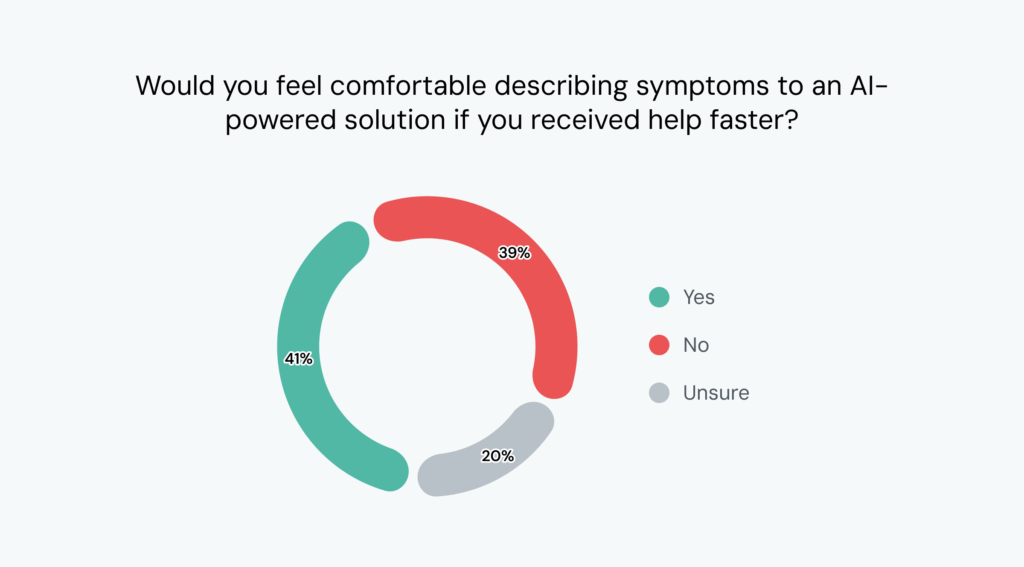
It appears uncertainty around using AI dissipated for some once it was clear that it would improve their experience. In fact, this question specifically mentioned providing AI with potentially sensitive information about their symptoms.
What this means for AI and healthcare communication
When patients interact with healthcare providers, they expect a human touch. That’s why a good “bedside manner” is so important for physicians. People want to feel cared for. When designed with that in mind, AI chatbots can provide an experience that emulates empathy and leaves your patients feeling seen and understood.
Meantime, while there is plenty of healthcare data for AI to process, some of the simplest information could provide the biggest impact. Healthcare providers should consider ways AI can help with scheduling appointments and answering non-emergency medical questions. How could an AI solution keep your patients engaged in between appointments?
Trust in AI for financial services
Financial health is another important aspect of everyday life in which AI is having an impact. Here are the top three areas where FinServ leaders say their companies are using artificial intelligence:
say they use AI chatbots to automate support responses.
say they use AI to analyze client data for better communications.
say they use AI to provide basic financial advice.
Like their counterparts in healthcare, data and security (41%) are among the biggest concerns for business leaders in financial services. 37% worry about consumer perception when using AI and 35% hesitate to trust AI for accurate answers.
Among all four industries that Sinch surveyed, FinServ respondents were the most likely to already use AI chatbots. 59% cited chatbots as part of their customer communications mix. That compares to an average of 52% across industries.
Personal finances are personal, and when financial futures are at stake, trustworthiness is paramount. So, it’s understandable that many consumers have some concerns about using AI for financial services.
Sinch’s survey revealed that 43% of consumers would not want to engage with an AI chatbot that provides financial advice. Another 21% are unsure, and 36% expressed an interest and willingness to interact with AI for financial advice.
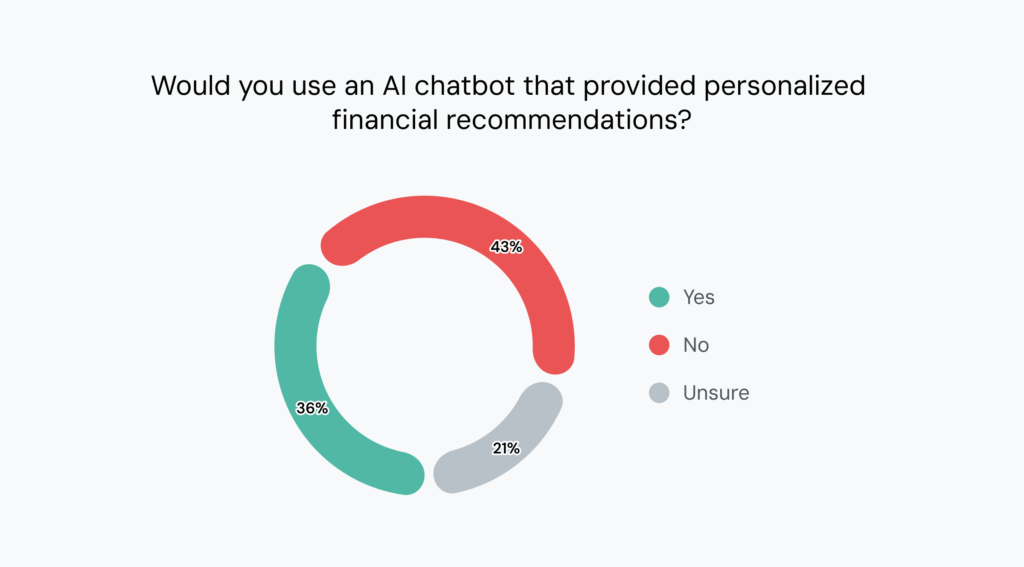
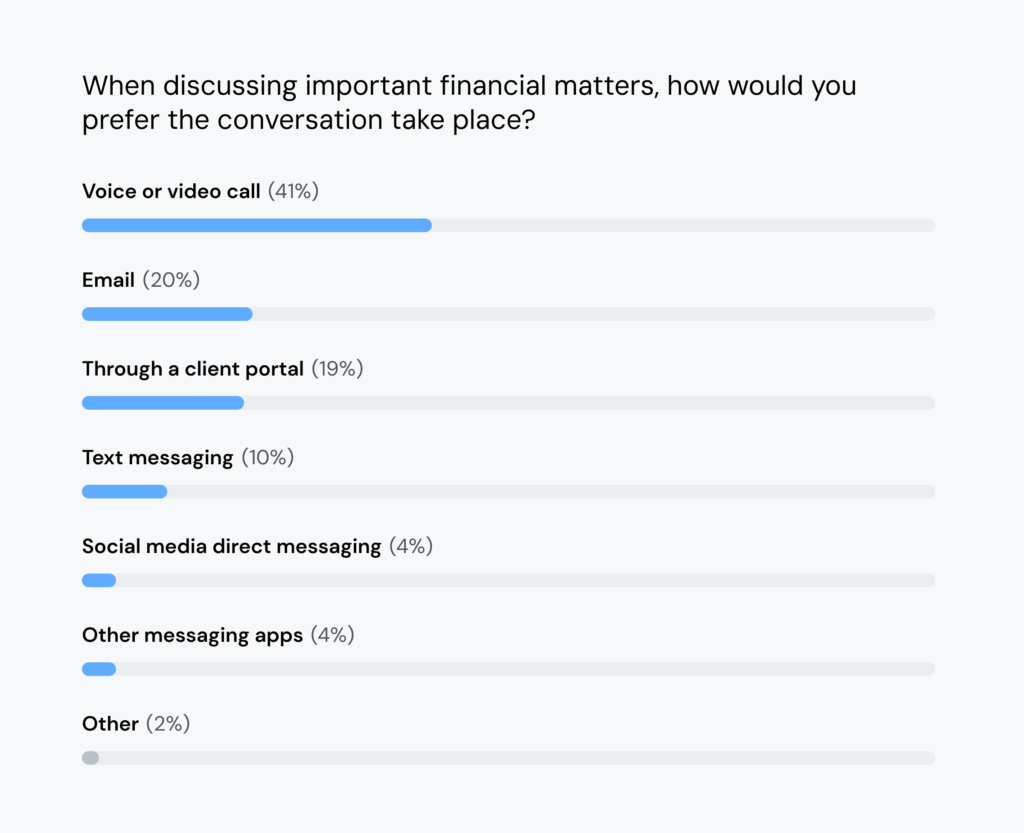
While there are opportunities to use AI to optimize financial portfolios, many consumers are more comfortable getting guidance from a human expert – like their financial advisor. In fact, when a face-to-face meeting with an advisor isn’t possible, 41% of consumers prefer replicating that experience with a voice or video call over any other communication channel.
Keep in mind, AI is changing quickly and so are consumer opinions. A separate study from Intuit Credit Karma, conducted later in 2025, found two thirds of Americans (66%) have used AI for financial advice. That number jumps to 82% among Gen Z and millennials.
What this means for AI and FinServ communications
Even if it takes time for consumers to place trust in AI-powered solutions from financial institutions, conversational banking provides plenty of opportunities. People can turn to AI chatbots with questions on account balances, transactional histories, upcoming payments, and more. These use cases streamline experiences and keep people happy.
However, even when AI is used to analyze financial data and make smart decisions, you may find that many of your clients continue to prefer receiving that advice from trustworthy humans with expertise and experience. That’s where other communication channels can keep your company connected with the people you serve.
Trust in AI for retail customer experiences
Retail and ecommerce are ripe for a transformative revolution thanks to the opportunities AI provides. So, where are retailers implementing AI in customer communications? Here are the top three retail AI uses cases:
are using AI to deliver real-time notifications on shipping and delivery times.
use AI to send personalized offers and promotions to shoppers.
are automating customer service responses with AI chatbots.
As in healthcare and financial services, data privacy (48%), accuracy (44%), and customer trust around AI (37%) are retailers’ biggest concerns with implementing AI.
Getting AI-powered updates on their orders is one area where most shoppers seem very comfortable trusting artificial intelligence. 52% of global consumers in Sinch’s survey said they’d use AI to stay informed on order tracking and delivery. Among younger consumers, that number jumps to 67% of Gen Z shoppers and 63% of millennials.
Conversational commerce using AI can also help facilitate returns and exchanges via text messaging chatbots. That’s something a combined three quarters of consumers (76%) are at least willing to try.
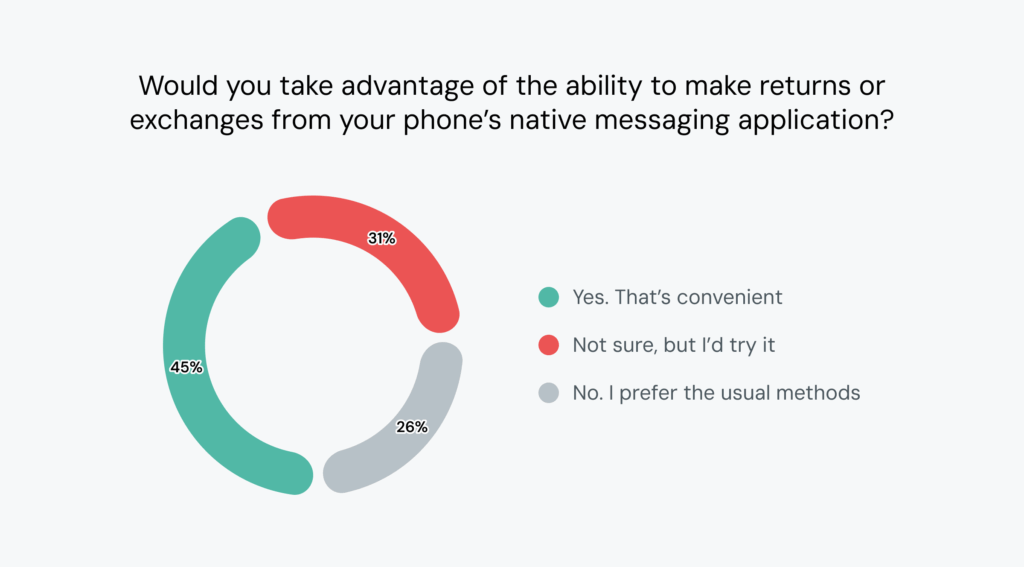
More advanced use cases for AI in retail experiences include chatbots that act as personal shopping assistants. There is, however, a bit of a disconnect between consumers who are willing to share their preferences with AI and the desire for personalized shopping suggestions.
One question in our survey revealed that 40% of consumers might be uncomfortable talking about their personal preferences with an AI chatbot. But in a separate question, more than 70% of consumers indicated they’d value personalized recommendations from AI, if the recommendations made sense.
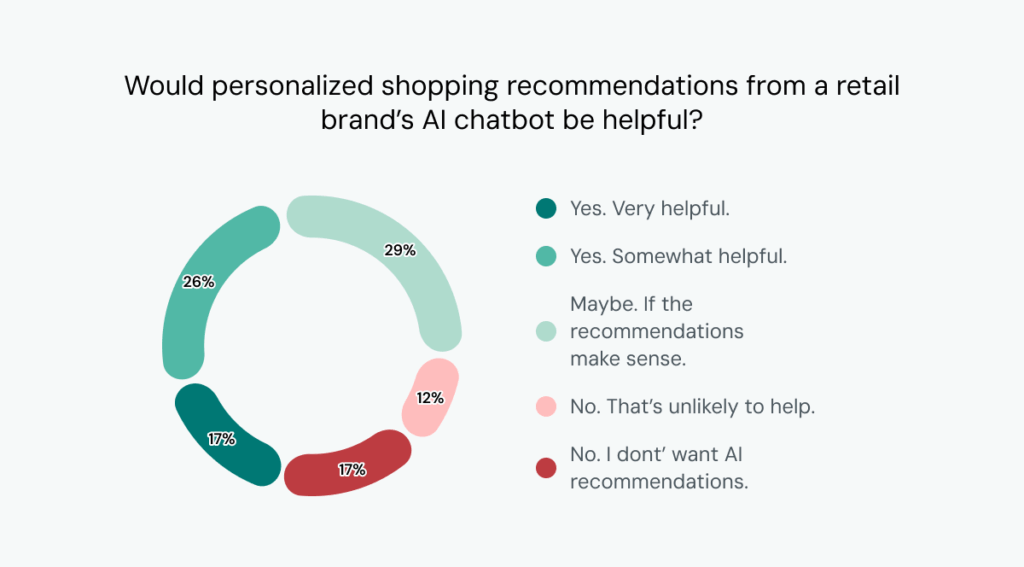
Even when retail customers feel uncertain about revealing their likes and dislikes to an AI-powered personal shopping assistant, you can still use zero- and first-party data. That’s how you provide a relevant, personalized shopping experience without asking too many annoying questions.
What this means for AI and retail communications
Shoppers want meaningful, personalized shopping experiences. But they don’t want AI to know too much about them. That’s when things start to feel creepy and invasive.
Finding ways to add personalized touches at the right moments will be key. Whether it’s reminding someone about an item they almost bought or sending a timely offer based on in-store behavior, the goal is to enhance the journey without overstepping.
Smart personalization with artificial intelligence balances context with consent. Brands that get this right will win trust and long-term loyalty.
But don’t forget about the simple ways to enhance retail experiences and build trust. For example, when AI-powered communications proactively alert customers about a shipping delay. Knowing your package is arriving later than expected is much better than expecting it and it doesn’t show up.
Agentic AI: The next wave of customer communications
Expect to witness the rise of agentic AI in 2026. This is where systems act on behalf of customers, not just respond to them. AI agents will understand goals, make decisions, and take action across channels to deliver proactive, personalized experiences.
Trust in AI will be the deciding factor in how far this transformation goes and how quickly agentic AI is adopted by businesses and consumers.
Leaders at Sinch are predicting that AI is in the midst of making yet another leap, moving from a way to boost efficiency and productivity to truly enhancing customer experiences.
“Today, businesses use AI agents to minimize costs. The focus is not to solve the problem but to end the conversation as soon as possible… AI agents will evolve from simple cost-savers to true growth engines. All of a sudden, you are greeted with context. Everyone knows who you are.”

For businesses, agentic AI will evolve from a support tool into a proactive communicator An AI agent can send personalized reminders, alerts, and confirmations on its own. To earn customer confidence, brands will need transparency around when, why, and how AI acts, maintaining human oversight while letting trusted systems take initiative.
For consumers, the rise of personal AI assistants will change expectations once again. People will rely on their own agents to interact with brands. AI agents will help them compare prices, resolve support issues, and schedule appointments – all within trusted communication networks.
Sinch is powering this new layer of autonomy through secure, compliant, and reliable APIs. Agentic systems will need trusted pathways for identity verification, message delivery, and data handling to ensure every automated action works as expected.
In 2026, trust will define the success of agentic AI. The companies and partners that build on reliable infrastructure and deliver transparent communication experiences will be the ones customers trust to act on their behalf.

Author: