Insights
Shoppers don’t mind early Black Friday campaigns, but they’re getting choosier

Every year, holiday promotions seem to start earlier, a trend referred to as “Christmas creep,” and grumbling usually follows. But it doesn’t reflect how most shoppers feel. Ahead of Black Friday and Cyber Monday, we asked 2,501 shoppers across eight countries what matters most to them when it comes to BFCM brand communications, and 58% said they want to start hearing about deals at least a month before Black Friday. That puts the ideal start of the holiday sales season in late October at the latest.
Retail giants didn’t wait: this year, Amazon billed its early-October sale as the kickoff of holiday shopping, and Walmart and Target ran similar sales the same week.
But our survey describes holiday shoppers who, while still wanting deals, are getting choosier about where and how they want to hear from brands, and last year’s playbook may no longer work.
Consumers are watching their budgets and planning their holiday shopping ahead
This year’s shoppers are heading into the season cautious with their budgets. Deloitte’s 2026 holiday forecast expects U.S. holiday retail sales to reach $1.70 trillion to $1.71 trillion between November and January. But it also reports shoppers at every income level hunting for value, switching brands and stores, and leaning on promotions to stretch their budgets.
According to our survey, only 25% globally plan to spend more during Black Friday and Cyber Monday, down seven points from last year, and 34% plan to spend less. U.S. shoppers are steadier but aren’t splurging: just 18% plan to spend more, and 42% expect to spend about the same as last year.
Spending plans aside, the survey found that 58% of shoppers want to hear about deals at least a month ahead. The most popular time is a whole month before Black Friday, chosen by 36% of shoppers, and 22% want those messages even sooner.
How soon do you want to start hearing from brands about Black Friday and Cyber Monday deals?
An early start gives shoppers time to compare offers and plan purchases, instead of rushing everything in a single weekend. In a PayPal survey of 2,005 U.S. adults, 29% said they planned to begin holiday shopping earlier than last year.
While most shoppers are open to an early start, that doesn’t mean they’re open to being contacted everywhere. They have clear preferences about which channels they want holiday promotions on.
Channel preferences for holiday deals are narrowing, but there’s no consensus
Our survey found that shoppers’ appetite for receiving holiday promotions on multiple channels has dropped since 2024: 67% want them on more than one channel, down from 72% in 2025 and 78% in 2024. That leaves one third of this year’s shoppers wanting promotions through a single channel, up 11 points in two years. Shoppers still want to hear from brands, but the terms are changing.
Email, the long-standing default for brand deals, is still the number one channel for holiday offers at 55%, ahead of social media ads at 40% and websites at 36%. But it’s not everyone’s first choice.
How do you prefer to hear from brands about Black Friday, Cyber Monday, and other holiday season deals? (Select all that apply)
Among shoppers who want holiday promotions through just one channel, email is the top pick, but only 37% chose it. The other 63% are split among nine other channels, each chosen by fewer than 15%. This means there’s no default channel to please all shoppers, and what they want depends a lot on who they are.
Shoppers in France favor email more than in any other country surveyed: 64% want promotions by email, nine points above the global average. The U.S. is close behind at 63%. But this popularity doesn’t hold everywhere: in Mexico, social media ads (58%) and WhatsApp (47%) both rank above email, which ties with websites for third place at 32%.
Age changes the picture too. Younger generations are the least attached to email. Gen Z shoppers prefer social media ads (58%) over their inboxes (49%), making their feeds the more popular place for holiday deals. Millennials are almost evenly divided: 53% picked email for holiday promotions, and 50% prefer social media ads. Older shoppers lean more clearly back toward email: 58% of Gen X and 61% of Boomers prefer it.
But even on the right channel, an offer still has to earn attention.
Personalization is more than welcome, on one condition
Most shoppers are comfortable being known by the brands they buy from. Our survey found that 77% want personalized messages and only 14% say personalization feels invasive.
Do you value receiving personalized recommendations from brands during Cyber Week and the holiday shopping season?
This marks a shift from 2025, when appreciation for personalization dipped: last year’s survey found that 72.7% of shoppers valued personalized offers, down 7% from the year before, and 17% said personalization felt invasive.
For many shoppers, however, it comes with a condition: 42% value personalization as long as it’s relevant. Personalization is a trade: brands use shoppers’ browsing and purchase data, and shoppers expect to receive offers worth their attention in return. That’s the unspoken deal, and in a context of growing privacy concerns, showing shoppers what they’re getting for their data matters even more.
In Deloitte’s 2025 Connected Consumer survey of 3,524 U.S. adults, 70% said privacy and security are a concern when using digital services, and only 48% felt the benefits of these services were worth the privacy trade-off, down from 58% in 2024.
Getting personalization wrong has a cost. In our 2025 State of Customer Communications report, a third of consumers cited irrelevant messages as one of their frustrations with brand promotions.
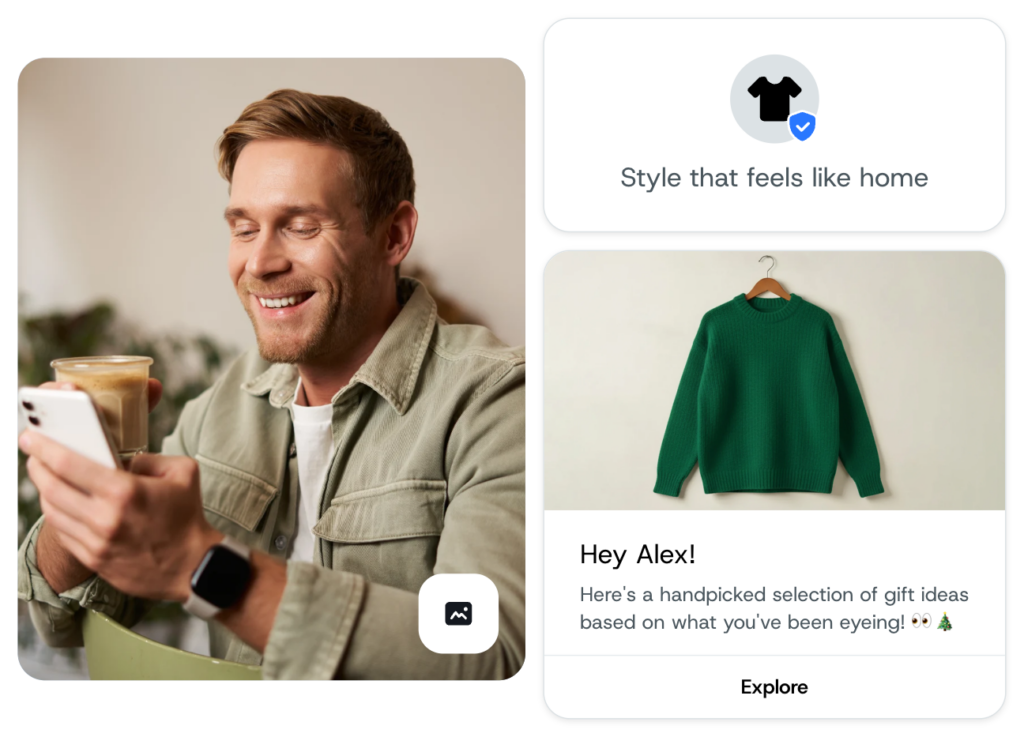
Personalized gift ideas based on what a shopper has been browsing for the people on their list are useful. Recommending something they just purchased is noise that might make them tune out for good.
Campaigns that land, even at peak volume
For a shopper with a gifting list to check off and a budget to stick to, a deal that arrives too late, lands in the wrong place or isn’t relevant isn’t much of a deal. So start by late October. When your customers sign up to receive promotions, let them choose where they actually want to receive them and how often they want to hear from you, and make it easy to update those settings. Finally, make every personalized offer earn its place.
At holiday scale, delivering on shoppers’ preferences takes an intelligent execution layer that routes every promotion to the right channel reliably, whether that’s email, SMS, RCS, or WhatsApp. Discover how Sinch’s scalable communications infrastructure helps businesses handle the demands of the busy shopping season without a hitch.

Author: