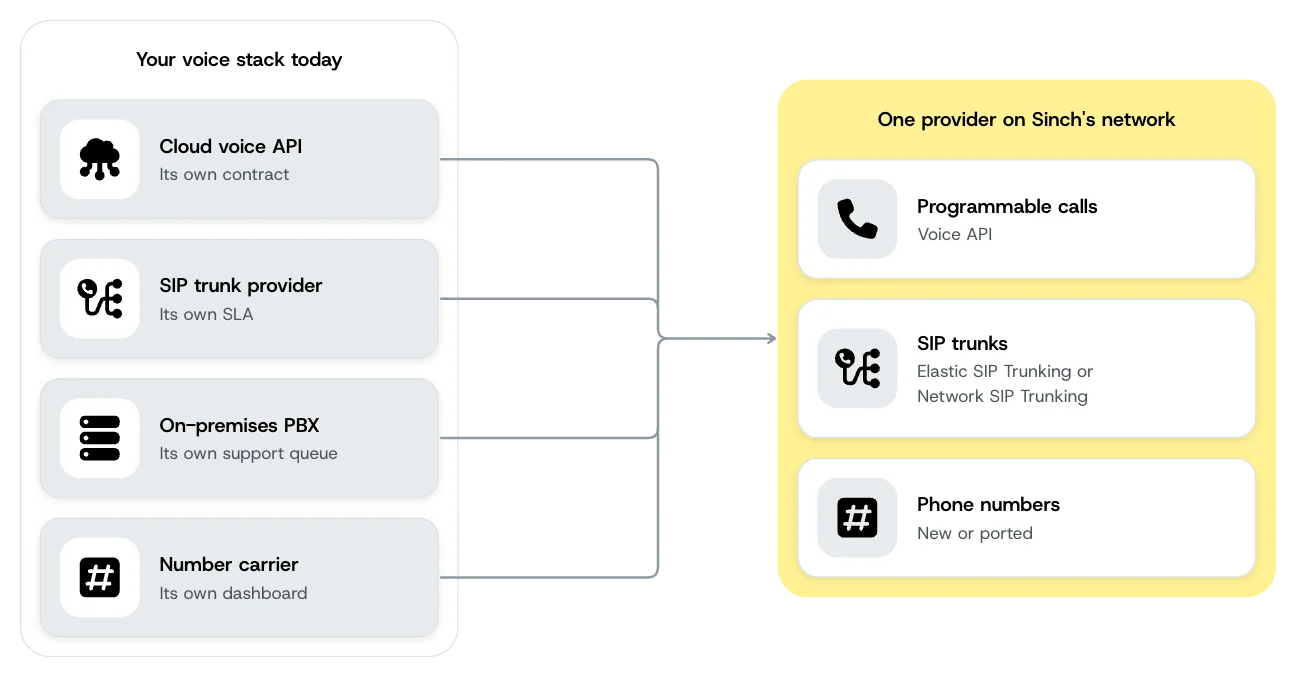
Most enterprise voice stacks weren’t planned. They grew one team, one acquisition, and one renewal at a time. Moving calling, SIP trunks, and phone numbers to a single provider cuts the overhead that comes with every extra vendor.
VOICE PROVIDER CONSOLIDATION
Most enterprise voice stacks weren’t planned. They grew one team, one acquisition, and one renewal at a time. Moving calling, SIP trunks, and phone numbers to a single provider cuts the overhead that comes with every extra vendor.
One contract covering your voice traffic
One escalation path when a call fails
One provider for programmable calls, SIP trunks, and phone numbers
Multi-provider voice costs
Each extra provider adds a contract, an SLA, a support queue, and a security review. Those costs rarely land on one invoice, so they’re easy to underestimate. Here’s where they tend to show up.
Consolidate voice providers
Few teams consolidate voice for its own sake. It usually starts with an event that makes the current setup hard to defend. Whatever the reason, the path to one provider follows the same three steps.
Sinch voice products
Sinch’s voice portfolio covers the workloads enterprises most often split across vendors. Programmable calling, SIP trunking, and phone numbers all come from one provider, on Sinch’s network.
Sinch’s US voice network
Consolidating only helps if the provider you keep can carry the full load. Sinch owns and operates its US voice network instead of reselling capacity. Fewer handoffs between carriers mean fewer places for a call to fail.
Largest independent voice network in the US
Direct connections to every Tier-1 US carrier
Direct delivery for 95% of North American calls
More than 300 billion US voice minutes a year
Phone numbers in 95 countries, with reach in 190+ countries
Pricing and compliance
Consolidation pays off in procurement as much as in operations. With one provider, you run one security review, sign one set of data processing terms, and negotiate volume in one place.
Voice consolidation FAQ
These are the questions teams ask most before moving voice traffic to one provider.
For most enterprise workloads, yes. Sinch’s voice portfolio covers PSTN calling, SIP trunking, in-app calling, IVR, text-to-speech, call recording, and number masking. Your audit shows whether anything in your stack falls outside that list.
No. Consolidation changes the carrier layer, not the platform. Your UC platform or contact center keeps handling calls, agents, and workflows. Bring Your Own Carrier (BYOC) connects it to the phone network through Elastic SIP Trunking instead of the platform’s bundled calling.
With Network SIP Trunking, Sinch teams manage implementation, number porting, and initial configuration. Older TDM systems need a gateway to translate their signals for SIP. Moving one location first lets you confirm call flows before you schedule the rest.
Yes. You can port your existing numbers, or add new local and toll-free numbers as each site moves. Porting needs authorization from your current provider and an agreed migration timeline.
Voice API calls bill per minute for inbound and outbound traffic, phone numbers bill monthly, and advanced features such as recording bill by usage. With Elastic SIP Trunking, capacity follows your calling demand. For enterprise volume pricing, talk to sales.
You need a Sinch account, plus a SIP-compatible PBX or UC system for SIP trunking. Programmable voice needs developers familiar with REST APIs and a server to receive call events. With Elastic SIP Trunking, each US number also needs a registered E911 address.