Resources
Best SMS providers in Australia: A comparison for 2026

Every “best SMS provider in Australia” list I read before writing this one had a similar problem. The company publishing it always came out on top.
So let me get my bias out of the way first.
I work on Sinch’s messaging products, and I’ve spent 15 years in SMS and marketing – including running content at Sinch SimpleTexting (a business texting service focused on the US and Canada), which Sinch also owns. Three of the SMS providers on this list, which I’m writing specifically for Australia, are part of Sinch. I’ll flag each one where it comes up, and I’ll tell you plainly when a provider that isn’t ours is the better fit for your use case.
I’ll do this because there is no single best SMS provider in Australia. There’s a provider that is best for your volume, your budget, your tech setup, and how much you care about local support. This guide is built to help you find that for your Australian business, regardless of who pays my salary.
Here’s the short version:
- The cheapest headline rates come from Australian-owned providers like Mobile Message, and Cellcast.
- Developers building SMS into software usually land on Twilio Messaging APIs or Sinch Engage, formerly MessageMedia, for the API and global reach.
- Since July 1, 2026, whether a provider is on the ACMA approved list matters as much as its price.
- “Australian-owned” and “global” are a real trade-off – local support and carrier routes on one side, scale and multichannel on the other.
How to choose an SMS provider in Australia
Before the list, here’s the framework I’d use. Price is a loud factor, but it’s rarely the one that decides whether a provider works for you.
Six things separate the providers below from the ones that didn’t make this list:
- Pricing model. Pay-as-you-go credits, monthly plans, or custom enterprise rates. Watch for credit expiry and GST.
- Deliverability and routing. Direct connections into Australia’s biggest carriers like Telstra, Optus, and TPG matter more than a headline cent-per-message rate.
- Compliance support. Whether the provider is on the ACMA approved list, and how it handles sender ID registration and opt-outs.
- API versus dashboard. Developers need clean API documentation. Marketing teams need a usable web dashboard.
- Integrations. Native links to your CRM, e-commerce platform, or tools like Zapier.
- Support and location. Australian-based support in your timezone, versus follow-the-sun global support.
Weight these by what you’re actually doing. A developer adding one-time passcodes to an app cares about the first four. A marketer sending weekly campaigns cares about the dashboard and integrations. Keep your own use case in front of you as you read.
A note on who owns whom
The Australian SMS market looks more crowded than it is. Several familiar names sit under the same parent companies.
Sinch owns Sinch Engage (formerly MessageMedia), ClickSend, and SMS Broadcast, which all have a deep background in Australia. So when you compare those brands, you’re comparing products from one group, not independent rivals. I’ve marked each Sinch-owned provider below.
The rest – Mobile Message, SMSGlobal, Kudosity, SMS Broadcast, Notifyre, Cellcast, and Twilio – are independent of Sinch.
With that clear, here are the providers.
SMS providers in Australia compared
I’ve ordered these by the buyer they suit best, not by rank. Each entry covers who it’s for, where it’s strong, and where it isn’t.
Mobile Message: Best for the lowest price
Mobile Message is Australian-owned and competes hardest on price. It advertises a rate of 1.6¢ per SMS for new customers’ first purchase, scaling to around 2¢ per message at higher volumes. Credits don’t expire, there are no monthly fees, and a dedicated number is included.
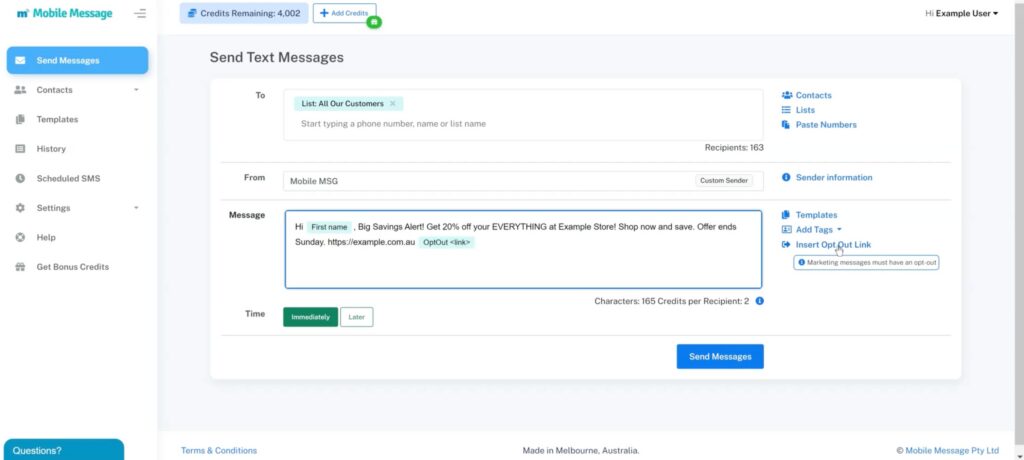
For small businesses sending campaigns or reminders on a budget, it’s hard to beat on headline cost. The trade-off is depth. You get solid bulk SMS and a clean dashboard rather than a broad multichannel platform.
Best for: Small and mid-sized Australian businesses that want the lowest cost per message.
Kudosity: Best for security and compliance
Kudosity, formerly Burst SMS, is 100% Australian-owned and one of the country’s longest-running providers, founded in 2008. It’s the option to look at first if security certifications drive your procurement. Kudosity states it’s ISO 27001:2022 certified and SOC 2 Type II compliant, and describes itself as Australia’s first ISO 27001 certified messaging platform.
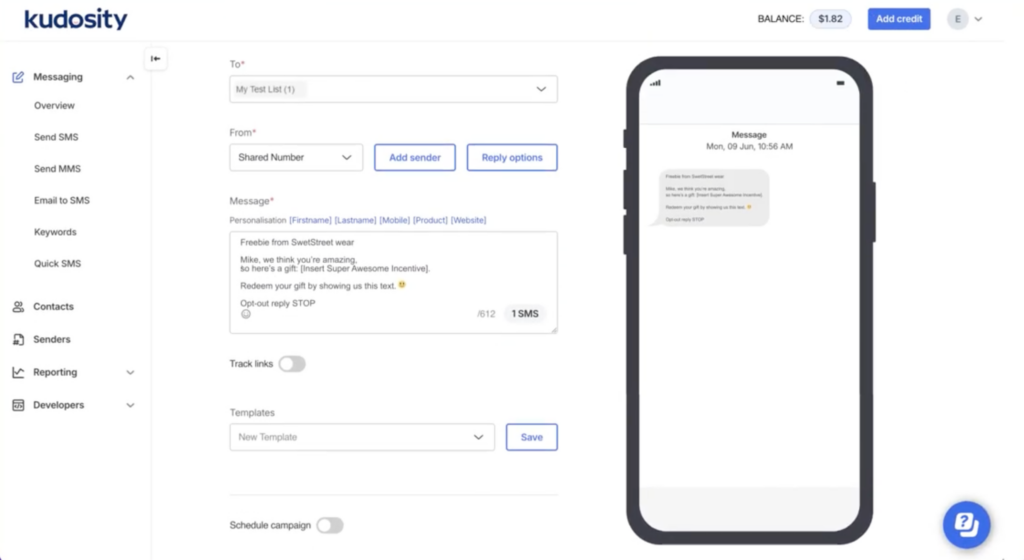
Pricing is tiered: 7.9¢ pay-as-you-go, 5.9¢ on the growth plan, and 4.9¢ at scale, with data held in Australia. That’s not the cheapest, but security-conscious buyers rarely choose on price alone.
Best for: Regulated industries and businesses with strict data and security requirements.
Sinch Engage, formerly MessageMedia: Best for enterprise and omnichannel
Here’s the first of the Sinch-owned options, so read it with that in mind. Sinch Engage, formerly MessageMedia, is built for businesses that want SMS alongside MMS, WhatsApp, and other channels in one platform. It adds CRM integrations and support for larger sending volumes.
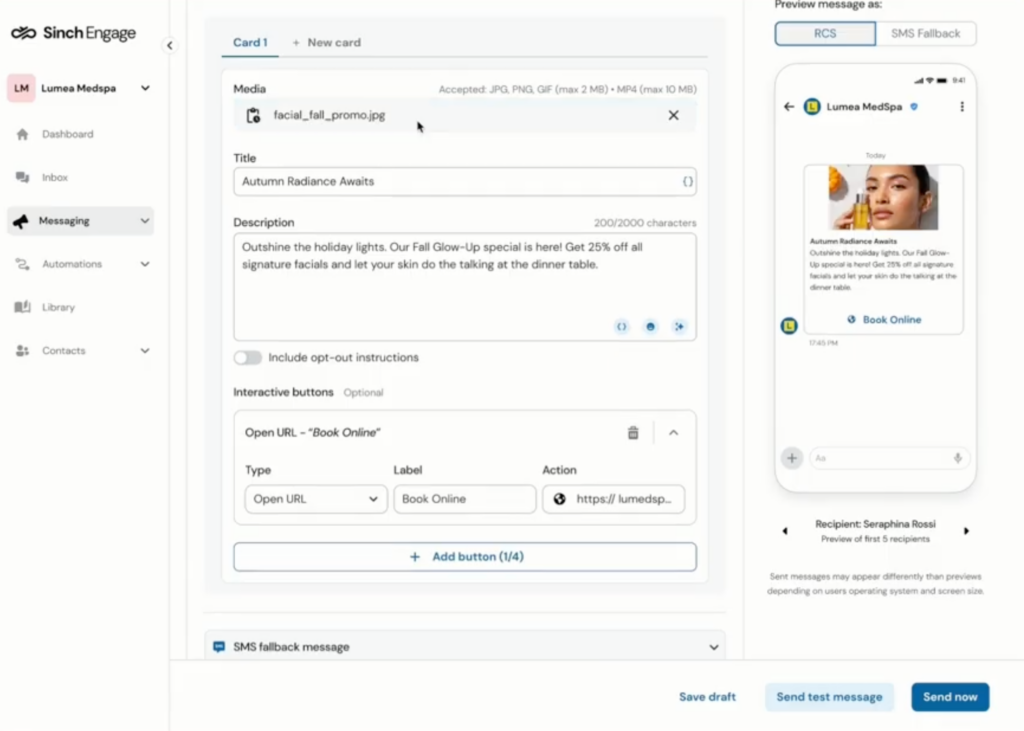
Plans run from around $42 to $749 a month, with custom pricing above roughly 13,500 SMS a month. Inbound messages are free in Australia, with no carrier passthrough fees. It sits within the wider Sinch network, which connects to more than 600 carriers across over 190 countries. Sinch and Sinch Engage are both on the ACMA approved list, so sender ID registration runs through the platform you already use.
The honest limitation: It’s not built to win on lowest cent-per-message against some Australian-owned budget providers. Its case is scale, omnichannel, and compliance handled in one place.
Best for: Mid-sized and enterprise teams that want omnichannel messaging and CRM integration.
Another note: MessageMedia began in Melbourne in 2000 as Message4U, and rebranded as MessageMedia in 2004. MessageMedia went on to cement its legacy in Australia with many owned or controlled Australian entities including SMS Broadcast, SMS Central Australia, DirectSMS, Wholesale SMS, Bulletin.net, Streetdata, Text Messaging Technologies, Mobipost, MessageNet, and ClickSend – among other acquisitions focusing on markets outside of Australia, such as SimpleTexting.
Following Sinch’s acquisition of MessageMedia in 2021, MessageMedia underwent a rebranding to Sinch Engage in 2026. That said, Sinch Engage still has a huge presence in Melbourne and all things Australia SMS.
SMS Broadcast: Best for simple, low-cost bulk
SMS Broadcast is an Australian provider focused on doing bulk SMS simply and cheaply. SMS Broadcast is owned by Sinch, coming from a MessageMedia acquisition back in 2018. Recharge rates run from about 7¢ down to 3.7¢ as volume rises, credits are valid for 12 months, inbound messages are free, and new accounts get 25 free credits to test with.
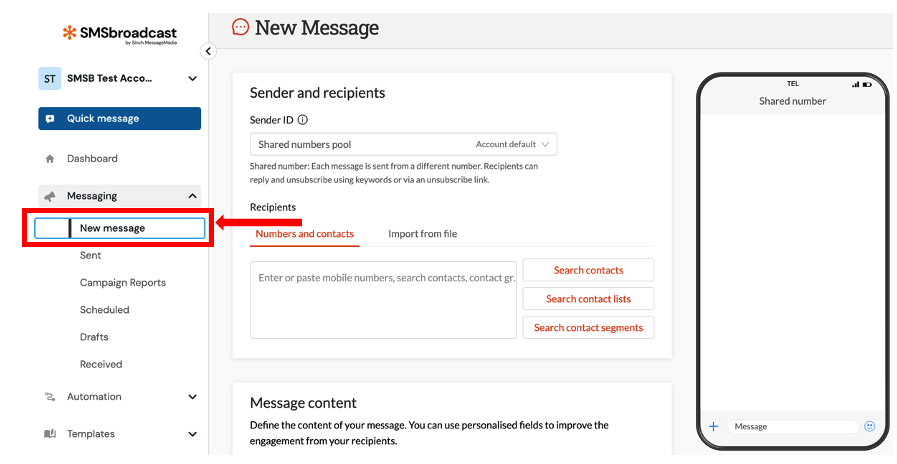
It won’t give you a deep marketing suite, and that’s rather the point. If you want to upload a list and send without learning a platform, it fits.
Best for: Businesses that want straightforward bulk SMS without extra features.
ClickSend: Best for self-serve multichannel
ClickSend is also part of the Sinch Group, so the same disclosure applies. ClickSend started in 2013 in Perth, and the team working on this product is still crushing it from Perth. ClickSend offers self-serve SMS, MMS, and rich messaging, with volume-tiered pricing that drops as you top up more.
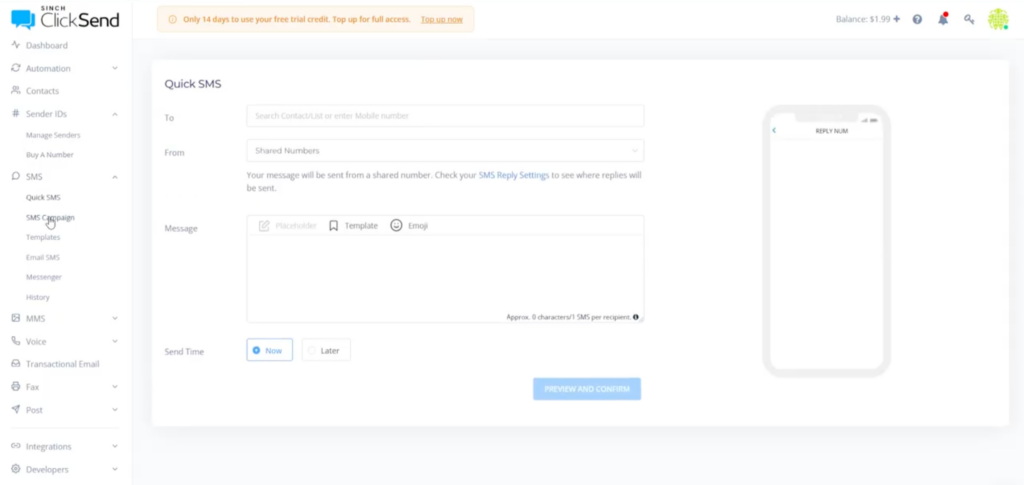
It suits businesses that want to sign up, connect a few tools, and send without a sales conversation. It’s a lighter, more self-directed experience than Sinch Engage, aimed at smaller teams.
Best for: Small businesses that want self-serve multichannel messaging.
Notifyre: Best for SMS and fax together
Notifyre is 100% Australian-owned and unusual in pairing SMS with online fax, which matters especially in healthcare, legal, and finance. SMS starts from about 5.5¢ per part on pay-as-you-go, with virtual numbers from $17.50 a month for two-way messaging.
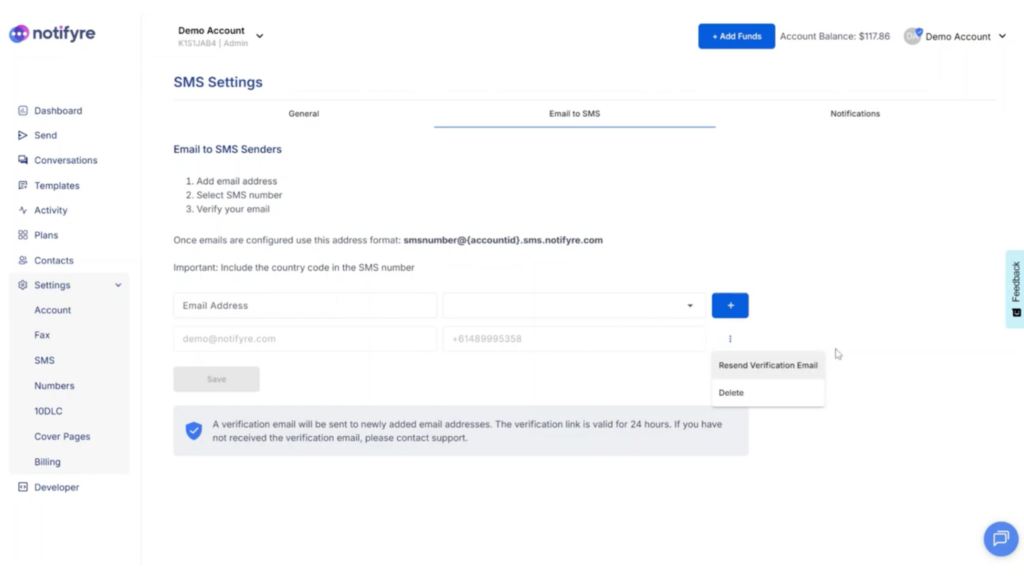
If your workflows still involve fax, or you want two-way SMS for notifications and verification from a local provider, Notifyre covers both in one account.
Best for: Healthcare, legal, and finance teams that need SMS and fax in one place.
Cellcast: Best for Australian-owned budget sending simplicity
Cellcast is Australian-owned and independently operated, competing at the lower end on price. Pay-as-you-go rates run from about 3.7¢ per message at 2,000 messages down to 2.9¢ at 20,000 or more, and prepaid credits don’t expire.
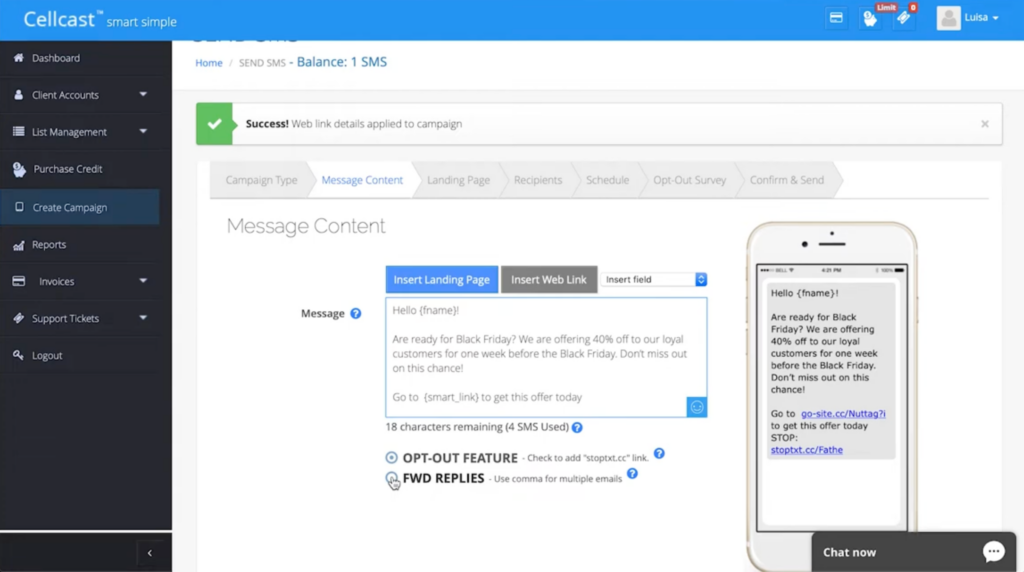
It’s a practical middle ground between the rock-bottom rates of Mobile Message and the platform depth of the larger providers, while keeping everything onshore.
Best for: Australian businesses wanting competitive volume pricing from a local provider.
Twilio Messaging API: Best for global developers
Twilio Messaging API is the reference point for developers building messaging into software. It charges around US$0.0515 to send an SMS to an Australian mobile, plus about US$8.25 a month for a mobile number, so it’s priced in USD and not the cheapest for Australia-only sending.
What you get is breadth: Programmable APIs across more than 150 locales, deep documentation, and enterprise scale. Twilio was named a Leader in the 2026 Gartner Magic Quadrant for Communications Platform as a Service. For a team building custom, multi-country messaging, it’s a natural shortlist entry.
Best for: Developers and enterprises building custom, multi-country messaging.
SMSGlobal: Best for Australian-owned bulk sending
SMSGlobal is Melbourne-based and Australian-owned and operated, with direct carrier routing and a long track record in bulk messaging. Pricing runs on monthly plans from $39 to $179, with per-message rates falling to roughly 1.6¢ at the top tier, plus a prepaid option.
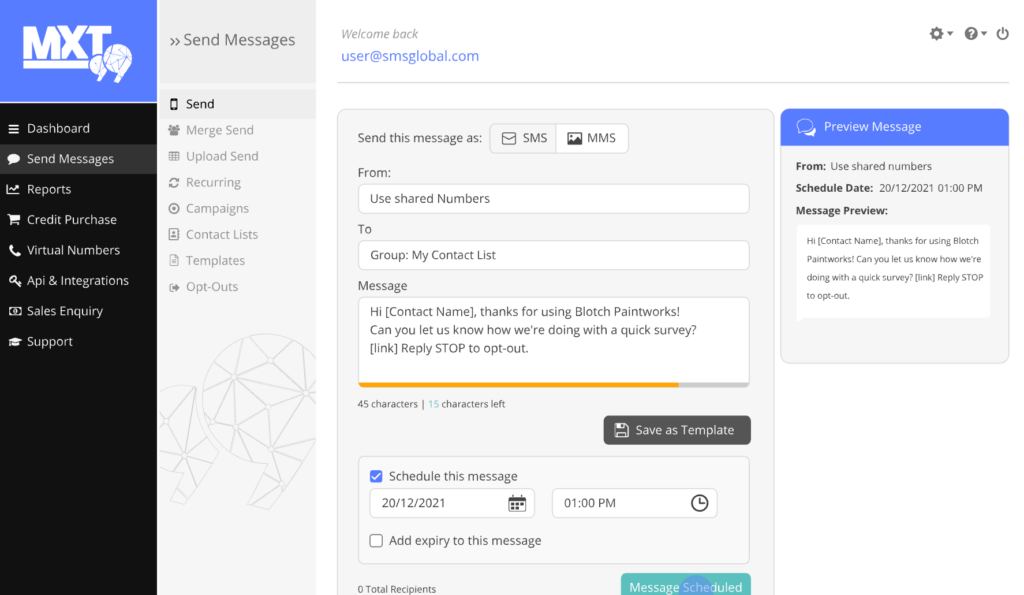
It offers SMPP, REST, and SOAP API access alongside its dashboard, which makes it flexible for both technical and non-technical teams. If keeping your provider onshore matters and you send in volume, it’s a strong pick.
Best for: Australian businesses sending high volumes that want a local, carrier-direct provider.
A few names you’ll see elsewhere sit just outside this list. Klaviyo folds SMS into e-commerce email, and Podium bundles messaging with reviews and payments. Both are worth a look if that broader job is what you’re solving.
SMS pricing in Australia compared
Here’s the pricing side by side. These are headline rates for sending to Australian mobiles, drawn from each provider’s own published pricing.
| Provider | Indicative rate (AUD unless noted) | Model |
|---|---|---|
| Mobile Message | 1.6¢ intro, ~2¢ at volume | Prepaid credits, no expiry |
| Cellcast | 2.9–3.7¢ | Pay-as-you-go, no expiry |
| SMS Broadcast | 3.7–7.0¢ | Prepaid credits, 12-month expiry |
| SMSGlobal | ~1.6–3.8¢ | Monthly plans $39–179 |
| Kudosity | 4.9–7.9¢ | Tiered plans |
| Notifyre | from ~5.5¢ | Pay-as-you-go |
| Sinch Engage | Custom above ~13,500/mo | Monthly plans $42–749 |
| ClickSend | Volume-tiered | Prepaid, scales with top-up |
| Twilio | ~US$0.0515 + US$8.25/mo number | Pay-as-you-go |
Pricing is accurate as of July 2026 and excludes GST unless stated. Rates change often, so check each provider’s pricing page before you commit. Treat this as a starting point for a shortlist, not a final quote – volume discounts and carrier fees move the real number.
Australian-owned versus global providers
The clearest divide in this list isn’t price. It’s whether a provider is Australian-owned or part of a global network, and each side has a genuine advantage.
The Australian-owned providers here are Mobile Message, SMSGlobal, Kudosity, Notifyre, and Cellcast. They tend to offer local support in your timezone, onshore data, and pricing tuned to the domestic market. If your sending is Australia-only and you value talking to someone local, that’s real value.
Global providers like Sinch and Twilio bring scale, multichannel messaging, and international reach. If you send across borders, need channels beyond SMS, or are building into software, that breadth is hard to match locally. Neither side is better in the abstract. The right choice depends on whether your problem is local and simple or broad and technical.
What choosing a provider has to do with compliance
Provider choice used to be about price and features. Since July 1, 2026, it’s also about compliance, and this is the part I’ve spent the most time on for Sinch’s Australian customers.
Australian business texting is governed by the Spam Act 2003, which requires consent, sender identification, and a working opt-out on every marketing message.
On top of that, the SMS Sender ID Register is now live. Branded texts sent from an unregistered sender ID show to recipients as “Unverified” and get grouped with suspected scams.
You register your sender ID through an approved telco or message provider, not with the ACMA directly. So your provider has to be on the ACMA approved list for you to register at all. Check that before anything else. A cheap provider that can’t register your branded name will cost you far more in lost trust than it saves per message.
This is general information, not legal advice. Check with your own compliance or legal advisers for your situation.
How to choose by use case
If you’d rather not weigh every factor yourself, start from what you’re sending.
- Bulk campaigns and reminders on a budget: Look first at Mobile Message, Cellcast, or SMS Broadcast. For a deeper walkthrough, see our use case piece on bulk SMS in Australia.
- SMS built into your own software: Compare Twilio Messaging API and Sinch Engage on API quality and reach. Our SMS API and gateway page for Australia covers the developer side.
- Marketing campaigns with a dashboard: Sinch Engage, Kudosity, or Mobile Message suit regular campaign sending. Start with SMS marketing in Australia.
- Security-sensitive or regulated sending: Kudosity’s certifications and Sinch Engage’s compliance tooling are the ones to shortlist.
Frequently asked questions
There isn’t a single best one. The best provider depends on your volume, budget, whether you need an API or a dashboard, and how much you value Australian-based support. Australian-owned providers tend to win on price, while global providers like Sinch Engage and Twilio Messaging API win on scale and multichannel reach.
Australian-owned providers offer the lowest headline rates. Mobile Message advertises 1.6¢ per SMS for a new customer’s first purchase, and Cellcast and SMS Broadcast are also competitive at volume. Always check current rates and whether GST and carrier fees apply.
Not for ongoing business sending. Some providers offer free trial credits – SMS Broadcast includes 25 to start – but sending at any real volume is paid. Genuinely free consumer SMS tools aren’t built for business use or compliance.
No. Most providers offer a web dashboard where you upload a list and send, with no code required. You only need an API if you’re sending SMS from your own software or automating messages based on events, such as order confirmations.
For most small Australian businesses, an Australian-owned provider with pay-as-you-go pricing and no monthly fee is the easiest start. Mobile Message, Cellcast, and ClickSend are all built for self-serve sending without a sales call.
Yes, using a branded sender ID. Since July 1, 2026, you must register that sender ID through an approved provider, or your messages show as “Unverified.” Confirm any provider you’re considering is on the ACMA approved list.
Yes, but reach varies. Global providers like Sinch and Twilio are built for multi-country sending across many carriers. Some Australian-owned providers support international sending too, though the domestic market is their focus.
Choosing your SMS provider in Australia
The honest answer is to shortlist two or three providers that fit your use case, then test them. Most offer trial credits, and there’s no substitute for sending a real message through a real dashboard or API.
If omnichannel messaging and compliance handled in one place is what you’re after, explore Sinch Engage or talk to our team.

Author: