Resources
SMS marketing in Australia: How to start and stay compliant
Most SMS marketing advice you’ll read was written for the United States. It splits your messages into promotional, transactional, and conversational. It quotes a 98% open rate ghost stat with no source. And it skips the most important thing that actually decides whether your campaign is legal in Australia.
I work on Sinch’s messaging products, and I’ve spent 15 years in marketing and SMS, including a US-focused stint running content at Sinch SimpleTexting. So I spend a lot of time in SMS marketing, and since I’ve been responsible for some communications for the the recent ACMA Sender ID Register change in 2026, I’ve been recently involved much more in Australia’s SMS scene.
This piece covers SMS marketing in Australia. It covers how SMS marketing works here, the Spam Act rules that govern it, the campaigns worth sending, and how to launch your first one.
For the SMS channel-level fundamentals that apply everywhere, the complete SMS marketing guide is the better starting point. This resource is about what changes when you market to an Australian number.
What is SMS marketing (in Australia)?
SMS marketing is the practice of sending promotional or informational text messages to people who have agreed to hear from you. Businesses use it for sale alerts, appointment reminders, order updates, and two-way support, delivered straight to a phone’s native messaging app.
That definition holds anywhere. What changes in Australia is how the law sorts your messages, and this is where the US framing falls down.
The Spam Act 2003 doesn’t recognise “promotional” or “transactional” or “informational” as categories. It sorts every message into one of two buckets: Commercial and factual. The distinction decides which rules apply to your business.
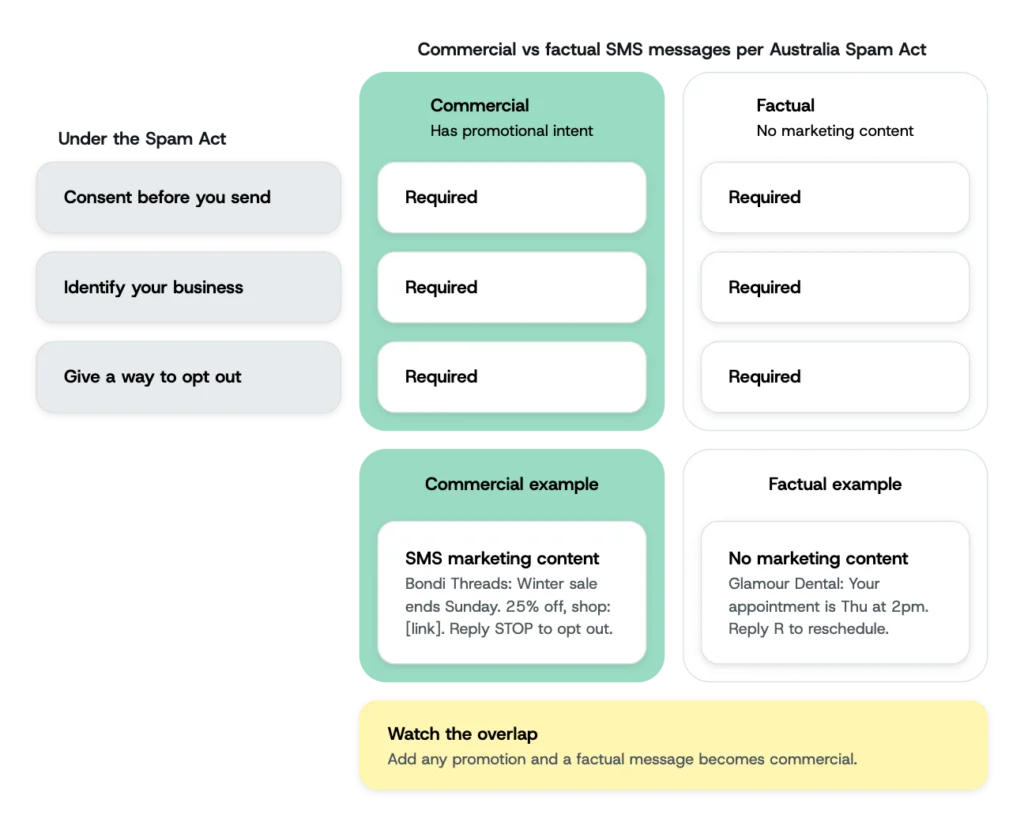
- Commercial messages carry any promotional or sales content. A sale, an offer, or even a single marketing link makes a message commercial. These need consent, sender identification, and a working opt-out. In a very pure definitional sense, commercial messages are what legally make up SMS marketing in Australia.
- Factual messages carry no marketing. A bill, a delivery update, an appointment reminder, or a one-time passcode is factual. These need neither consent nor an opt-out, though you must still identify yourself.
Here’s the trap that catches teams implementing business texting in Australia. A message can be mostly factual and still count as commercial if it slips in one promotion. An appointment reminder that adds “and 20% off your next visit” has just become a commercial message, with all the consent rules attached. The laws guide I wrote covers where that line sits in detail.
Get this framing right and the rest of SMS marketing in Australia gets simpler. Get it wrong and you inherit rules that don’t apply, or miss ones that do.
Why SMS marketing matters for Australian businesses
In short: People want to receive texts from businesses. It’s a win-win for you and your customers.
Australia had 34.4 million active mobile connections in early 2025, equal to about 128% of the population, according to DataReportal. There are more active mobiles in the country than there are people.
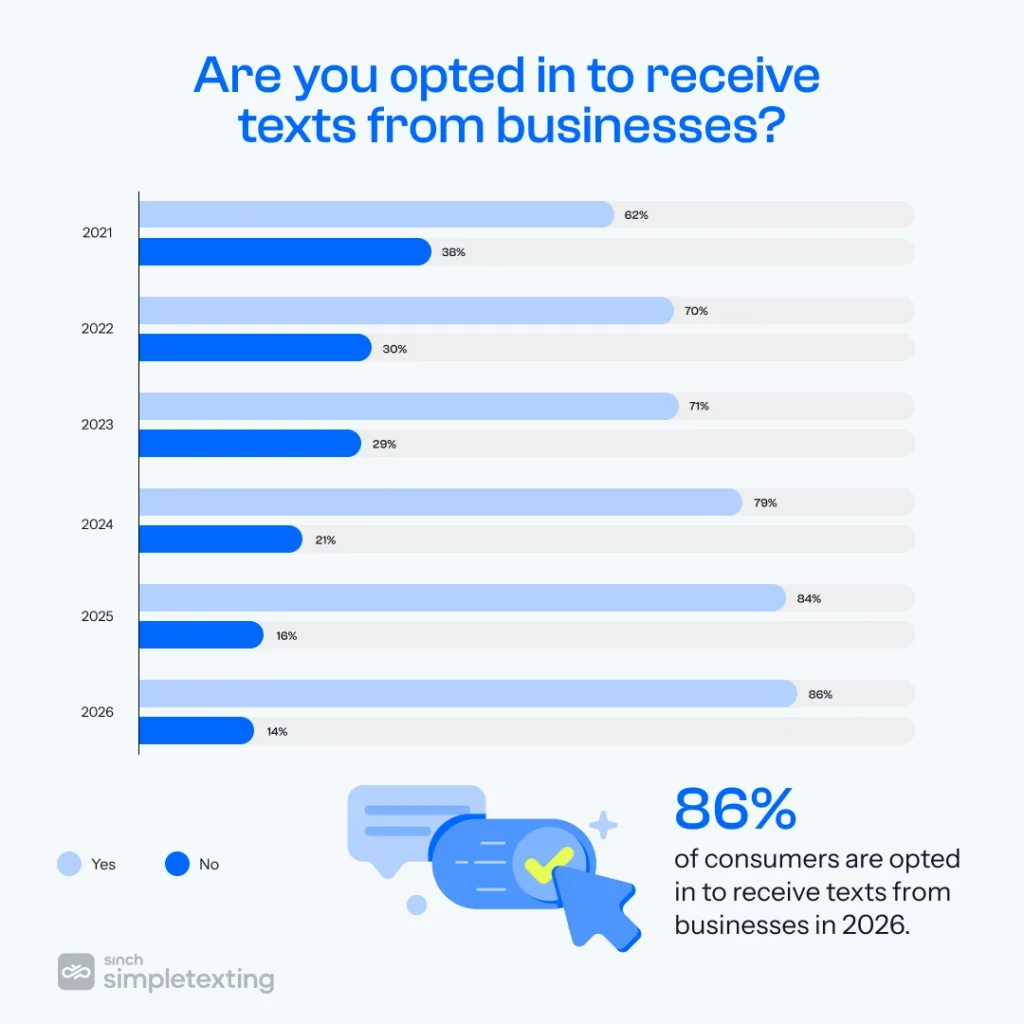
According to Sinch SimpleTexting’s 2026 survey of 1,000 consumers, 85.6% of consumers are now opted in to receive texts from businesses, up from 61.8% in 2021. Nearly three-quarters of them check a new notification within five minutes.
Those two figures are US data, and I’m flagging that on purpose. Most “SMS statistics” you’ll see quoted at you are US or global numbers presented as if they’re universal. The mobile-saturation picture is genuinely Australian. But that engagement appetite is a global trend that Australia shares, too.
Use cases: What Australian businesses use SMS marketing for
The best SMS programs mix message types rather than sending one long stream of discounts. Below are the campaigns worth starting with, each with a compliant example you could adapt.
Notice which examples carry an opt-out and which don’t. That’s the commercial-versus-factual line from earlier, applied in practice.
1. Promotional and flash-sale campaigns
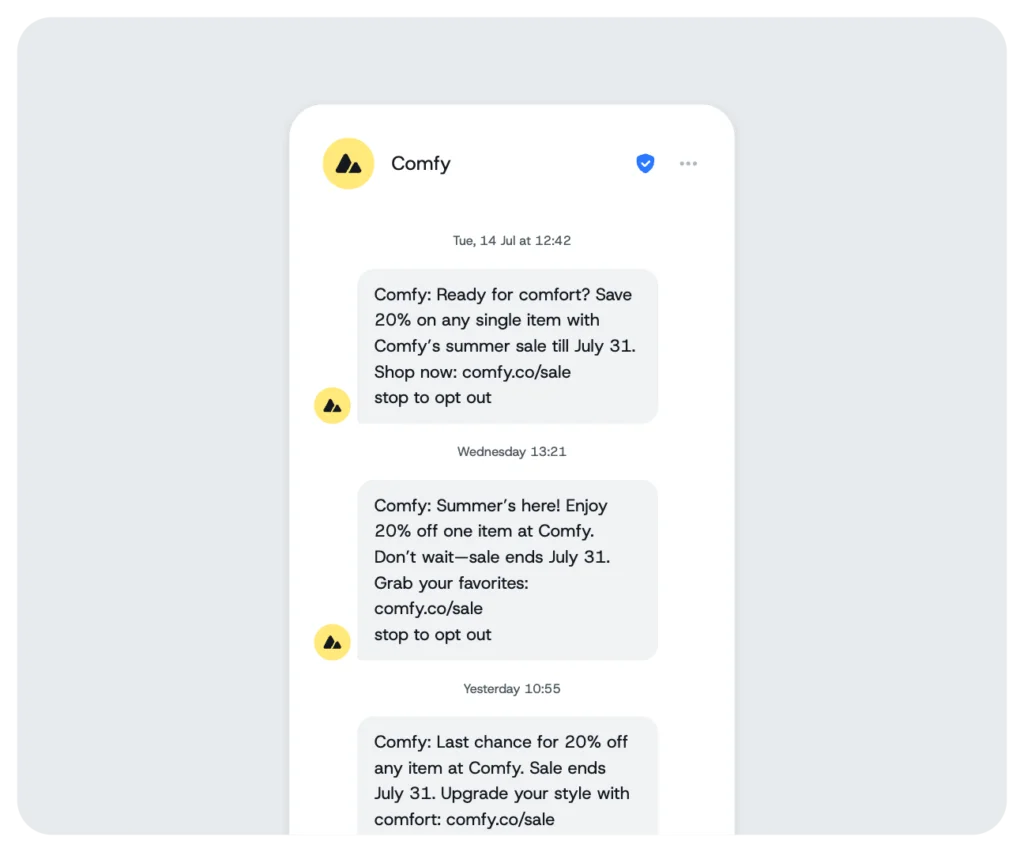
Time-limited offers create urgency and move stock. These are commercial, so they need consent and an opt-out.
2. Abandoned-cart reminders
A well-timed nudge recovers sales that would otherwise vanish. The marketing intent makes these commercial.
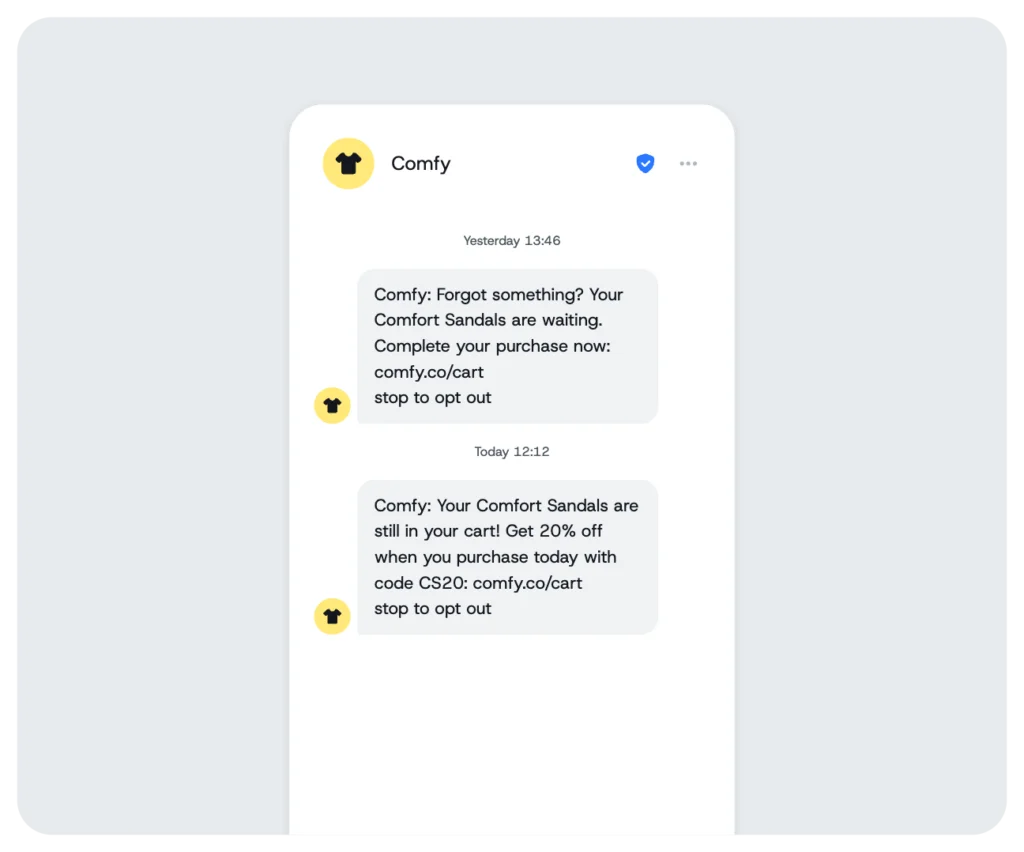
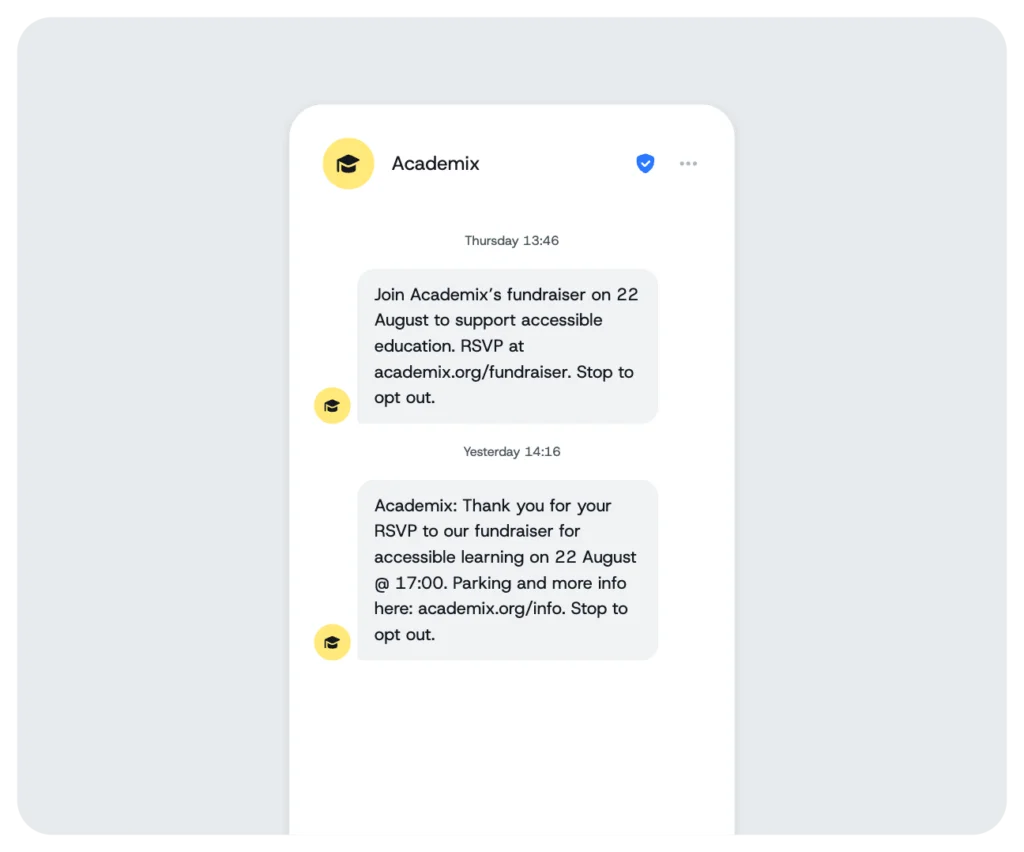
3. Event coordination and updates
SMS is the fastest way to reach a group about a time or venue change. A pure logistics update is factual, so it needs identification but no opt-out.
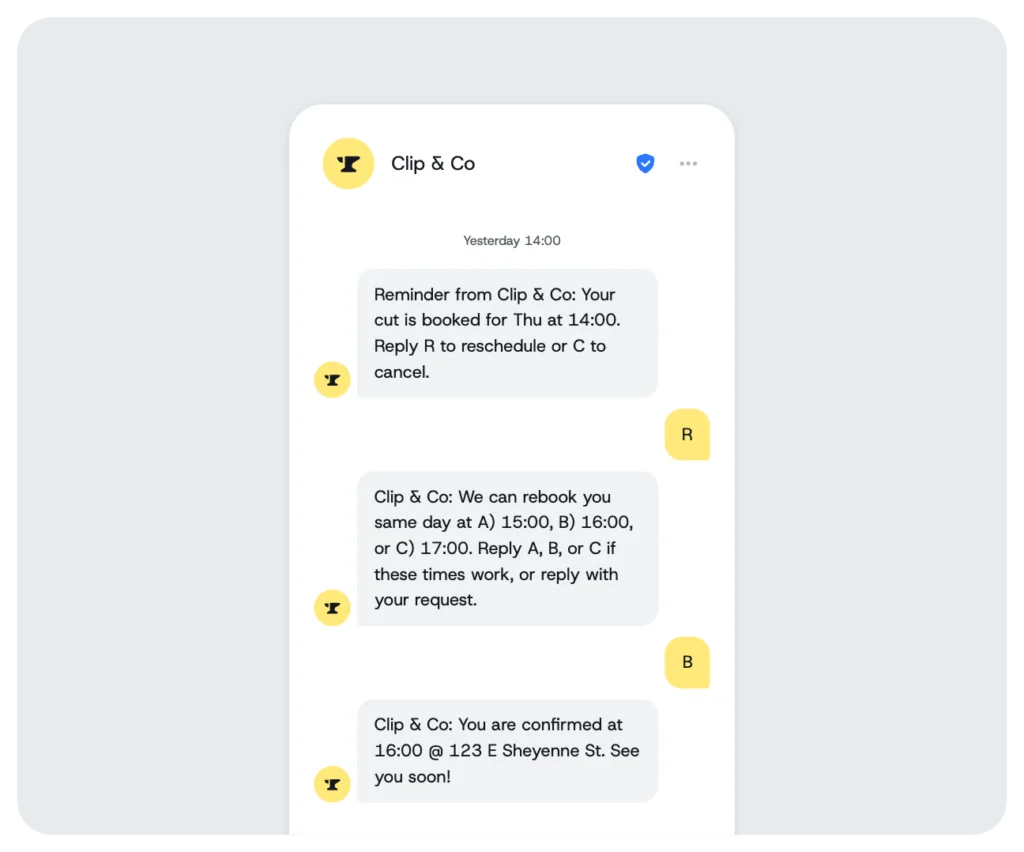
4. Appointment and booking reminders
These reduce no-shows and protect revenue. A plain reminder is factual, but add an offer and it becomes commercial.
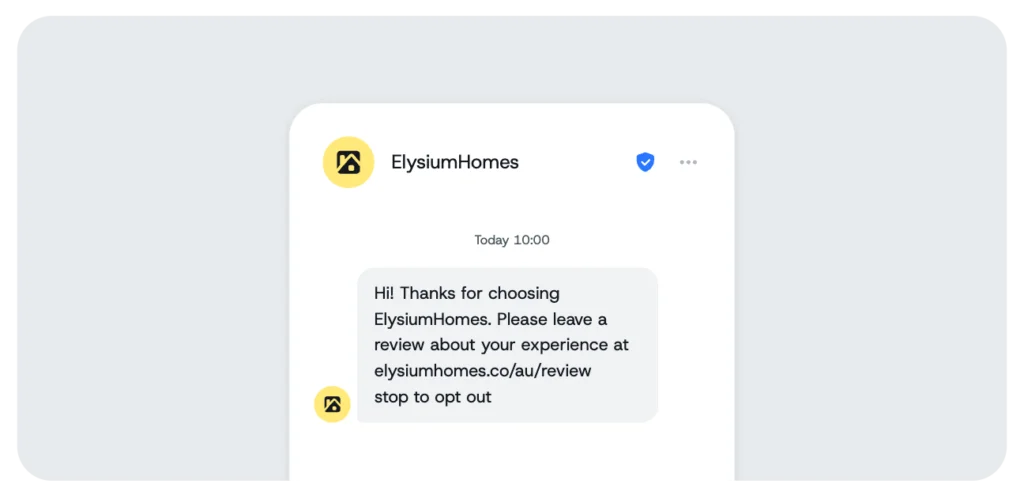
5. Feedback and review requests
Ask while the experience is fresh. A neutral request for feedback is factual; framing it around a reward tips it commercial.
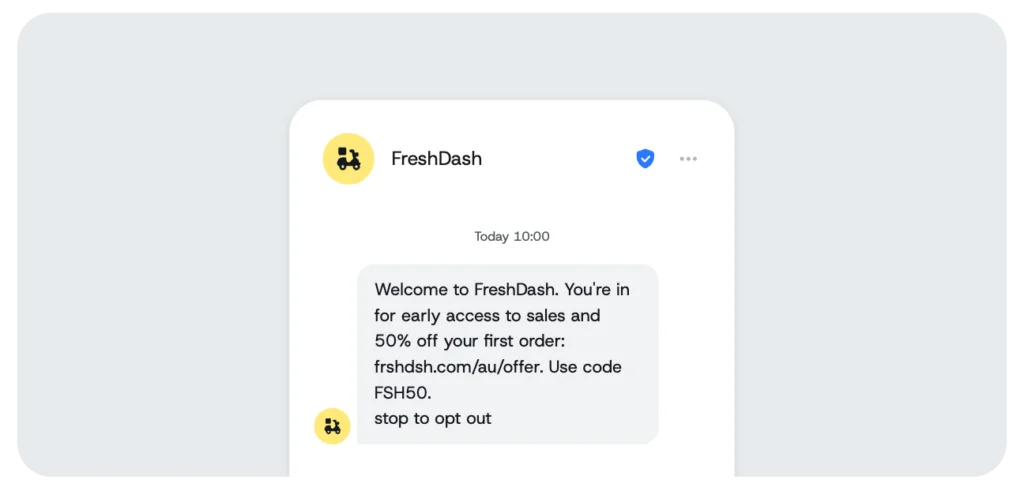
6. Welcome messages for new subscribers
The first text sets expectations and confirms the opt-in. If it includes a joining offer, treat it as commercial.
How to start SMS marketing in Australia
You don’t need much to send your first campaign. You need a plan, a compliant list, and a provider that can register your name. Here’s the order I’d work through.
1. Decide what you’ll send
Start from the campaigns above. Knowing whether you’re sending weekly promotions, booking reminders, or a mix shapes every choice that follows, from your provider to your sending volume.
2. Choose an SMS provider that suits that plan
Match the provider to your use case, not the other way around. A marketer sending weekly campaigns needs a good dashboard; a developer automating order updates needs a clean API.
Since July 1, 2026, the provider also has to be able to register your sender ID, which the next steps cover. Our comparison of SMS providers in Australia breaks down the services that best suit which job.
3. Get a number or sender ID
You send from either a dedicated number or a branded alphanumeric sender ID, the short name that appears at the top of a text. A branded name builds recognition, but in Australia it now has to be registered before you use it.
4. Set up your provider and integrations
Connect the platform to the tools your messages depend on, such as your CRM, booking system, or e-commerce store. This is what lets you trigger a cart reminder or a booking confirmation automatically rather than by hand.
5. Build a consent-based contact list
Collect express opt-ins through website forms, a keyword-to-join, in-store signage, or a line on your receipts. Keep a record of who agreed, when, and how, because under the Spam Act the burden of proof sits with you. Never buy a list.
6. Send your first compliant message
Keep it under 160 characters, lead with your business name, make the offer clear, and include a “Reply STOP” opt-out on anything commercial. Start with a small test send to check formatting and delivery.
7. Handle opt-outs and keep the list clean
Action every opt-out request within five working days and never charge for it. A clean, willing list beats a big, resentful one on every metric that matters (plus, a clean list is a compliant list).
Steps five through seven are where the Spam Act does most of its work, so it’s worth understanding the rules behind them.
SMS marketing rules in Australia: Spam Act and Sender ID Register
SMS marketing is legal in Australia when you follow the Spam Act 2003. The ACMA, which enforces it, boils the law down to three requirements on every commercial message.
- Consent. Get permission before you send. Express consent, where someone actively opts in, is the standard. You can’t text someone to ask for consent, because that text is itself marketing.
- Identification. Name your business in every message and keep your contact details accurate. A registered sender ID is the clearest way to meet this.
- Opt-out. Offer a free, working way to unsubscribe, honour it within five working days, and keep it functional.
There’s a second rule that’s new and specific to Australia. Since July 1, 2026, businesses sending branded texts must register their sender ID with the SMS Sender ID Register.
Register through your provider and your brand name shows on the message. Skip it and your texts display as “Unverified,” grouped with suspected scams. The Australian government’s guidance for businesses confirms the change and the date.
I’ve kept this deliberately short, because both topics have their own full guides. For consent, penalties, exemptions, and the US rules that don’t apply here, read SMS marketing laws in Australia. For the registration process itself, read how to register your SMS sender ID with ACMA.
This is general information, not legal advice. Check with your own compliance or legal advisers for your situation.
SMS marketing best practices for Australia
Compliance keeps you legal. These habits keep people subscribed. A few are specific to sending across a country that spans three main time zones.
1. Mind the time-zone spread
A 9am send in Sydney lands at 7am in Perth. During daylight saving, when the eastern states shift but Western Australia and Queensland don’t, that gap widens to three hours. Australian law sets no quiet hours, but a text at 6am reads as a nuisance wherever it lands. Send to local business hours, not head-office hours.
2. Keep frequency honest
The law caps nothing, so your opt-out rate is the only feedback you get. Two to four messages a month suits most local businesses. Over-send and people reply STOP, which costs you the contact for good.
3. Personalise beyond the first name
Segment SMS messages by what people actually did, such as past purchases, location, or booking history. A message about the class someone attends beats a generic blast to the whole list.
4. Pair SMS with email
Use email for detail and storytelling, and SMS for the time-sensitive nudge. Together they outperform either alone, and you can reuse the same segments across both.
Habits like these are the difference between a list people tolerate and one they stay on. The channel rewards restraint more than volume.
Choosing an SMS marketing provider in Australia
Your provider decides your price, your deliverability, and now whether you can register your brand name at all. The Australian market has more choice than it first appears, though several familiar names sit under the same parent companies.
The providers worth shortlisting for Australian text messaging include:
- Mobile Message, Australian-owned and among the lowest headline rates.
- Kudosity, formerly Burst SMS, strong on security and compliance certifications.
- Sinch Engage, formerly MessageMedia, built for enterprise and omnichannel sending.
- SMS Broadcast, a Sinch-owned option for simple, low-cost bulk.
- ClickSend, a Sinch-owned option for self-serve multichannel messaging.
- Cellcast and SMSGlobal, Australian-owned options for budget and bulk sending.
- Notifyre, useful where SMS and fax sit together.
- Twilio Messaging API, the reference point for global developers.
I’ve compared all of these on price, deliverability, and compliance support in the full guide to the best SMS providers in Australia, including where a provider that isn’t part of the Sinch family is the better fit.
Whichever you choose, confirm it’s on the ACMA approved list. A provider that can’t register your sender ID will cost you more in lost trust than it saves per message.
Frequently asked questions
Yes. SMS marketing is legal in Australia when you follow the Spam Act 2003. You need consent before sending a commercial message, you must identify your business, and you must offer a free, working way to opt out.
Yes, for commercial messages. Express consent, where someone actively opts in, is the standard. Factual messages such as appointment reminders or delivery updates don’t need consent, but adding any promotion makes a message commercial.
It depends on the provider and your volume. Australian-owned providers advertise rates from roughly 1.6¢ to 8¢ per message, usually as prepaid credits or monthly plans. Check current rates and whether GST and carrier fees apply.
If you send branded texts, using a business name rather than a phone number, then yes. Since July 1, 2026, unregistered sender IDs are shown to recipients as “Unverified.”
Your brand name is replaced with the word “Unverified,” and the messages are grouped with suspected scams. That damages trust and deliverability, so the fix is to register through your provider as soon as you can.
Australian law sorts messages into commercial and factual, not the US promotional, transactional, and conversational split. There are also no quiet hours or frequency caps in Australian law, and no state-by-state patchwork, since the Spam Act is federal.
Ready to start SMS marketing in Australia?
The channel isn’t complicated once the framing is right.
Decide what you’ll send, build a list that wants to hear from you, register your name, and keep your messages short and honest.
The rules are there to protect a channel people actually read, not to slow you down.
If you’d like the compliance handled inside the platform you send from, explore Sinch Engage or talk to our team.

Author: