Looking for Sinch Engage? You’re now on Sinch’s main site. Go back to Sinch Engage

VOICE PROVIDER CONSOLIDATION

Consolidate your voice providers onto one network

Most enterprise voice stacks weren’t planned. They grew one team, one acquisition, and one renewal at a time. Moving calling, SIP trunks, and phone numbers to a single provider cuts the overhead that comes with every extra vendor.

  • One contract covering your voice traffic

  • One escalation path when a call fails

  • One provider for programmable calls, SIP trunks, and phone numbers
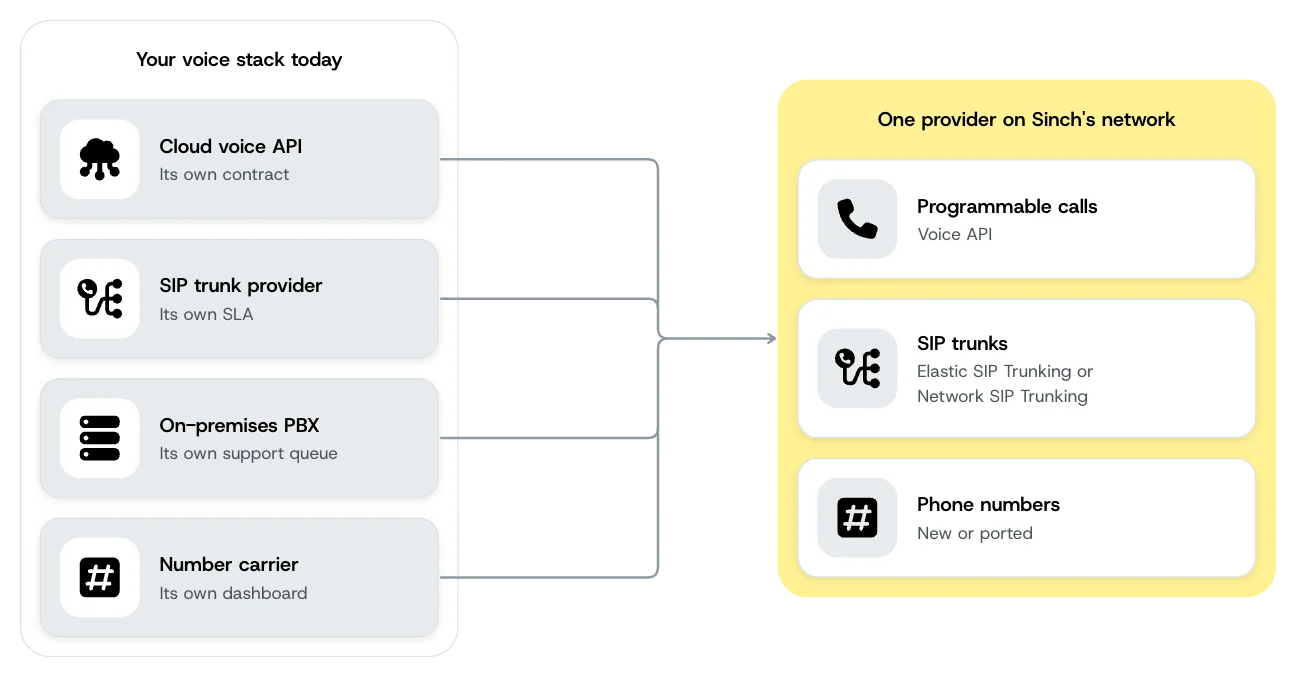
Image for Consolidate your voice providers onto one network
Join over 200,000 businesses, including 8 of the 10 largest tech companies in the world

Multi-provider voice costs

Where a multi-provider voice stack costs you

Each extra provider adds a contract, an SLA, a support queue, and a security review. Those costs rarely land on one invoice, so they’re easy to underestimate. Here’s where they tend to show up.

Split accountability

When a call drops, each provider can point at the other’s network. Your team spends the outage proving whose problem it is.

Uneven call quality

Routing differs by vendor, so call quality varies by site, team, or number range. Your customers hear the difference.

Integration upkeep

Every voice API you integrate needs its own updates, monitoring, and credentials. That engineering time doesn’t go to your product.

Compliance per vendor

Data processing terms, audits, and caller ID authentication get handled once per provider. The work grows with your vendor count.

Fragmented reporting

Call data sits in separate portals with separate formats. Building one view of voice performance becomes a project of its own.

Weaker negotiating position

Spreading minutes across providers means no single contract carries your full volume. That limits the pricing you can negotiate.

Consolidate voice providers

Common reasons to consolidate voice providers

Few teams consolidate voice for its own sake. It usually starts with an event that makes the current setup hard to defend. Whatever the reason, the path to one provider follows the same three steps.

Renewals are a natural point to change providers. Lining up contract end dates lets you move volume on your own schedule.

Every vendor carries a risk review, a renewal cycle, and ongoing monitoring. Procurement teams often look to voice first because the overlap is easy to see.

An outage that touches several providers shows how little shared fallback exists. Consolidating puts failover and escalation with one team.

When on-premises PBX hardware ages out, you have to decide where calling goes next. It’s a good moment to replace legacy voice infrastructure and move trunks and numbers together.

Combining companies means combining voice stacks, often with overlapping carriers and duplicate numbers. Rationalizing them is part of integrating IT.

Image for Common reasons to consolidate voice providers

Sinch voice products

One provider for calling, trunking, and numbers

Sinch’s voice portfolio covers the workloads enterprises most often split across vendors. Programmable calling, SIP trunking, and phone numbers all come from one provider, on Sinch’s network.

Voice API

Place, receive, and control calls from your own code, with text-to-speech, call routing, and keypad menus built in. One API replaces separate programmable voice providers.

Elastic SIP Trunking

Self-service SIP trunks with no pre-allocated channels to buy or size. Connect your PBX, contact center, or UC platform.

Network SIP Trunking

Managed SIP connectivity for multi-site enterprises moving off PRI and TDM lines. Sinch teams handle implementation, number porting, and initial configuration.

In-App Calling

Voice and video calls inside your mobile and web apps, including app-to-phone and phone-to-app. You won’t need a separate WebRTC vendor.

Number Masking

Connect two people by phone without revealing either person’s number. Marketplaces, delivery services, and ride-hailing apps use it to protect privacy.

Call Recording

Record whole calls or one side, with recordings delivered to your own cloud storage. Add transcripts for audits, coaching, and disputes.

Sinch’s US voice network

An owned US voice network with direct carrier connections

Consolidating only helps if the provider you keep can carry the full load. Sinch owns and operates its US voice network instead of reselling capacity. Fewer handoffs between carriers mean fewer places for a call to fail.

  • Largest independent voice network in the US

  • Direct connections to every Tier-1 US carrier

  • Direct delivery for 95% of North American calls

  • More than 300 billion US voice minutes a year

  • Phone numbers in 95 countries, with reach in 190+ countries

Image for An owned US voice network with direct carrier connections

Pricing and compliance

One commercial relationship and one compliance review

Consolidation pays off in procurement as much as in operations. With one provider, you run one security review, sign one set of data processing terms, and negotiate volume in one place.

Usage-based pricing

Voice API calls bill per minute, and phone numbers bill monthly. Enterprise customers can negotiate a volume agreement across calling, trunking, and numbers.

Uptime SLAs

Elastic SIP Trunking and Network SIP Trunking carry a 99.99% uptime SLA. A 24/7 network operations center monitors traffic around the clock.

Security and compliance

Sinch holds ISO/IEC 27001:2022 certification and is GDPR-compliant. Elastic SIP Trunking includes TLS/SRTP encryption, E911, and STIR/SHAKEN signing for US calls.

Voice consolidation FAQ

Questions about consolidating voice providers

These are the questions teams ask most before moving voice traffic to one provider.

For most enterprise workloads, yes. Sinch’s voice portfolio covers PSTN calling, SIP trunking, in-app calling, IVR, text-to-speech, call recording, and number masking. Your audit shows whether anything in your stack falls outside that list.

No. Consolidation changes the carrier layer, not the platform. Your UC platform or contact center keeps handling calls, agents, and workflows. Bring Your Own Carrier (BYOC) connects it to the phone network through Elastic SIP Trunking instead of the platform’s bundled calling.

With Network SIP Trunking, Sinch teams manage implementation, number porting, and initial configuration. Older TDM systems need a gateway to translate their signals for SIP. Moving one location first lets you confirm call flows before you schedule the rest.

Yes. You can port your existing numbers, or add new local and toll-free numbers as each site moves. Porting needs authorization from your current provider and an agreed migration timeline.

Voice API calls bill per minute for inbound and outbound traffic, phone numbers bill monthly, and advanced features such as recording bill by usage. With Elastic SIP Trunking, capacity follows your calling demand. For enterprise volume pricing, talk to sales.

You need a Sinch account, plus a SIP-compatible PBX or UC system for SIP trunking. Programmable voice needs developers familiar with REST APIs and a server to receive call events. With Elastic SIP Trunking, each US number also needs a registered E911 address.