Insights
What’s ahead for retail customer experience in 2026
The retail industry has always been shaped by changing consumer behavior, but those changes are happening faster than they used to.
Now, shoppers move easily between online and in-store experiences, expect updates in real time, and notice quickly when something feels disconnected or unclear. Whether they’re tracking a delivery or deciding whether a promotion is worth their attention, communication determines how the experience is perceived.
Late last year, we released Sinch Predictions 2026, a research-based look at how customer communications are expected to evolve in the year ahead. The themes were consistent across industries: more AI-driven conversations, higher expectations for trust and relevance, and growing pressure for brands to meet customers on their terms.
For retailers, these shifts feel especially immediate because communications touch every stage of the shopping journey.
So, what big shifts will shape retail customer communications in 2026?
1. AI agents will spark an explosion in retail conversation volume and opportunity
Retail messaging has long been built around updates and promotions like order confirmations, shipping notifications, and sale alerts. These notifications are essential, but they have rarely been designed to invite interaction.
That’s starting to change.
Shoppers increasingly expect to be able to ask questions and resolve issues in the moment. When a delivery is delayed or an item is out of stock, they want answers immediately, not a link to a help center or a long wait for support.
Sinch’s State of retail communications research found that around 28% of consumers say they get frustrated when they can’t ask a question in response to a transactional message. With AI agents, it becomes increasingly possible to turn these routine updates into real conversations.
For example, imagine a retailer’s delivery notification having options to reschedule or ask a question to an AI agent without leaving the message thread. A back-in-stock alert can become a conversation that confirms size availability or suggests similar items. Each interaction increases conversation volume, but it also creates opportunities to resolve issues faster and keep shoppers moving forward.
As AI agents become more capable of initiating conversations on their own, proactive outreach will also become more common. An AI agent can notice when a shopper repeatedly checks an order status and reach out with an update before frustration builds. Over time, these small moments add up, and retailers should expect conversation volume to grow as more messages are designed for genuine engagement rather than one-way updates.
2. AI agents will evolve from simple cost savers to true growth engines for retail brands
Retail automation has long been about efficiency, where chatbots and automated responses were designed to reduce support volume and close interactions quickly. That still matters, but it’s no longer the whole picture.
Retail is part of the wider pattern Sinch found across 2,527 enterprises: confidence is high (90%), but 75% of organizations in production have already experienced a governance rollback.
As AI agents become better at understanding context and intent, they’re starting to support growth across the customer journey – and shoppers are open to this. In fact, more than 70% of consumers say they’re willing to interact with an AI shopping assistant built for retail. This makes space for conversations that go beyond resolving issues one at a time.
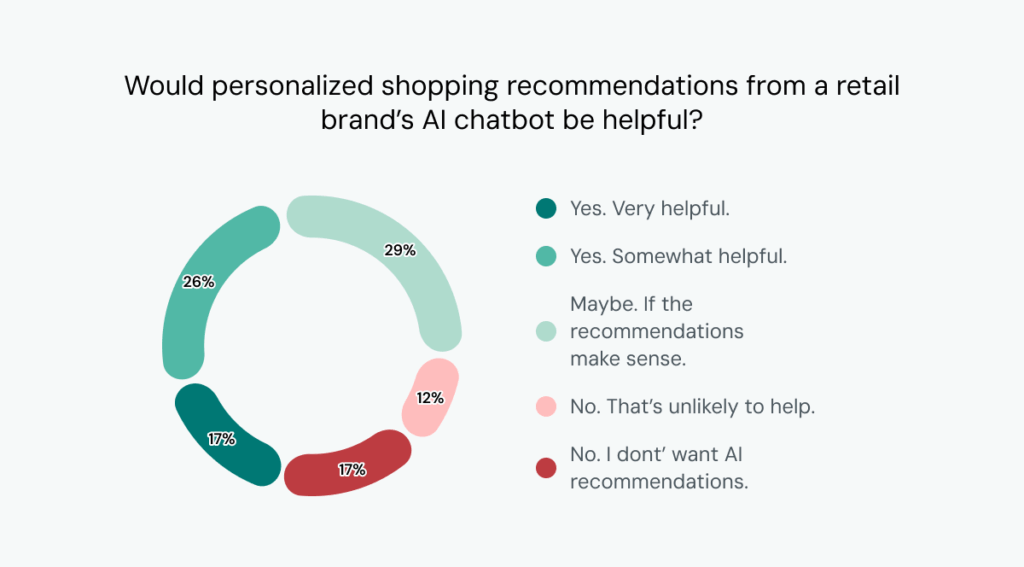
Consider a customer who completes a purchase and receives a confirmation message. An AI agent can follow up with delivery options, product care tips, or a relevant accessory recommendation while the interaction is still active. After a return, an AI agent can suggest alternatives that fit the shopper’s preferences, keeping the relationship moving forward.
We expect AI agents will also play a larger role in retention. When browsing behavior drops or loyalty activity slows, an AI can check in with support or a timely incentive. For shoppers, this feels helpful. For retailers, it turns service interactions into moments with long-term value.
3. Voice AI will become the preferred channel for complex conversations
When an issue feels urgent or complicated, many shoppers would rather talk than type. That might include situations like problems with a high-value order, delivery issues during peak shopping periods, or situations where they need clarity and reassurance.
Traditional automated voice systems have struggled to meet those expectations, and have trained customers to associate voice automation with frustration. Voice AI is changing that, which could be why around 65% of retail leaders said their businesses plan to adopt AI voice assistants in the next year.
Sinch’s Director of Programmable Voice, Sofia Schönbeck, says advances in speech-to-speech technology will soon allow voice AI agents to respond quickly and understand intent in real time. For shoppers, this could mean they could explain an issue in their own words and get relevant help without navigating rigid menus. For retailers, this means complex conversations can be handled more efficiently while still feeling human.

“[Latency in] human conversations happen below 500 milliseconds. AI is now getting below 800 milliseconds, which is getting very, very close to a natural conversation. You can describe your problem, and the AI will immediately realize your intent and connect you to the right place.”

Voice AI will be particularly valuable during high-volume periods such as holiday peaks, when contact centers are under pressure and customers need fast answers. Instead of becoming a bottleneck, voice can become a reliable way to resolve issues and maintain trust.
4. Conversational messaging will redefine retail customer expectations
Consumer expectations around messaging have changed. People are used to easy, back-and-forth conversations in their personal lives, and they increasingly expect the same from the brands they shop with.
In retail, one-way messages are quickly becoming a source of friction. Around 28% of consumers say they get frustrated when they can’t ask questions or get support from informational message. When an update arrives that they can’t reply to, it creates extra effort and often delays resolution. As a result, conversational messaging is starting to feel like a basic expectation rather than a differentiator.
This shift is most visible during peak retail moments like Black Friday and Cyber Monday, when customers are tracking orders, watching delivery timelines, and looking for quick answers. In 2025, this behavior directly shaped how retailers communicated. The use of RCS messaging had the strongest year-over-year gains across the Sinch platform, climbing 144% YoY as more brands used rich, verified messages to handle real-time updates and customer questions at scale.
“[Black Friday 2025] showed that rich AI-powered, conversational experiences are no longer optional, they are the new standard. RCS gained real traction as brands look for ways to stand out in crowded markets, while SMS email, and voice continued to provide the trust and reliability that peak-season commerce demands. The strong increases we saw were driven by earlier promotions, longer campaigns, and the growing expectation for real-time delivery updates, order tracking, and customer support.”

This year, SMS will continue to provide reliable reach for critical updates, but richer channels like RCS and WhatsApp will add the interactivity shoppers now expect. Retailers that continue to rely on broadcast-style messaging will find it harder to meet expectations as conversational experiences become the norm, especially during high-pressure moments when clarity and speed matter most.
5. Connected customer journeys will unlock brand loyalty and long-term value
Retail journeys often span multiple channels. A shopper might discover a product through email, ask a question via chat, and receive delivery updates by text. When those interactions don’t connect, the experience feels fragmented and frustrating.
Most retailers are working toward integration, but there’s still uneven maturity. Today, 59% of retailers say their customer communications are fully integrated with their tech stacks, while 31% say they’re only somewhat integrated. For consumers, that shows up as broken handoffs and repeated questions.
of retailers say customer communications are fully integrated with their tech stacks.
of retailers say customer communications are at least somewhat integrated.
In 2026, connected customer journeys will be essential for building loyalty. Customers will expect brands to remember context as they move between channels and touchpoints, and if they have to repeat themselves, they’ll be more likely to abandon the brand.
AI will help make this possible by summarizing interactions and passing context seamlessly between systems and agents. A service representative will see the full history before responding, and an AI agent will understand what has already happened in the journey.
For retailers, this connection across channels reduces friction and creates experiences that feel intentional rather than pieced together.
6. Regionalized communication strategies will define the true leaders in retail
Retail may be a global business, but customer communication is not. Channel usage, timing expectations, and local norms may vary widely from one region to the next.
This year, successful global retailers will need to move beyond one-size-fits-all messaging strategies. They’ll balance global consistency with local expertise, making sure messages feel relevant in each market while still aligning with brand standards.
The retail industry is already ahead of many others when it comes to adopting channels like WhatsApp, Messenger, and Instagram, with 56% of retailers saying they communicate with consumers on these platforms. That makes retail strategy even more important.
Success will depend on understanding which channels dominate in specific regions, how shoppers prefer to engage at different stages of the journey, and how local regulations shape communication. Retailers that invest in regional insight will be better positioned to deliver experiences that resonate rather than relying on assumptions that don’t translate across markets.
7. Verified and secure communications will define the future of trust for retail brands
Retail communications often involve a consumer’s personal and financial data, from payment confirmations to account updates and delivery notifications. At the same time, consumers are more cautious than ever due to the rise of scams and spoofed messages.
In 2026, trust will need to be visible from the moment a message arrives. Verified sender identities, recognizable branding, and clear indicators of legitimacy will become critical for engagement. Customers should be able to tell at a glance that a message is real and safe to interact with.
But many retailers still have room to improve here. In 2025, just 26% of retailers said they were currently using RCS in 2025, compared to 37.5% across all industries. This is a missed opportunity when channels like RCS support branded, verified sender profiles that help establish trust before a customer ever opens a message.
Security will also become less intrusive. Authentication and fraud prevention will increasingly happen in the background, reducing friction without compromising protection. Retailers that make trust obvious and effortless will stand out as communication volumes continue to grow.
8. Intelligent inboxes will reinvent email as a precision channel
Email remains a core part of retail communications, and nearly half of consumers say it’s the best channel to receive messages from retailers. At the same time, inboxes are becoming more selective. AI-powered filtering and summarization are already shaping which messages get attention and which are ignored.
This year, intelligent inboxes will reward relevance over volume. Generic promotions and loosely targeted campaigns will struggle to reach primary inboxes. Messages that clearly reflect customer intent will perform better. This is a shift many marketers are already feeling, as Vandita Arora, Group Product Manager at HubSpot, explained in our Sinch Predictions 2026 webinar.
“It’s no longer just enough to show up by giving your brand presence by scheduling campaigns. You have know both where the customer is at, and what success really means on this channel.”

If a shopper browses a category or abandons a cart, follow-up emails will need to acknowledge that behavior with specific, useful content. Email will also become more interactive, with customers replying, asking questions, and receiving responses from AI-powered assistants directly in the inbox.
For retailers, this shift reinforces the need to treat email as a precision channel, focused on value and timing rather than scale alone.
What these predictions mean for retail in 2026
Taken together, these predictions point to a clear reality for retail: Shoppers expect experiences that feel connected, responsive, and trustworthy, shaped by the digital interactions they have every day. This year, these kinds of communications will be the baseline.
The mistake retail leaders can make is thinking this requires a complete reset, but we’re here to tell you that it doesn’t.
The real work is prioritization. The biggest updates will come from fixing the moments where expectations and experiences are most misaligned. Turning updates into conversations, connecting journeys across channels, and making trust visible are practical starting points.
The retailers who focus on these moves in 2026 will be better prepared for what’s ahead because they chose to make communication clearer, more relevant, and more human. That is where preparation turns into advantage.
If you want to go deeper into the thinking behind these predictions, including insights from industry leaders, you can watch the full Sinch Predictions 2026 webinar on demand.
At Sinch, we believe the next phase of retail growth will be driven by communication that feels natural, trusted, and genuinely helpful. That’s the future we’re building toward, and it’s already within reach for retailers ready to take it seriously.
Curious to know how our team can help? Let’s chat!

Author: