AUTOMATIC MESSAGE FORMATTING

Stop worrying about SMS encoding and segmentation
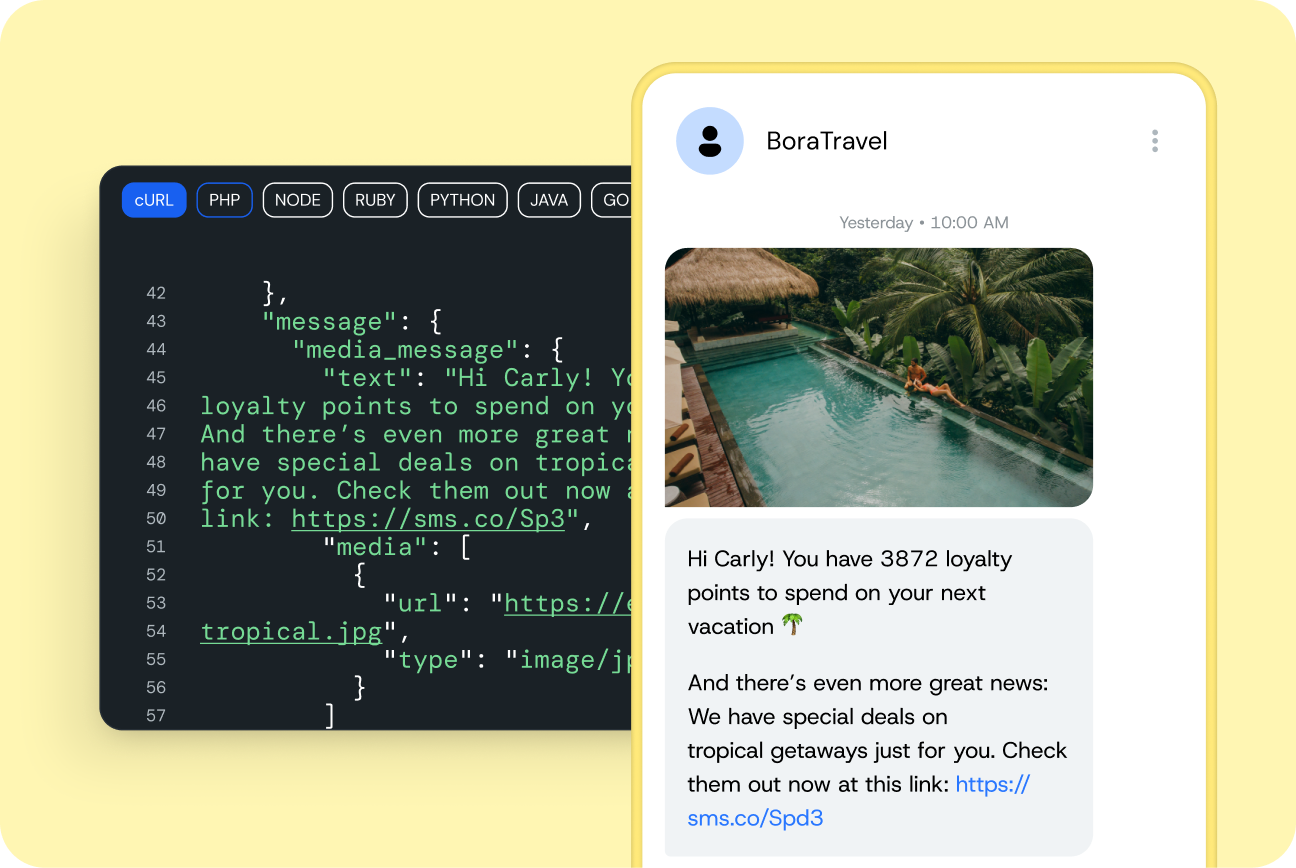
With Sinch, your messages show up as intended. Our API automatically manages character encoding and long message segmentation, so messages are delivered exactly as intended—no matter the language or length.

Image for Stop worrying about SMS encoding and segmentation
Join over 190,000 businesses, including 8 of the 10 largest tech companies in the world
WHY SINCH

Take the guesswork out of long, multilingual SMS

Stop worrying about character limits, encoding, or message order. The Sinch SMS API automatically handles message length and character sets, so your texts arrive readable and intact—without extra code or edge-case handling.

Write without limits

Send messages longer than 160 characters. We automatically splits them into multiple SMS parts and ensures they’re reassembled correctly on the recipient’s device.

Communicate globally

Send messages in any language and include emojis or special characters. Full Unicode support ensures text renders correctly across devices and networks worldwide.

Simplify development

You don’t need to manage encoding rules yourself. The API detects GSM-7 vs. Unicode, applies the correct limits, and handles segmentation automatically—so you can focus on building your application.

Long messages arrive complete and in order every time

Messages that exceed the standard SMS character limit are automatically sent as multiple parts. The Sinch SMS API handles this for you, ensuring each part is delivered and reassembled correctly on the recipient’s device.

  • Long messages are split into correctly encoded SMS parts without any manual configuration

  • User Data Headers are added automatically so message parts are reassembled in the right order on supported devices

  • Send long texts as a single message string—we take care of segmentation and delivery details

Image for Long messages arrive complete and in order every time

GLOBAL REACH

Send in any language with Unicode and emoji support

Send messages using non-Latin alphabets, accented characters, or emojis. The Sinch SMS API automatically switches to Unicode encoding when needed and handles message segmentation so text arrives readable across global networks.

  • Automatically uses Unicode encoding for languages and symbols outside the GSM-7 character set

  • Emojis and accented characters are preserved using standard Unicode encoding

  • Supports the full Unicode standard, enabling messaging across languages and regions without manual handling

  • Use standard \n characters to format messages for readability

Image for Send in any language with Unicode and emoji support

POPULAR USE CASES

Where Message Formatting shines

International communications

Send important messages in Arabic, Cyrillic, Chinese, or any script. Full Unicode support keeps every character intact and readable right when it hits the inbox.

Engaging marketing

Boost engagement by adding emojis to offers and promotions. The API treats them as Unicode, so your brand personality shows up consistently everywhere.

Detailed instructions

Deliver multi-step verification or service updates that run past 160 characters with automatic message splitting so customers see one clear, complete SMS.

Personalization

Personalize alerts with names that include accents or special symbols. Intelligent encoding chooses GSM-7 or Unicode for predictable costs and perfect display.

Message Formatting FAQs

It’s an API capability that handles encoding, segmentation, and reassembly so long texts, special characters, and emojis arrive exactly as sent—without custom code.

Using even one special character, such as an emoji, switches the encoding to Unicode, which has a 70-character limit per SMS part and may double your parts.

When a message goes past the standard limit, the API splits it into parts and adds User Data Headers (UDH) so the device reassembles them into one message.

Here’s the Message Formatting workflow:

1. API Call: You send a message string to the API exactly how you want it to appear.

2. Analyze & Segment: The API inspects length and character type. If it’s long or contains Unicode, it splits into correctly encoded segments with headers for reassembly.

3. Deliver & Reassemble: Segments travel over carrier networks, and the handset uses invisible UDH headers to reconstruct the single, perfectly formatted message.

Yes. The API automatically includes User Data Headers (UDH) that tell the device how to reassemble the parts correctly.

You can use the standard \n character in the message string of your API call, and it will render as a new line when it’s delivered.

Use the API’s intelligent encoding detection. It selects GSM-7 or Unicode based on your content and manages conversions to keep every character intact.

Yes. Transparent API feedback shows how a message will be segmented so teams can manage costs predictably.

The feature supports GSM-7 and Unicode standards and uses API functionality for multipart message concatenation.

This feature is a built-in part of the Sinch SMS API, so no add-on is required. You just need a Sinch account and an active integration with the Send SMS API to get started.

SMS is a text-only channel, so bold, italics, and other rich media are not supported. For rich content, consider MMS.