Insights
8 signs your current voice infrastructure needs an update

From sleek Voice AI and overworked call center teams to frustrated customers: If you’re managing a voice system in an enterprise, you’re probably facing a lot of external and internal pressure to modernize.
At the same time, you’ve probably worked around your legacy system for years. But when does “making it work” stop working?
We’ve rounded up eight tell-tale signs it’s time to modernize. If any of these sound familiar, don’t wait too long to take action.
Identifying the shortcomings of your voice infrastructure
While each situation is different and unique, there are some common problems enterprises face with their voice channel – and they’re clear indicators that you’re overdue for an upgrade.
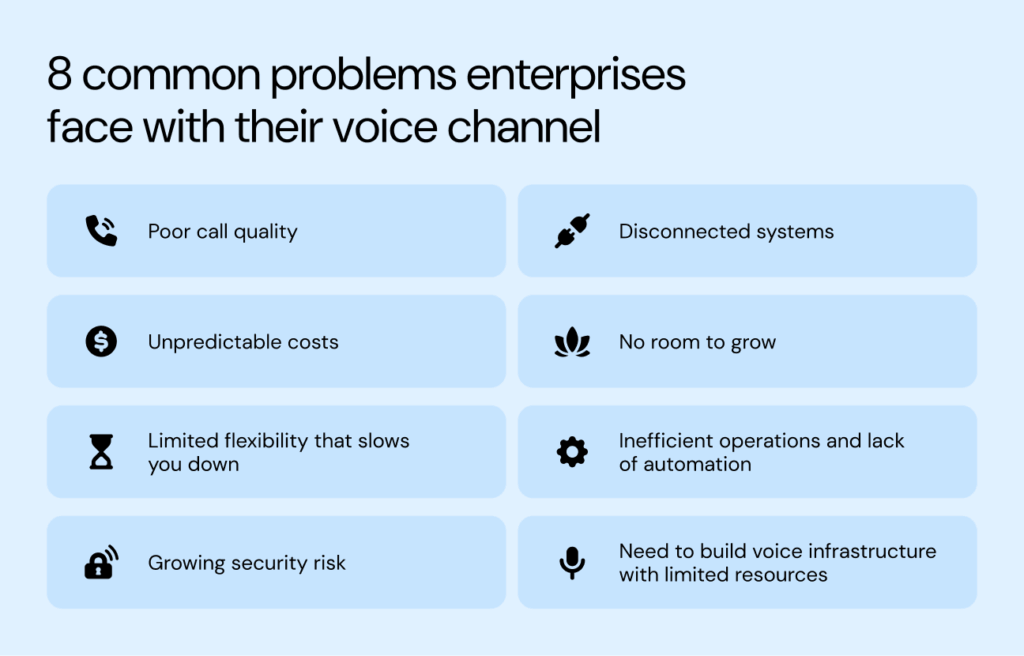
1. Poor call quality
Choppy audio. Static. Dropped calls. When voice quality is unreliable, every conversation becomes a risk. It damages trust, slows down sales and support, and signals to customers that you’re not equipped to serve them well. If your system lacks modern Quality of Service (QoS) capabilities, chances are it can’t keep up with demand, especially during peak hours.
2. Disconnected systems
Modern businesses run on integrated systems. Your CRM, support platform, and communication tools should work as one. But too often, voice is the outlier – disconnected from your tech stack and reliant on manual workarounds. This not only slows down workflows but creates friction across the customer journey.
3. Unpredictable costs
A reactive approach to IT often leads to unpredictable spending. You may find yourself burdened by expensive emergency fixes, surprise hardware upgrades, and costly licensing fees just to keep an aging system running.
4. No room to grow
Scaling should be simple, but for many enterprises, adding users or locations means delays, new hardware, and added complexity. Remote work, global teams, and seasonal surges all demand a voice solution that flexes as fast as your business does.
5. Limited flexibility that slows you down
Legacy voice infrastructure often comes with fixed capacity limits and long lead times for changes. Scaling up for seasonal demand? You may face delays, outages, or degraded performance. Scaling down? You’re still paying for unused capacity. When your systems can’t adapt in real time to the needs of your business, you’re stuck choosing between overspending or underdelivering – and both come at a cost.
6. Inefficient operations and lack of automation
If your infrastructure lacks automation, or the automation in place is too rigid or outdated, your teams end up doing more manual work than necessary. That means more time spent on maintenance, more room for error, and more frustration for everyone involved. Over time, these inefficiencies erode both internal productivity and customer satisfaction.
7. Growing security risk
Older voice systems often miss critical security updates, leaving them vulnerable to cyberattacks, compliance failures, and data breaches. Without encrypted traffic, active monitoring, and built-in compliance, your voice infrastructure becomes a security risk for your entire enterprise.
8. Need to build voice infrastructure with limited resources
Not every business has legacy voice issues. Some are still in the early stages of building a product or service and haven’t implemented voice yet. For example, if your team is developing a mobile app, website, or SaaS platform and now needs to add calling capabilities, standing up voice infrastructure can feel overwhelming. The challenge is finding a way to move fast without investing in telecom hardware or hiring telephony experts to build a modern voice infrastructure that integrates with your applications.
So, your voice systems need a facelift – what now?
If you recognize any or even more of these situations, you should seriously start thinking about modernizing your voice architecture.
If any of these signs hit close to home, it’s time to rethink your voice setup. But that’s just the start. The next step is to figure out how to modernize because that can mean many things.
Maybe it’s a hybrid model that bridges your legacy systems and the cloud. Maybe it’s enhancing VoIP capabilities through APIs. Or maybe it’s a full shift to a cloud-native platform. There’s no one-size-fits-all solution. The key is knowing where to start and what to look for.
To help you along the way, we’ve created a technical guide to modernizing enterprise voice infrastructure – a roadmap that’ll help guide you through the process, from evaluating your status quo to evaluating providers.

Author: