Insights
Telegram bots for businesses: Advantages, use cases, and real-life examples
With over one billion monthly active users, Telegram is the fourth most popular messaging app in the world. No wonder, businesses across the globe have taken to using the messenger platform to send messages for marketing and customer service on the Telegram app. With increased demand around a dedicated business solution, Telegram has rolled out key features for business like quick replies, away messages, click-to-chat links, automated messages – and chatbots.
For companies that are looking at scaling their customer communications on the messaging app, Telegram bots for businesses are a great way to manage large message volumes, simplify workflows, streamline operations, optimize response times, and increase efficiency.
But how do Telegram business chatbots work exactly? Is it worth launching one? Can you combine it with other messaging channels? And what are good use cases? Let’s explore!
What’s a Telegram bot?
A Telegram chatbot is an application that runs on the Telegram messaging platform. It offers functionalities to interact with users and automate specific tasks, or provide information automatically when prompted.
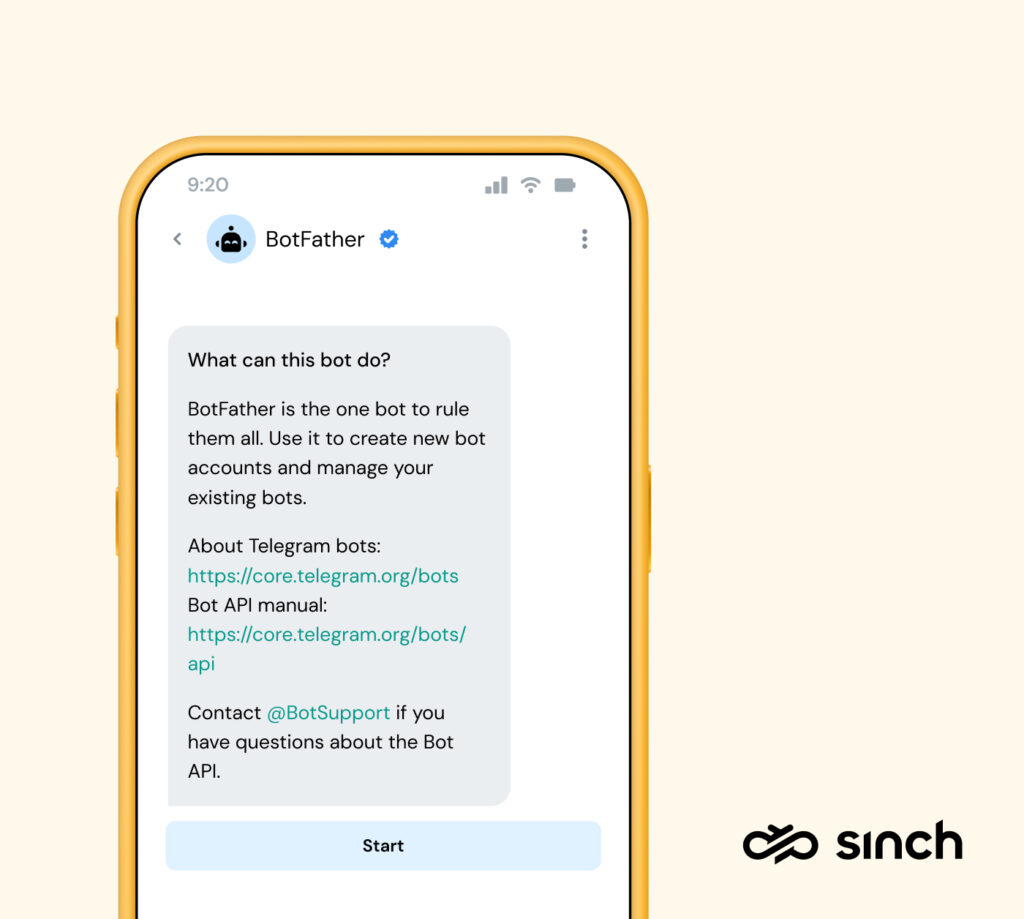
Users can interact with these bots by sending commands or messages, and the bots respond accordingly. You can either use Telegram’s own chatbot builder, the BotFather, Telegram’s API, or an API from a reliable third-party provider to create new bots.
Private users as well as users with a Telegram business account can build chatbots on the app.
Why should you use a Telegram chatbot as a business?
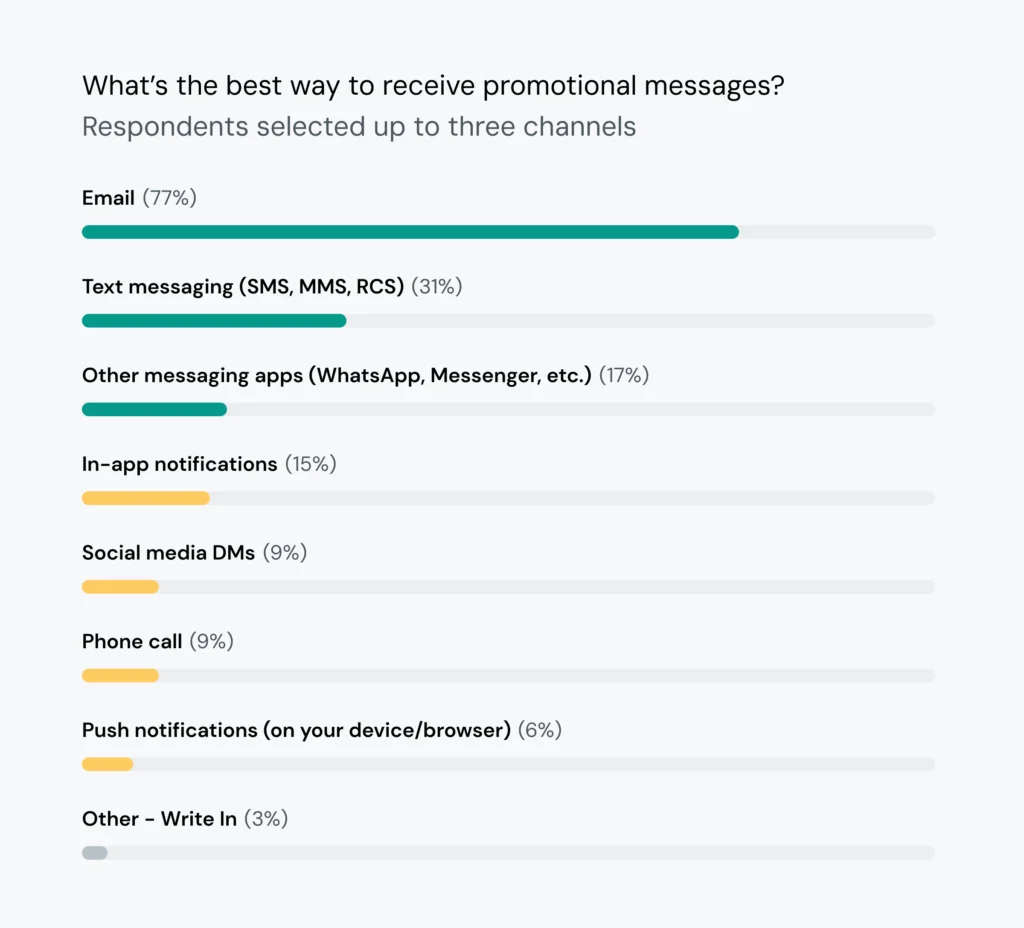
Conversational messaging channels have become very popular with consumers. As our 2025 Sinch survey The state of customer communications shows, 48% of consumers want to receive promotional content on a messaging channel. And 17% explicitly prefer messaging apps like Telegram.
Of course, channel preferences vary by region or demographic, but if your target audience is active on Telegram, it’s definitely worth considering it as a customer communication channel aligned with your business needs.
And Telegram bots are a great opportunity to scale your messaging and improve efficiency. Here are some advantages of using a Telegram business chatbot:
- Ease of integration: Telegram’s open API platform allows for very easy chatbot integration.
- Popularity with users: The Telegram community is not only very loyal to the messaging platform, users are also very familiar with Telegram bots and enjoy interacting with them – which is a great starting point for introducing a bot for your business on the app.
- Scalability: As with any chatbot, Telegram bots help your business scale messaging. From automated replies to sending large-scale marketing campaigns – chatbots on Telegram offer many ways to grow your messaging without too much effort.
- Efficiency: Chatbots on Telegram will save you resources and free up your team to complete other tasks.
- Many use cases: Telegram bots are very versatile and cover various business use cases – which is exactly what we’ll explore next.
10 use cases for Telegram business chatbots + real-life examples
From simple menu bots to AI-powered bots: There are many useful ways for your business to benefit from Telegram bots. Here are a few examples.
1. Automate welcome messages
Use Telegram bots to welcome new customers. Even a simple note that states relevant business and contact information can already be a helpful start into a conversation. Or, you can even go beyond that and have the bot drop a special discount code for the first purchase.
With bots, customers can easily start engaging with your business – even when you’re not there or if they send a message outside your, business hours.
Many businesses use Telegram to send out regular newsletters. Unlike on WhatsApp, businesses don’t get charged for these marketing messages on Telegram, making it a cost-efficient channel for scaling one-to-many campaigns.
Real-life example: The Washington Post readers can sign up for Telegram newsletters to get live coverage on Russia’s war in Ukraine. This doesn’t only keep readers up to date as soon as news drop, it also shows that the Post understands its audience because Telegram is very popular in Eastern Europe and Russia.
Before you hit “send”: Always ask customers to actively opt in to receive marketing messages from your business. That’s not only a common data protection requirement, you also make sure that users really want to hear from you.
3. Recommend products
Just like with RCS or WhatsApp, one-on-one conversations on Telegram stay in the same chat, so it’s easy for a Telegram bot to access the entire exchange. Plus, with an integrated CRM tool, a bot can use customer information, purchase and chat history to automatically send out personalized product recommendations.
You can also set up the Telegram bot to ask subscribers to answer questions of what content they prefer before signing up for a newsletter. That’ll also let you automatically segment your audience and send more targeted content.
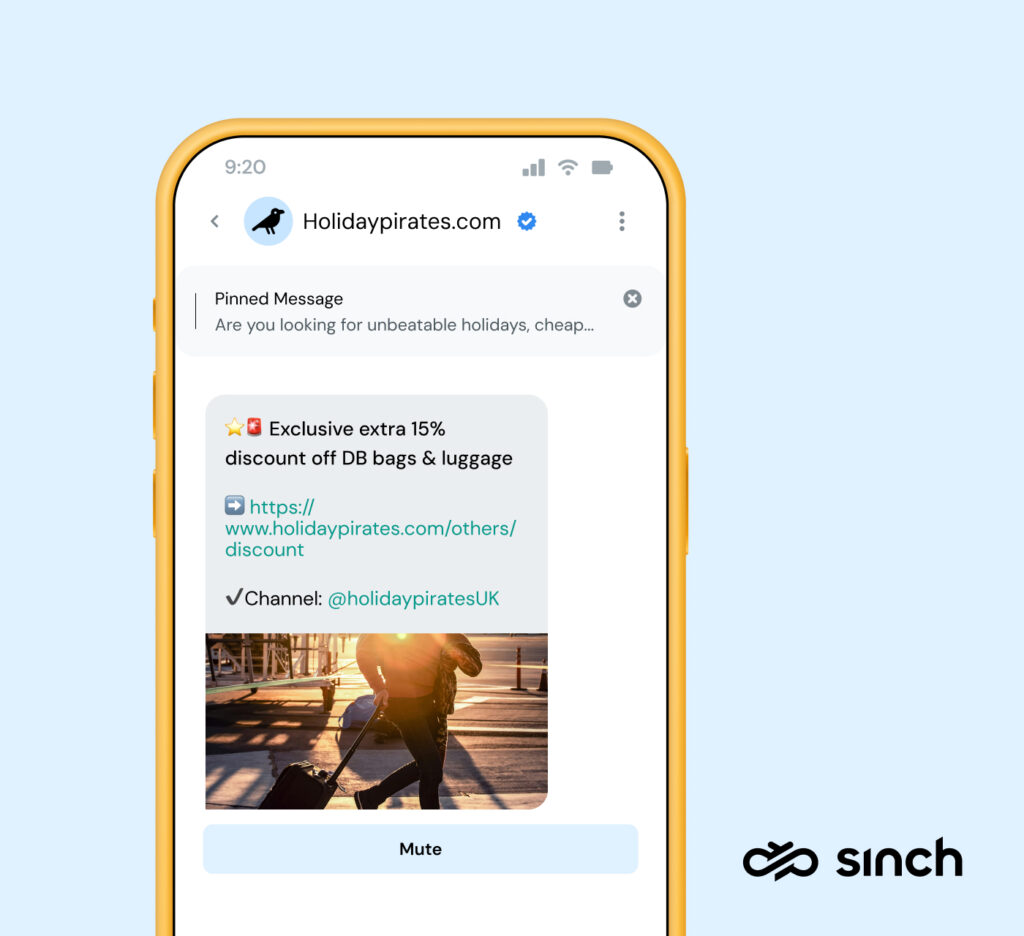
Real-life example: The e-commerce travel platform Holidaypirates sends out a regular Telegram newsletter. As users sign up for it, they can select what type of travel recommendations they’re interested in to receive more targeted information.
4. Send discount codes and special offers
You can set up Telegram chatbots to automatically send out discount codes to users, for example after a customer makes a purchase, spends a certain amount on your site, or to first-time buyers. This requires an integration of e-commerce and CRM tools with Telegram, but with the right API as the foundation, this can be a very promising scenario for businesses.
Alternatively, you can set up a special Telegram newsletter where subscribers get automated alerts as soon as a new deal drops.
Real-life example: That’s exactly what the German e-commerce platform SportSpar does. Their customers want to know about the latest sportswear discounts right away, so they sign up to receive real-time price drop alerts on Telegram. For SportSpar, this is a very cost-efficient way to reach their customers with new offers – and they’ve seen impressive customer interaction metrics like a 20% click-through rate for promotions and a subscriber retention rate of 99%.
5. Gather customer information or feedback
Telegram bots are also a great business tool to gather valuable customer information. This could either be a lead generation bot like the Holidaypirates use, or a bot that automatically reaches out to customers to gather feedback after a purchase.
You could even set the bot up to gather reviews – and include a link to a review portal to make it easy for users to leave their ratings.
Or, use it for customer service to gather information before your support team takes over.
6. Schedule appointments and send reminders
Are you in a business where it’s important for customers to schedule or show up for appointments? If your audience is active on Telegram, you can automate the scheduling process and reduce no-shows by using a Telegram bot.
7. Guide users through complex processes
Telegram also supports AI chatbots, which means that you could use Telegram bots even for more complex business use cases like a shopping AI assistant or for guiding customers step-by-step through a sign-up process.
8. Track orders
Our extensive consumer survey revealed that 38% of customers also want to receive transactional messages like order tracking or shipment notifications on messaging channels because they don’t like to miss out on any relevant updates.
That’s a perfect use case for automation – and Telegram bots can easily jump in and automatically send out these notifications.
9. Answer FAQs
Letting bots on Telegram answer frequently asked questions about your products or services will save your team a lot of time and free them up to cover more complex customer support cases.
Depending on your business or the types of questions you usually get, you could either use a pre-programmed menu bot or a conversational AI chatbot.
With the right AI tool, like Sinch Chatlayer, you can even set up your FAQ or Knowledge Base bot on Telegram in over 100 languages and easily reach an international audience.
10. Conduct surveys
Feedback is invaluable for better understanding your customers and improving satisfaction and retention. With Telegram bots, you can automate that process and get even more insights.
You can either use Telegram polls or have the bot guide users to an external link to fill out the survey.
As you can see, Telegram chatbots are very versatile and support several business use cases.
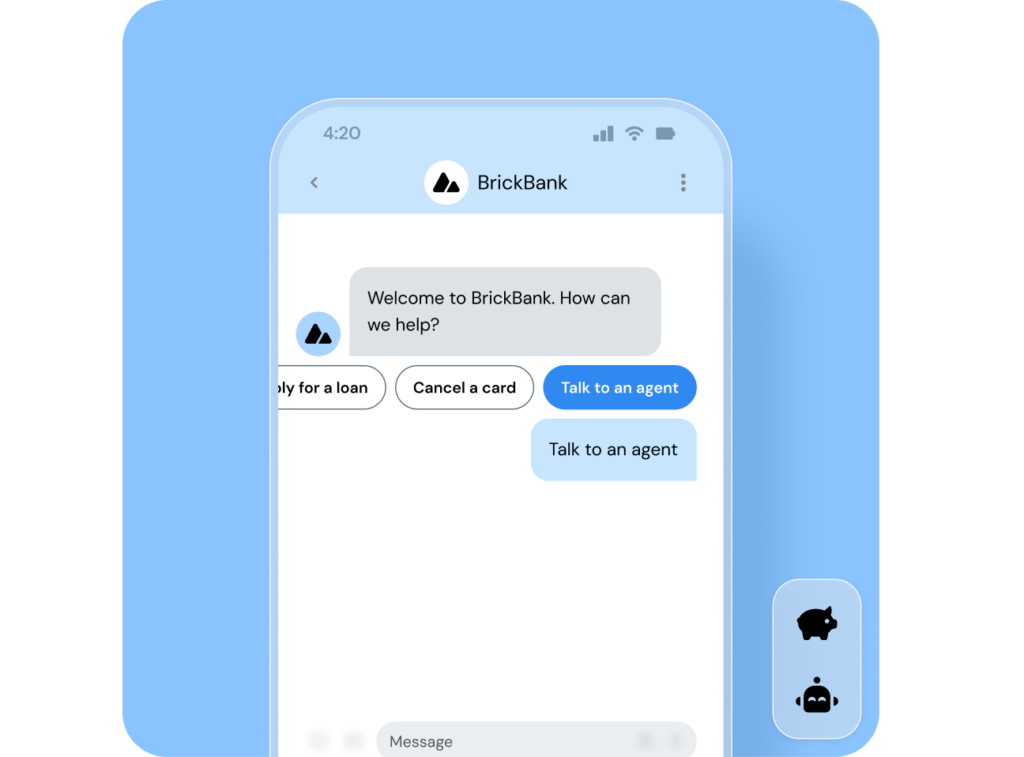
For business chatbots on Telegram, we recommend including an option where users can request to talk to a human agent if they have follow-up questions or need additional assistance.
What’s the best way to launch a Telegram business chatbot?
There is no one “right” way to launch a Telegram bot for your business. It all depends on your business and use case.
For instance, if you’re a one-person business and just want to automate welcome messages, you can probably set up your own bot with the BotFather.
But if you want to:
- Handle high message volumes
- Add AI capabilities
- Integrate CRM, support, or ecommerce tools
- Combine Telegram with WhatsApp, RCS, or SMS
… then a dedicated Telegram bot API is the better option.
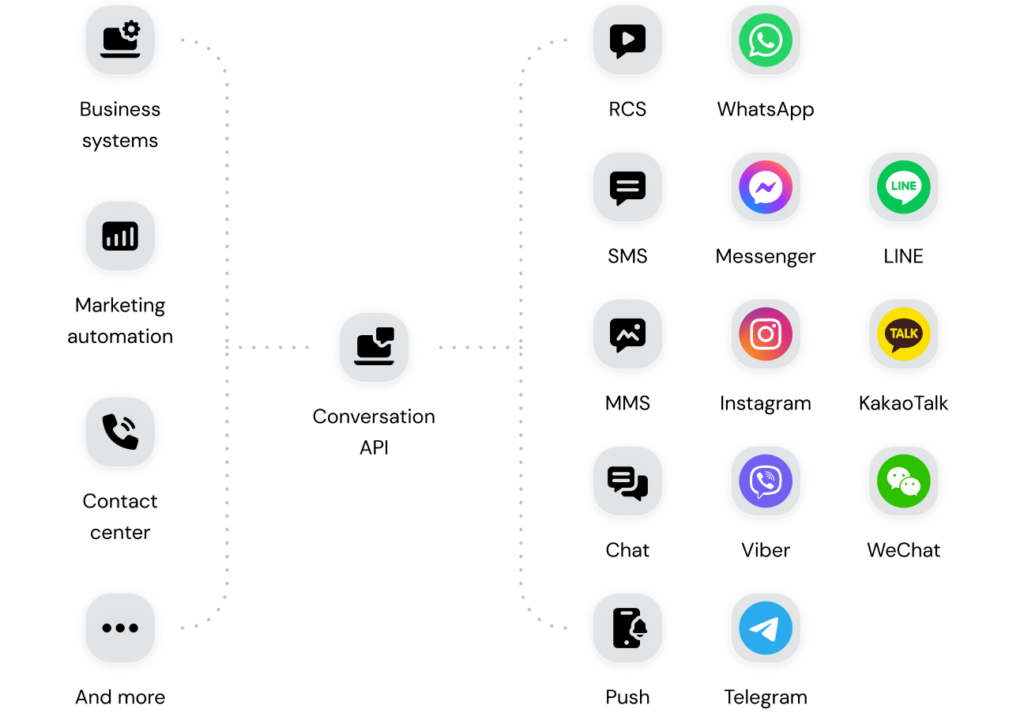
With the Sinch Telegram Bot API, for example, you can easily build and customize a Telegram bot – plus integrate it with other platforms like a CRM, marketing, contact center, or e-commerce tool.
And since it’s built on Sinch’s robust Conversation API, adding other messaging channels like WhatsApp, Viber, or even RCS and SMS is a breeze.
That makes it easy for businesses to get the most out of Telegram bots, regardless of your use case.
FAQs about Telegram business bots
Telegram bots support pretty much any business use case, from automating marketing messages and order tracking information to collecting feedback and customer support.
Absolutely. Telegram’s API lets everyone with coding skills build their own bot on the platform. However, for more complex use cases, omnichannel messaging, or third-party integrations, it’s more convenient to work with a dedicated API, like Sinch’s Conversation API.
Telegram is particularly popular in Ukraine, Russia, Uzbekistan, and Indonesia. But even in countries like India, Spain, or Germany, where WhatsApp is the most-used messaging app, Telegram has a strong and loyal user base.
Telegram typically attracts a more technical audience and many Telegram users don’t use WhatsApp or other messaging channels. For businesses, Telegram is a good platform to reach an alternative target audience.
Telegram doesn’t charge businesses for sent messages, so it’s a lot more cost-effective to scale messaging on Telegram than WhatsApp, for instance.
Telegram also has a more technical audience, so users are already familiar with bots and like to engage with them – leading to higher engagement and less friction with the technology.

Author: