Products
Smart Conversations: Stop making customers repeat themselves

Most customer support teams already know where conversations break down. And the data says it, too: Sinch’s 2025 State of customer communications report found that 81% of consumers react negatively when they’re forced to repeat themselves during a support conversation.
This problem shows up across industries, channels, and use cases, and it isn’t good for anyone. Customers lose patience and trust, while support teams are left juggling manual work and recovering context that should have followed the conversation automatically.
At the same time, business investment in automation is accelerating, with 97% of businesses investing in AI to improve customer communications, and what the enterprise production record shows is that the issue is not a lack of investment: it is that many systems still treat messages as isolated events instead of parts of an ongoing conversation.
There’s a big opportunity for businesses to have smarter conversations that preserve context, make agents’ lives easier, and make it easier for people to get help without repeating themselves or starting over. When conversations work this way, support teams spend less time repairing broken interactions and more time actually solving problems.
What we mean by “smarter conversations”
Most support teams are still reactive by default. A ticket comes in, an agent responds, and the cycle repeats. That works for a while, but it can start to break as support ticket volumes rise, or issues become more complex. Conversations get handed off, context gets lost, and customers bounce between agents. The result is a slower support experience slows down where customers are forced to repeat themselves, and what could’ve been a quick resolution starts to chip away at trust.
A smarter approach would change how teams work with conversations, and using AI to proactively improve the flow of customer communications. Imagine what that could look like:
- Understanding real meaning. Instantly knowing if a customer is happy, frustrated, or ready to escalate, and being able to route conversations to the right person or process.
- Intelligent automation. Instead of relying on basic keyword detection, this means supporting real support scenarios across text, voice, or images.
- Built-in compliance and security. Clear guardrails around data handling and customer privacy can ensure every interaction is compliant and create a safer environment for your support teams.
At Sinch, we call this Smart Conversations. Built into Sinch Conversation API, Smart Conversations is a feature suite that gives support teams more structure and visibility into what’s happening inside customer conversations, helping them stay coherent across channels and scale support more effectively.
Smart Conversations empower faster, more secure customer interactions
Smart Conversations works as an intelligence layer within the Sinch Conversation API. It brings together six AI capabilities that help support teams understand and manage customer conversations without adding complexity.
Here’s what Smart Conversations includes:
- Natural Language Understanding (NLU): Detects the intent of a customer’s query, so different ways of asking for the same thing can be handled consistently.
- Sentiment analysis: Recognizes customer emotion (like whether a conversation is positive, negative, or neutral) across more than 100 languages so your customer agents can respond in the right way.
- Speech-to-text transcription: Converts customer voice notes and audio files from any channel (like WhatsApp or Messenger) into written, searchable text.
- Personally Identifiable Information (PII) masking: Automatically detects and redacts sensitive customer data before it reaches agents or logs.
- Offensive content checker: Flags abusive or inappropriate language to help protect support teams.
- Image comprehension engine: Extracts text from images and documents so requests can move forward without manual data entry.

“At scale, even small breakdowns in a conversation create a lot of extra work. When context doesn’t carry forward, agents end up doing recovery work instead of support.”

Smart Conversations in action
Smart Conversations shows its value in the moments that typically slow support teams down or frustrate customers. Here’s how that could look in practice.
Automate privacy with PII masking
Maria is chatting with her bank to resolve a billing issue. When the conversation turns to verification, she pastes her full credit card number into the chat instead of the requested ID detail.
In a traditional setup, that message would reach the agent and be stored in logs, creating an instant compliance problem.
With Smart Conversations, the sensitive data is detected and masked automatically before anyone sees it. The agent continues the conversation naturally, asking for the correct information, while Maria’s data stays protected.
What could have turned into a security incident becomes a non-event, handled quietly and correctly in the background.
Effortless onboarding with image comprehension
David is opening a new rideshare account. To verify his identity, he’s asked to send a photo of his driver’s license directly in the chat.
As soon as he uploads the image, the image comprehension engine in Smart Conversations validates that it’s a driver’s license and extracts the relevant data fields. There’s no manual data entry or follow-up questions, and when a human agent takes over the chat, they already have the verified information they need to help David move forward.
From David’s perspective, onboarding feels fast and straightforward. For the support and operations teams, the process moves forward without extra work.
Getting to the real problem with natural language understanding
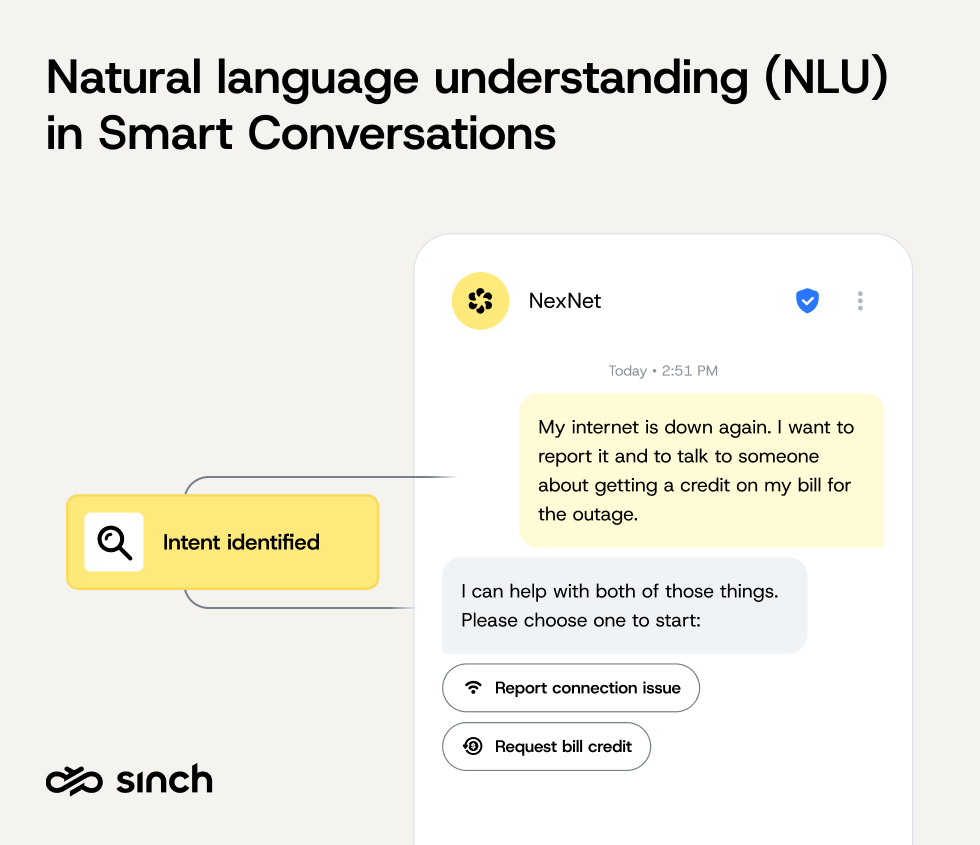
Sam opens a support chat after their internet goes down. They send a single message explaining what they need, and request to report it and talk to someone about getting a credit on their bill for the outage.
Natural language understanding analyzes the message and identifies the primary intent as reporting a service issue. Based on that intent, the conversation is routed to the right support flow, while the additional context about billing is retained.
From there, the chatbot can guide Sam through reporting the outage and surface the next relevant step, like connecting them to billing once the service issue is addressed.
Sam gets help faster, and the conversation keeps moving without confusion or unnecessary handoffs.
How Smart Conversations show up in business metrics
When conversations are better, the impact shows up in the numbers support teams already track. Here’s what we mean:
- Average handling time (AHT) is often one of the first places teams notice a shift. When conversations arrive with clearer intent and better context, agents spend less time figuring out what’s going on. Voice transcripts and extracted document data remove the need to pause and review separate systems.
- First-contact resolution (FCR) improves as conversations stop bouncing between teams. There’s better routing and clearer next steps, meaning fewer unnecessary handoffs and follow-ups just to finish what should have been resolved the first time.
- Customer satisfaction (CSAT) tends to follow. When customers don’t have to repeat themselves or correct misunderstandings, the experience feels calmer and more intentional.
Operationally, teams also see changes in manual rework. Image comprehension reduces data entry errors, and PII masking prevents clean-up work after sensitive data has already been exposed.
This also lowers compliance risk. Fewer exposed data points mean fewer potential violations and less reliance on agents to manage sensitive information correctly under pressure.
“A lot of compliance risk in support comes from conversations going off the rails. When guardrails are built into the interaction, risk drops without slowing anyone down.”
Over time, these shifts compound. Agents spend more time solving problems and less time repairing conversations. Support operations become easier to scale because each interaction requires less recovery work.
That’s what measurable impact looks like when conversations start working the way customers expect them to.
Get started with Smart Conversations
Smart Conversations is built to address the breakdowns support teams face today without forcing a full rebuild of existing systems or slowing teams down in the process.
It works as an intelligence layer that sits on top of the Sinch Conversation API. For existing Conversation API customers, Smart Conversations can be enabled as an add-on directly in the Sinch Build Dashboard after accepting the terms of service, enabling the relevant features, and configuring a webhook to start working with specific AI features. An existing integration with a contact center solution is required.
Or, if you want support along the way, we have a more guided option, which starts with a conversation with our team about where support breaks down today, whether that’s protecting sensitive customer data, reducing agent workload, or understanding customer intent more clearly. From there, the right Smart Conversations capabilities can be configured so your developers can begin using them immediately within existing communication flows.
Either way, the result is the same: Support teams spend less time managing broken conversations, and customers can finally stop repeating themselves.
Reach out to our team via the form below to talk through your use case and next steps.

Author:

Co-author: