Resources
How Gen Z and Millennials want you to text them, according to new data

Gen Z and Millennials now represent the largest block of consumers. But reaching them is harder than ever. Your messages aren’t just competing with other brands; they’re competing with the 85% of consumers who receive more than 10 notifications every single day.
To earn their attention, you need to understand precisely how they want to engage. A recent report surveying over 1,400 Gen Z and Millennial consumers reveals a clear roadmap for creating a messaging strategy that cuts through the noise.
Here’s what the data says about how to text these powerful generations – and how you can put these insights into action in your own texting strategy. It can pay off big if you do it right: 42% of consumers have made a purchase as a direct result of a brand text in the past year.
It’s about conversation, not one-way blasts
While both generations welcome brand texts, they see the channel differently. Millennials are more accustomed to one-way alerts, while Gen Z expects a two-way street.
The data shows Gen Z is more active on conversational platforms like Instagram DMs (42% vs. 29% of Millennials), and they bring that expectation to texting. They see it as a tool for interaction, not just information.
For a conversational messaging strategy to work, you need a platform that can manage two-way text interactions at scale without losing the human touch.
The type of message matters
Not all messages are created equal. Given the many types of messages, offers, and information your business may be tempted to send through a text message, know that some are more welcomed than others.
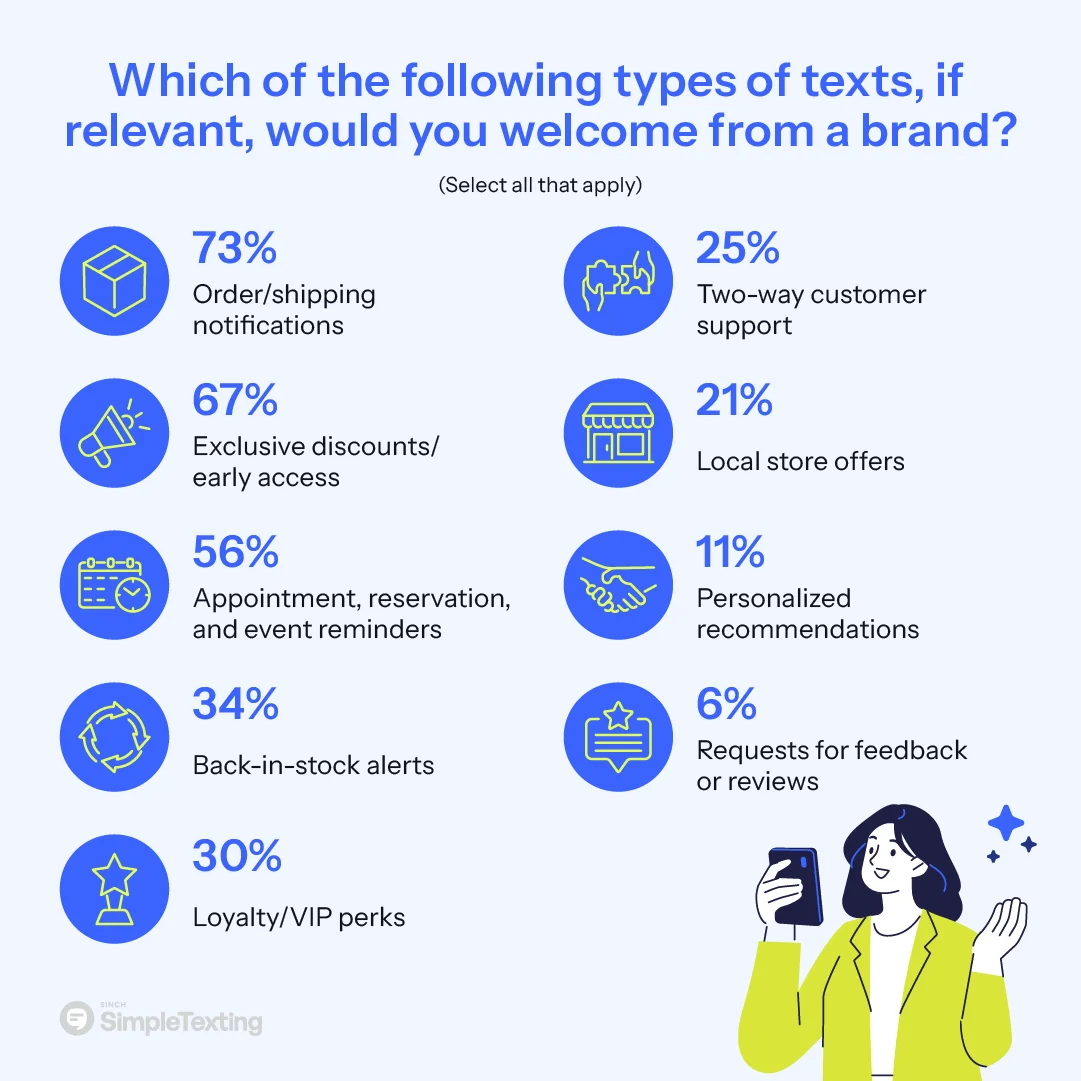
Millennials are more receptive than Gen Z to service and relationship-oriented texts, including two-way customer support (27% vs. 22%), loyalty or VIP perks (32% vs. 27%), and local store offers (22% vs. 19%).
Focus on value, not volume
Frequency is the single biggest factor consumers consider before opting in. The report found that 28% of consumers want to know how often you’ll text them before they subscribe.
The answer? Not very often. A staggering 90% of consumers want to hear from brands once a week or less, with “every other week” being the most popular cadence (40%). Sending too many messages is the #1 reason consumers tune out (44%).
Personalization is about relevance, not just the name field
Mass texts have their place, but generic blasts are becoming less and less effective. It’s all about personalization – and personalization is more than just using a customer’s first name. It’s about demonstrating that you understand their needs.
When asked what kind of personalization makes them more likely to engage, 63% of consumers chose discounts on items they had previously browsed. This far outpaced generic “personalized recommendations,” which interested only 11%. To get these relevant offers, consumers are willing to share their birthday (50%) and interests (47%).
Be transparent when using AI
Automation is essential for scaling communication, but consumers are wary of AI. The report found that 37% of consumers feel negative about brands using AI in texts, and a combined 72%want brands to disclose when AI is being used.
Gen Z is particularly skeptical, with 42% feeling negative about AI in brand texts, compared to 34% of Millennials.
Build a strategy that connects
The data is clear: a one-size-fits-all approach to messaging is no longer effective. Winning over Gen Z and Millennials requires a strategy that respects their time, delivers real value, and adapts to their conversational expectations. This requires a platform built for security, powerful integrations, and sophisticated, two-way messaging.
Ready to build a messaging strategy that works? Try Sinch Engage for free or talk to one of our experts to see how you can connect with your customers on their favorite channels.

Author: