Resources
How to build an SMS loyalty program that keeps customers coming back
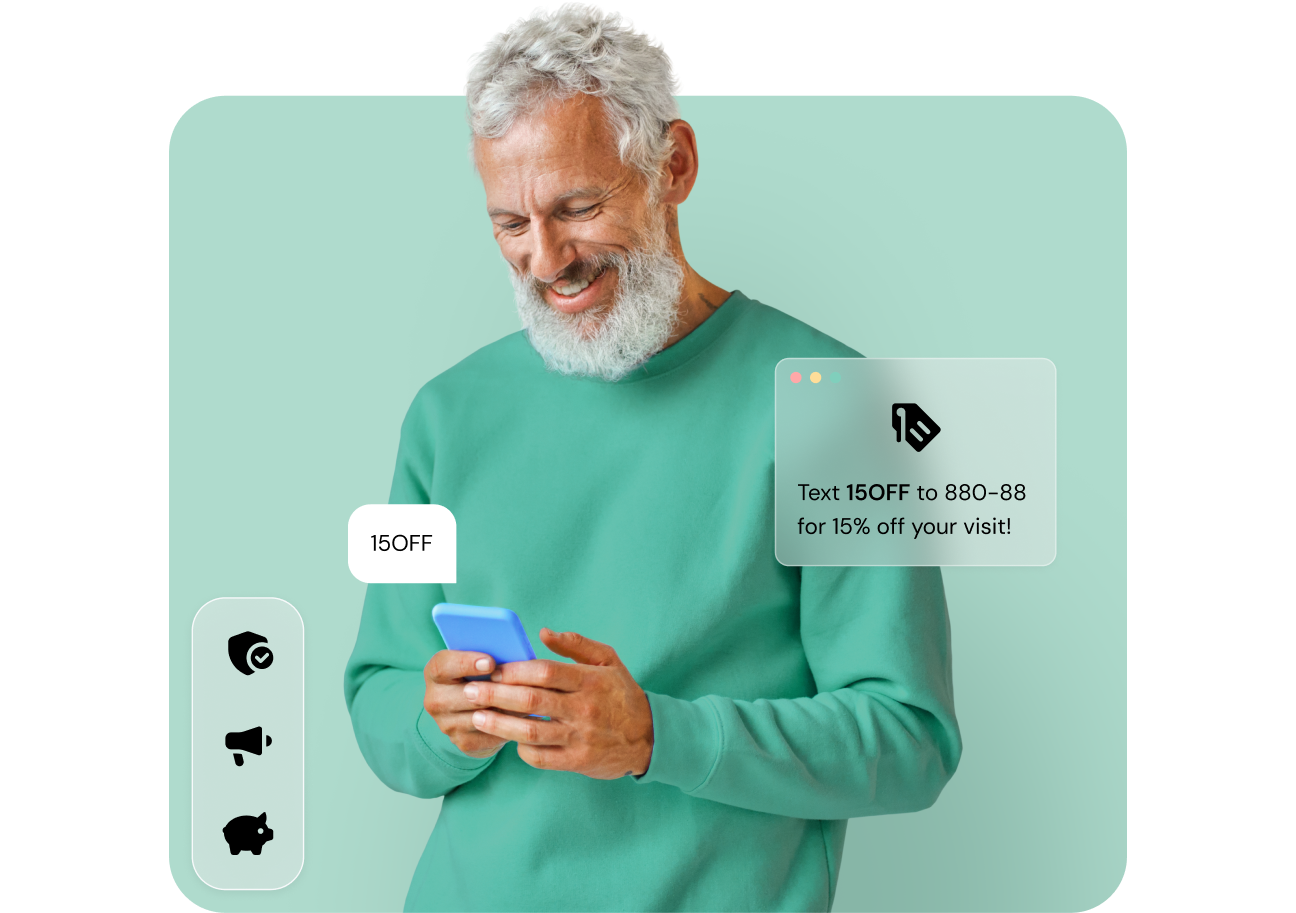
You’re watching repeat customers drift toward competitors who make loyalty feel effortless. The problem isn’t your rewards — it is the channel delivering them.
SMS loyalty programs strip away the friction that kills traditional loyalty efforts. No app to download. No email to dig out of a promotions tab. Just a text message that lands on the one device your customers always have within arm’s reach. This guide walks you through everything: choosing the right program type, setting it up step by step, writing messages that drive redemptions, and measuring what actually matters.
What is an SMS loyalty program?
An SMS loyalty program is a rewards system that uses text messages as the primary channel to enroll customers, communicate rewards, and drive repeat purchases. Customers join by texting a keyword to a short code or entering their phone number at checkout. Once enrolled, they receive automated texts about points balances, personalized offers, VIP tier updates, and reward redemptions.
Unlike app-based programs that require downloads and logins, SMS loyalty programs meet customers on a channel they already use daily — with no extra software required. A program can be as simple as a digital punch card (“Buy 9, get the 10th free — you’re at 7!”) or as sophisticated as a multi-tier VIP system with personalized offers driven by purchase history. The structure depends on your business model. The channel stays the same: a direct line to your customer’s pocket.
Why SMS loyalty programs boost customer retention
SMS attacks the retention problem from four angles simultaneously — here’s how each one works.
Direct and immediate communication
Text messages land on a lock screen and get read. In fact, recent studies show that 74% of consumers check their notifications within five minutes of receiving a text. That immediacy matters for loyalty because timing drives action. A points balance reminder that arrives while a customer is deciding where to eat lunch is infinitely more valuable than an email they’ll see three days later. SMS also creates a sense of personal, one-to-one communication that strengthens the emotional connection that keeps customers coming back.
Higher redemption rates than email
A reward that never gets redeemed never drives a repeat purchase. Email-based loyalty programs suffer from a compounding visibility problem: low open rates lead to low awareness of available rewards, which leads to low redemption, which leads to program abandonment. SMS flips that dynamic. When customers can see their points balance or a ready-to-redeem offer in a text, the path from notification to action shrinks dramatically.
Recent studies even show SMS drives purchases: 42% of consumers have made a purchase as a direct result of a brand text in the past year.
Personalized customer experiences at scale
SMS loyalty programs let you send the right offer to the right customer at the right time without a team of data scientists. With basic segmentation tied to purchase history, you can automatically send a win-back campaign to lapsed customers, a birthday discount to loyal regulars, or a VIP tier upgrade notification to high spenders — all set up once and running automatically.
Seamless omnichannel integration
The strongest loyalty strategies use SMS as the real-time engagement layer within a broader omnichannel approach. SMS handles time-sensitive, high-open-rate messages — reward alerts, flash offers, points updates. Email handles longer-form content — monthly summaries and program updates. WhatsApp or RCS can deliver richer experiences with interactive reward catalogs and two-way messaging. When these channels connect through a unified platform, you create a loyalty experience that follows the customer across every touchpoint.
Types of text message loyalty programs
Not every business needs the same loyalty structure. The right program type depends on your average transaction value, purchase frequency, and how much complexity your customers will tolerate. Here is a breakdown of the four most effective models.
| Program Type | Best For | Complexity | Customer Effort | Example |
| Points-based | Retail, eCommerce | Medium | Low–Medium | Earn 1 point per $1 spent; redeem 100 points for $10 off |
| VIP tier | Brands with high-value repeat buyers | High | Medium | Silver → Gold → Platinum with escalating perks |
| Digital punch card | Restaurants, coffee shops, services | Low | Low | Buy 9, get the 10th free |
| Gamified rewards | Brands targeting younger demographics | Medium–High | Medium | Spin-to-win, scratch-off, surprise rewards |
Points-based programs
Points-based programs are the most versatile option. Customers earn points for purchases — and sometimes for referrals, reviews, or social shares — then redeem them for discounts, free products, or exclusive access. A simple automated text after each transaction (“You have 73 points now — just 27 away from a $10 reward!”) is one of the most effective repeat purchase drivers you can deploy.
VIP tier programs
VIP programs segment customers into levels based on spending or engagement, with each tier unlocking better rewards. SMS is the ideal channel for tier-related communication because the messages are inherently personal. A text that says “Congratulations — you’ve reached Gold status! Your new perks are now active.” feels like an achievement, not a marketing blast.
Digital punch card programs
For coffee shops, salons, quick-service restaurants, or any business with frequent low-value transactions, a digital punch card via SMS is the simplest path to loyalty. Customers text a keyword or scan a code at checkout, receive a text confirming their punch, and get a reward after a set number of purchases. No physical card to lose, no app to download, no account to create.
Gamified reward programs
Gamified programs add surprise or play to the loyalty experience — spin-to-win wheels, mystery discount texts, or challenge-based rewards. A text that says “Reply SPIN to reveal your mystery reward 🎰” generates engagement that a standard discount email never could. These pair especially well with RCS messaging, which supports interactive elements like buttons and carousels natively.
How to set up an SMS loyalty program
Setting up an SMS loyalty program doesn’t require an enterprise budget or a development team. Follow these seven steps and you can have a working program quickly.
1. Choose your SMS marketing platform
Your platform choice determines everything — what you can automate, how you segment, and whether you stay compliant. Look for these non-negotiable features when evaluating your options:
- Keyword opt-in and short code support for easy enrollment
- Automated message flows triggered by customer actions
- CRM integration so purchase data drives personalization
- Two-way messaging so customers can check balances or redeem rewards by replying
- TCPA compliance tools including opt-in management and opt-out processing
- Omnichannel capability covering WhatsApp, RCS, and email from one interface
2. Define your program structure and rewards
Before you write a single message, answer a few foundational questions: which program type fits your business, what action earns a reward, what the reward actually is, and how quickly customers can earn their first one. Aim for attainability within two to three visits or purchases. The biggest mistake businesses make is setting the first reward too far away — front-load a small, quick win to create early momentum.
3. Build your opt-in strategy
You need explicit opt-in consent before sending any loyalty text messages. TCPA compliance requires express written consent, clear disclosure of message frequency and data rates, an easy opt-out mechanism in every message, and record-keeping of when and how each subscriber gave consent. Your opt-in language should be specific. Here’s an example that works:
“Text JOIN to 55555 to enroll in [Brand] Rewards. Receive up to 4 msgs/month with exclusive offers and points updates. Msg & data rates may apply. Reply STOP to cancel at any time.”
Effective opt-in collection points include point-of-sale signage, website pop-ups, social media posts promoting the keyword, email campaigns inviting existing subscribers, and printed materials like receipts or packaging inserts.
4. Create automated loyalty message flows
Automation is what makes an SMS loyalty program scalable. Set up these core message flows before launch, and they will run automatically based on customer behavior:
- Welcome message: Confirm enrollment, explain the program, and deliver a first reward if applicable
- Points/progress update: Triggered after each qualifying purchase, showing current balance and proximity to next reward
- Reward earned notification: Triggered when a customer hits a threshold, with clear redemption instructions
- Milestone celebrations: Birthday messages, anniversary of joining, or tier upgrades
- Win-back campaign: Triggered after 30 or 60 days of inactivity
5. Segment and personalize your campaigns
Beyond automated SMS flows, periodic campaign messages perform dramatically better when they’re segmented. At minimum, segment your subscriber list by purchase frequency, spend level, product category preferences, loyalty tier, and geographic location. A VIP customer who spends $200 per month shouldn’t receive the same “10% off your next order” message as someone who bought once six months ago.
6. Launch and promote your program
Start with a soft launch to your existing customer base. Email your current customers about the new program, train staff to mention it at checkout, and post the keyword on your social channels. Focus on quality over quantity — engaged subscribers who actually redeem rewards are worth far more than a large list of people who opted in once and never returned.
7. Track performance and optimize
Go beyond vanity metrics like delivery rates and track numbers that connect directly to revenue. The key metrics worth monitoring are redemption rate (the percentage of sent offers that get redeemed), repeat purchase rate among loyalty members versus non-members, customer lifetime value lift over six- and twelve-month windows, revenue per message, and opt-out rate. Review monthly and adjust message frequency, offer values, and segmentation based on what the data tells you.
Loyalty text message examples by industry
Ready-to-use templates make the difference between planning an SMS loyalty program and actually launching one. Here are practical examples across four industries — customize the details for your brand but keep the structure.
Retail and eCommerce
Welcome: “Welcome to [Brand] Rewards! 🎉 You just earned 50 bonus points. Earn 1 pt per $1 spent. Check your balance anytime by replying POINTS. Reply STOP to opt out.”
Points update: “Nice purchase, [Name]! You earned 34 points today. Your balance: 187 pts. You’re only 13 points from a $20 reward! Shop now: [link]”
Win-back: “We miss you, [Name]! It’s been 45 days since your last visit. Here’s 2x points on your next purchase — valid through Sunday. [link]”
Restaurants and hospitality
Welcome: “Welcome to [Restaurant] Rewards! Your first stamp is on us. Collect 8 stamps, get a free entrée. Show this text on your next visit to get started.”
Progress update: “You’re at 5/8 stamps at [Restaurant]! Just 3 more visits and your next entrée is free. We’re open until 10pm tonight — see you soon?”
Birthday reward: “Happy Birthday, [Name]! 🎂 Enjoy a free dessert on us this week. Just show this text to your server. Valid through [date].”
Healthcare and wellness
Welcome: “Welcome to [Clinic/Spa] Rewards! Earn points with every appointment. Your first reward: 15% off your next service. Book now: [link]. Reply STOP to opt out.”
Re-engagement: “Hi [Name], it’s been a while! Your 200 points are waiting. Book by [date] and we’ll add 50 bonus points to your balance. [link]”
Service-based businesses
Welcome: “Thanks for joining [Business] Rewards! Every 5th service is 50% off. You’re at 1/5. We’ll keep count — you just keep coming back. Reply STOP to opt out.”
Two-way engagement: “Quick question, [Name]: What service would you most like a discount on? Reply A for [Service 1], B for [Service 2], or C for [Service 3]. We’ll tailor your next reward!”
Best practices for text-based loyalty programs
These practices determine whether your SMS loyalty program thrives or fizzles after the first month — get them right from the start.
Keep rewards easy to earn and redeem
If redemption requires a coupon code, a minimum spend, a specific day, and a manager override, your customers will give up. The gold standard: a customer receives a text saying their reward is ready, taps a link or shows the message at checkout, and the reward is applied. Test the flow yourself — sign up as if you were a customer, earn a reward, and redeem it. If any step feels confusing, simplify it.
Respect frequency and timing
Watch your opt-out rate — if it spikes after a campaign, you are either sending too often or the content is not relevant enough. Timing matters too: a restaurant loyalty text at 10:30 AM outperforms the same message at 3 PM. A retail offer on Thursday evening beats a Monday morning send. Test different send times and let your data guide you.
Stay compliant
TCPA compliance is not optional, and violations carry significant fines. Always honor opt-outs immediately, never add numbers to your list without explicit consent, and keep your opt-in records organized. If you operate across borders, ensure your platform handles country-specific regulations automatically.
Please note that this advice is for informational purposes only and is neither intended as nor should be substituted for consultation with appropriate legal counsel and/or your organization’s regulatory compliance team.
Think beyond SMS from day one
The most effective loyalty programs aren’t single-channel. Use SMS for real-time alerts and quick-action offers. Use email for detailed program updates and reward summaries. Consider WhatsApp for markets where it dominates mobile messaging. And keep an eye on RCS, which lets you send branded, interactive loyalty messages with images, buttons, and carousels natively through the default messaging app on Android devices.
Build a loyalty program your customers will actually use
The businesses that win at customer retention are not the ones with the most sophisticated loyalty apps — they are the ones that make loyalty effortless. SMS does that better than any other channel: higher visibility, faster action, zero friction.
Now you have the framework. Choose your program type, set up your opt-in and automation, write messages that drive redemption, measure what matters, and expand into omnichannel as you grow. Start small, get 200 subscribers, send your first points update, and watch what happens to your repeat purchase rate. Then scale from there.

Author: