Resources
SMS marketing: the complete guide to getting started in 2025
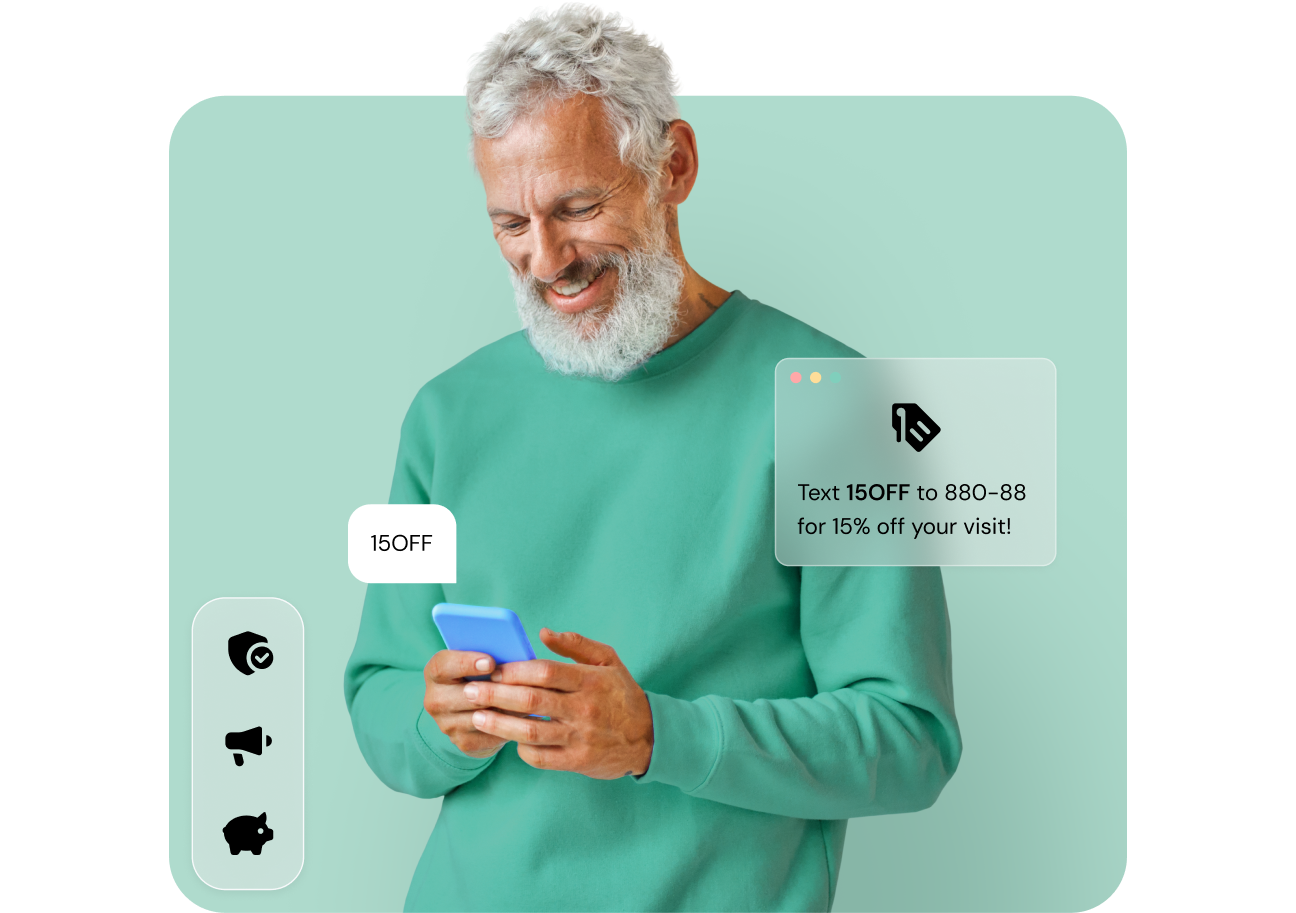
Most marketing teams still treat SMS as an afterthought, unsure of the rules, the costs, or where it fits alongside email and social.
This guide fixes that. Below, you’ll find a plain-language explanation of how SMS marketing works, the compliance rules you absolutely must follow, the metrics worth tracking, and step-by-step instructions for launching your first campaign. Whether you run a retail chain, a healthcare practice, or a hospitality brand, this is everything you need to move from “I’ve heard SMS works” to “Here’s our plan.”
What is SMS marketing?
SMS marketing is the practice of sending promotional or informational text messages to customers and prospects who have given explicit permission to receive them. Businesses use it to share time-sensitive offers, order confirmations, appointment reminders, and personalized recommendations. Unlike email, SMS messages land directly in a recipient’s native messaging app — no downloads, no spam folders, and no algorithm deciding whether they appear.
SMS stands for Short Message Service. Each standard SMS is capped at 160 characters, which forces every word to earn its place. When you need to include images, video, or audio — or exceed that character limit — you move into MMS (Multimedia Messaging Service) territory.
Here’s a quick comparison:
| SMS | MMS | |
| Character limit | 160 characters | Up to 1,600 characters (varies by carrier) |
| Media support | Text only | Images, video, audio, GIFs |
| Cost per message | Lower | Higher (typically 2–3× SMS) |
| Best use case | Flash sale alerts, reminders, two-way support | Product launches, lookbook previews, rich promotions |
The distinction matters for budgeting and strategy. Most brands start with SMS for its simplicity and lower cost, then layer in MMS for campaigns where visuals drive the sale.
SMS marketing sits within a broader category sometimes called text marketing, text message marketing, or SMS advertising. Regardless of the label, the mechanics are the same: you collect opt-in consent, send relevant messages through an SMS marketing service, and measure the results.
Why SMS marketing works — the numbers behind the channel
Data, not hype, makes the case for SMS. Here’s what the latest research shows across four dimensions that matter to any marketing team.
High open rates that leave email behind
The gap is staggering. No other marketing channel comes close to that immediacy.
Direct, personal communication with no algorithm in the way
There’s no feed ranking, no inbox tab sorting, and no ad auction between your message and your customer’s eyeballs. A text message arrives on a device people check roughly 96 times a day, and it sits there until it’s opened.
This directness builds trust. SMS — especially two-way messaging — meets that expectation by default.
Strong ROI at a low cost per message
When you factor in the low per-message cost (typically fractions of a cent to a few cents depending on volume and country), SMS becomes one of the most efficient channels in your stack.
Works alongside your existing marketing channels
SMS doesn’t replace email — it amplifies it. That’s not a marginal lift; it nearly doubles engagement.
The takeaway: SMS works best as part of an omnichannel marketing strategy that includes email, messaging apps like WhatsApp, and even RCS — not as a standalone experiment.
The four types of SMS marketing messages
Not every text message serves the same purpose, and the compliance rules differ depending on the type. Here’s a breakdown of the four categories you’ll work with.
| Type | Best used for | Compliance note |
| Promotional | Sales, discounts, product launches, flash deals | Requires explicit opt-in consent; must respect quiet hours |
| Transactional | Order confirmations, shipping updates, appointment reminders | Typically allowed without promotional opt-in, but consent still required |
| Conversational (two-way) | Customer support, feedback collection, guided selling | Must still honor opt-out requests; log conversations for compliance |
| Broadcast (bulk) | Company announcements, event invitations, seasonal campaigns | Requires opt-in; segment carefully to avoid high unsubscribe rates |
Promotional messages
These are the revenue drivers — flash sale alerts, discount codes, new product announcements, and limited-time offers. Promotional SMS must follow strict timing rules: send only during “waking hours,” 8 a.m. to 9 p.m. in the recipient’s time zone, per CTIA guidelines. This isn’t optional. Violating quiet hours can trigger carrier filtering and, worse, regulatory fines.
Transactional messages
Order confirmations, shipping notifications, appointment reminders, and password resets fall here. These messages carry high perceived value. Transactional messages generally face lighter regulatory restrictions than promotional ones, but you still need consent to send them.
Conversational (two-way) messages
This is where SMS moves from broadcast to dialogue. Two-way messaging lets customers reply, ask questions, and resolve issues without picking up the phone. Think of it as live chat, but in the channel your customer already uses dozens of times a day.
Broadcast (bulk) messages
Bulk SMS sends the same message — or a segmented variation — to a large list at once. Event invitations, company-wide announcements, and seasonal campaigns are typical use cases. The key here is audience segmentation: blasting the same generic text to your entire database is a fast path to high unsubscribe rates. Segment by purchase history, location, or engagement level to keep messages relevant.
How to start your first SMS marketing campaign
Launching an SMS campaign doesn’t require months of planning. Follow these six steps to go from zero to your first send.
1. Define your campaign goal
Start with a clear objective. Are you trying to increase customer engagement, boost brand awareness, drive more sales through drip campaigns, or build loyalty? Each goal shapes the message type, audience segment, and success metric you’ll track. A flash sale campaign optimizes for revenue; a welcome series optimizes for engagement and list retention.
Without a defined goal, you can’t measure whether the campaign worked. Pick one primary objective per campaign.
2. Choose an SMS marketing platform
Your platform choice determines your sending capabilities, compliance tooling, and integration options. Look for an SMS marketing service that offers:
- Built-in opt-in and opt-out management
- Audience segmentation and personalization
- Scheduling with time zone awareness
- Analytics dashboards (delivery rate, CTR, EPM, unsubscribe rate)
- Integration with your existing CRM, e-commerce platform, or email tool
- Support for international sending if you operate globally
Avoid platforms that treat compliance as an add-on. It should be baked into every workflow.
3. Build your opted-in subscriber list
You cannot simply text every customer in your database. Businesses must build an opt-in list from scratch — there are no shortcuts, and buying phone number lists is both illegal under TCPA and a guaranteed way to get your sending number blocked by carriers.
Effective list-building tactics include:
- Text-to-join keywords (e.g., “Text JOIN to 55555”)
- Website pop-ups with a clear value proposition
- Checkout opt-in checkboxes (unchecked by default)
- Social media promotions offering an SMS-exclusive discount
- In-store signage with a QR code linking to your opt-in page
Every opt-in must include compliant disclosure language. More on that in the compliance section below.
4. Write a compelling message
Every SMS campaign needs five elements: your company name, a time-sensitive offer or clear reason to act, an element of personalization, a shortened link (if directing to a landing page), and a STOP unsubscribe reminder.
Keep it tight. The 160-character limit forces you to create strong, targeted, well-crafted messages directed at the right customers at the right time. Cut filler words. Lead with the value. End with a clear call to action.
“Ask yourself: Does this message matter right now?” If the answer is no, don’t send it.”
5. Schedule and send at the right time
Timing affects open rates, click-through rates, and — critically — your legal standing. The TCPA quiet hours requirement restricts promotional texts to 8 a.m. to 9 p.m. in the recipient’s time zone. If your list spans multiple time zones or countries, your SMS platform needs to handle this automatically.
Beyond compliance, think about context. A lunch deal performs best at 11 a.m. A flash sale reminder works well mid-morning or early evening. Test different send times and let the data guide you.
6. Track results and optimize
Measure three metrics from day one: click-through rate, conversion rate, and opt-out rate. These tell you whether your messages are engaging (CTR), driving action (conversion), and keeping subscribers happy (opt-out rate).
Start conservatively. 1–4 campaigns per month is a solid starting cadence while you learn what resonates with your audience. Increase frequency only when the data supports it.
SMS marketing best practices and compliance rules
Compliance isn’t a nice-to-have — it’s the foundation of every SMS program. Get it wrong, and you face carrier blocks, lawsuits, and fines that can cripple a business.
Always get explicit opt-in consent
The TCPA requires explicit written consent before sending promotional SMS. This means a customer must actively agree to receive your texts — pre-checked boxes, implied consent from a purchase, or “we already have their number” don’t count.
Violations can result in fines of $500–$1,500 per unsolicited message under the TCPA. For a list of 10,000 contacts, a single non-compliant blast could mean millions in penalties.
Your opt-in flow must include clear disclosure language. Here’s an example of TCPA-compliant opt-in text:
“I agree to receive recurring automated text messages at the phone number provided. Consent is not a condition to purchase. Message & data rates may apply. Message frequency varies. Reply STOP to unsubscribe.”
If you send SMS internationally, additional regulations apply. The EU’s GDPR requires explicit consent with the right to withdraw at any time. Many countries have their own rules — your SMS marketing platform should help you navigate these automatically.
Make opting out effortless
Every message must include a way to unsubscribe. The CTIA mandates that carriers recognize standard opt-out keywords: STOP, END, CANCEL, UNSUBSCRIBE, and QUIT. When a subscriber sends any of these, your system must immediately remove them from future sends and confirm the opt-out.
Making this difficult — burying the opt-out instruction, adding extra steps, or delaying removal — violates carrier compliance rules and erodes trust.
Respect message frequency and timing
How often should you send marketing texts? More isn’t always better.
Start with 1–4 SMS campaigns per month and scale based on engagement data. If your unsubscribe rate spikes after increasing frequency, pull back.
Timing matters too. Promotional SMS must be sent between 8 a.m. and 9 p.m. in the recipient’s time zone — this is a legal requirement, not a suggestion.
Personalize every message
Generic blasts feel like spam. Personalized texts feel like service.
Use the data you have — first name, purchase history, location, browsing behavior — to tailor messages. A “Hey Sarah, your favorite moisturizer is back in stock” outperforms “New arrivals now available” every time. Audience segmentation is the engine that makes personalization possible at scale.
Keep messages short, clear, and actionable
The 160-character limit is a feature, not a constraint. It forces clarity. Use plain language, a clear CTA, and short links. Avoid jargon or filler. Every word should move the reader toward the action you want them to take.
If you need more space, consider MMS — but only when the visual element genuinely adds value. Don’t use MMS just to write longer copy.
SMS campaign strategies that drive real results
Theory is useful. Proven playbooks are better. Here are three SMS campaign strategies that consistently deliver measurable ROI across industries.
Abandoned cart recovery
That’s roughly seven out of ten potential sales walking away.
The key is speed and relevance. Send the first reminder within an hour of abandonment, include the specific product left behind, and add an incentive. One effective approach: offering free shipping in your abandoned cart SMS — a smart tactic because many shoppers leave due to unexpected shipping fees at checkout.
A typical abandoned cart SMS drip campaign looks like this:
- Message 1 (1 hour after abandonment): Friendly reminder with product name and a link back to cart
- Message 2 (24 hours later): Add an incentive — free shipping, a small discount, or a limited-time offer
- Message 3 (48 hours later): Final urgency message — “Your cart expires soon”
Flash sales and time-limited offers
SMS is built for urgency. The near-instant open rate makes it the ideal channel for offers with a tight window — think 24-hour sales, weekend-only deals, or inventory clearances.
A cosmetics brand ran a Black Friday campaign promoting 50% off makeup palettes via SMS, driving immediate action through the combination of a compelling offer and a channel customers check within minutes. The lesson: pair a strong offer with a deadline, and SMS will outperform almost any other channel for time-sensitive promotions.
Welcome series for new subscribers
First impressions set expectations. A welcome series — typically two to three messages sent over the first week after opt-in — introduces your brand, delivers the promised incentive (the discount or freebie that drove the sign-up), and establishes the cadence subscribers can expect.
A simple welcome series structure:
- Immediately after opt-in: Thank the subscriber, deliver the promised offer, and confirm what they’ve signed up for
- Day 2–3: Share a best-seller recommendation or a piece of valuable content
- Day 5–7: Invite them to explore a specific product category or join your loyalty program
The welcome series is also your best opportunity to segment new subscribers based on their responses and clicks, so future campaigns can be more targeted.
Start sending smarter texts today
SMS marketing isn’t a niche tactic anymore — it’s a core channel that 80%+ of consumers have already opted into. The open rates surpass email, the ROI is proven, and the compliance rules, while strict, are straightforward once you understand them.
Here’s your quick-start checklist:
- Define one clear goal for your first campaign
- Build an opt-in list using text-to-join keywords, website forms, or checkout opt-ins
- Write short, personalized messages with a clear CTA and STOP instruction
- Respect timing and frequency — start with 1–4 campaigns per month, send only during permitted hours
- Track CTR, conversion rate, and opt-out rate from day one
The brands seeing the best results aren’t treating SMS as a standalone experiment. They’re weaving it into an omnichannel strategy alongside email, WhatsApp, and other messaging channels — meeting customers wherever they already are.

Author: