Resources
SMS sales: The complete guide to closing more deals with text messages
Your follow-up emails are sitting unopened. Your cold calls go straight to voicemail. Meanwhile, your pipeline is leaking revenue because leads go cold before anyone on your team can reach them. If this sounds familiar, you’re not alone — and you’re probably wondering if there’s a channel that actually gets read.
There is. SMS is how modern sales teams cut through the noise, reach prospects on the device they check hundreds of times a day, and move deals forward in minutes instead of days. With conversion rates as high as 30% and most messages read quickly, text messaging isn’t just another marketing experiment — it’s the highest-attention channel available to your business right now.
This guide covers everything you need to implement SMS sales with confidence: what it is, which message types drive revenue, how to stay compliant, and how to build a strategy that works for both B2C and B2B companies.
What is SMS sales?
SMS sales is the practice of using Short Message Service (text messaging) to engage prospects, nurture leads, and close deals. It’s a direct, permission-based channel where sales teams send and receive text messages to move buyers through the pipeline — from first contact to signed contract.
It’s worth distinguishing SMS sales from general SMS marketing. SMS marketing typically refers to broadcast-style promotional campaigns: flash sale announcements, loyalty program updates, or seasonal discount blasts sent to large subscriber lists. SMS sales is more targeted. It focuses on revenue-generating conversations — following up with a lead who downloaded a whitepaper, confirming a demo appointment, recovering an abandoned cart, or answering a prospect’s pricing question in real time.
Think of it this way: SMS marketing fills the top of the funnel. SMS sales works the middle and bottom.
SMS sales messages can be transactional (appointment confirmations, order updates) or promotional (limited-time offers, upsell opportunities). They can be one-to-one or automated at scale. And critically, they can be two-way — turning a simple text thread into a live sales conversation where reps qualify leads, handle objections, and close deals without ever picking up the phone.
For B2B companies, this is especially powerful. A sales rep can text a prospect after a trade show, confirm a demo time, share a proposal link, and get a reply — all within a channel the prospect actually checks. No more “just following up” emails that disappear into an inbox graveyard.
Why SMS is effective for sales teams
Sales teams live and die by response rates. The best pitch in the world means nothing if the prospect never sees it. That’s the fundamental problem in 2026: attention is scarce, and many channels are losing the battle for it.
SMS cuts through because it meets people where they already are — on their phones, with notifications on. Unlike email, which competes with hundreds of other messages in a cluttered inbox, a text message arrives with immediacy and intimacy. It feels personal. It gets read. And it gets answered.
This isn’t theoretical. Sales leaders at high-volume companies have seen it firsthand.
There are three structural reasons SMS outperforms traditional sales outreach:
- Immediacy. A text message creates a real-time interaction window. Prospects see it within minutes and respond in kind.
- Brevity. SMS forces you to be concise. There’s no room for long-winded pitches or corporate jargon. That constraint actually works in your favor: Short, clear messages respect the prospect’s time and get to the point.
- Conversational nature. Text messaging is inherently two-way and an SMS invites a reply. That reply starts a conversation — and conversations are where deals happen.
For sales teams drowning in unanswered emails and unreturned voicemails, SMS isn’t a replacement for every other channel. It’s the channel that makes the others work better — by getting the prospect’s attention first.
Key benefits of using SMS for sales
Understanding why SMS works conceptually is one thing. Seeing the specific, measurable advantages is what moves it from “interesting idea” to “approved budget line.” Here’s what the data shows.
Faster response times
Speed matters in sales. The faster you engage a lead, the more likely you are to convert them. When a prospect fills out a form on your website, a text message within five minutes can be the difference between a booked demo and a lost lead.
Direct mobile engagement
Your prospects aren’t sitting at a desktop waiting for your email. They’re on their phones — in meetings, between calls, or commuting. SMS meets them in the moment, on the device they’re already holding. No app download required. No login needed. Just a message that appears on their lock screen.
Scalable personalization
Generic blast messages don’t close deals. Personalized outreach does. Modern SMS platforms let you personalize at scale, using merge fields for names, segmenting by behavior or deal stage, and triggering automated messages based on specific actions a prospect takes. You get the feel of one-to-one communication with the efficiency of automation.
Cost-effective outreach
Compared to paid advertising, direct mail, or even the fully loaded cost of a sales rep’s phone time, SMS is remarkably affordable. This allows businesses to reach their target audience cost-effectively while still driving above-average ROI. When you combine low per-message costs with high open and response rates, the unit economics are hard to beat.
Types of SMS sales messages
Not every sales text looks the same. The most effective SMS sales strategies use a mix of message types, each designed for a specific stage of the buyer journey. Here are the five categories that drive the most revenue.
Prospecting and lead follow-up
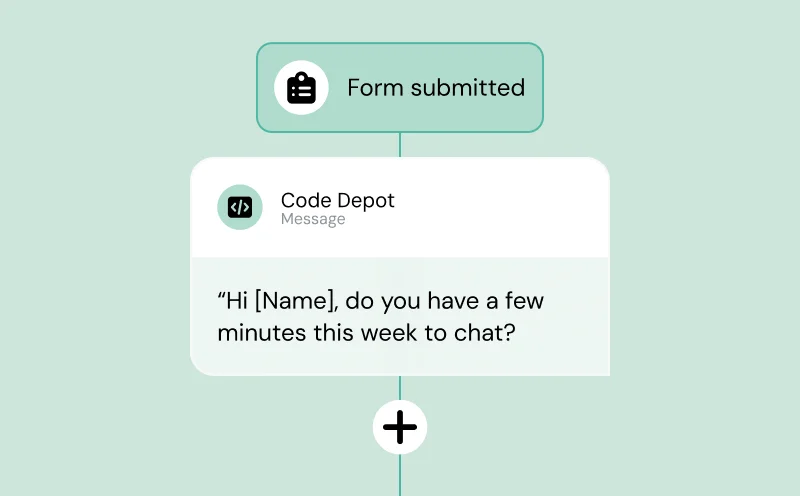
The first text you send to a new lead sets the tone for the entire relationship. A quick, friendly follow-up after a form submission, webinar registration, or trade show conversation shows the prospect you’re responsive — and gives them an easy way to reply.
Due to the casual nature of text messages, prospects may be more inclined to open up and have a more honest conversation than they would through other channels. That candor is invaluable during qualification. A prospect who might ignore a formal email will often reply to a text with a simple “Yes, I’m interested” or “Not the right time” — which saves your team hours of guesswork.
Example: “Hi [First Name], thanks for stopping by our booth at SaaStr. Would a 15-minute call Thursday or Friday work to walk through the demo? — [Rep Name]”
This approach works equally well for B2B sales teams. Instead of sending a LinkedIn InMail that gets buried, a text after an initial meeting keeps the momentum alive.
Appointment reminders and confirmations
Demo no-shows are one of the most expensive problems in sales. Every missed appointment wastes a rep’s time, disrupts the pipeline, and delays revenue. SMS reminders solve this with minimal effort.
The results speak for themselves. A simple reminder 24 hours before and again one hour before the meeting can dramatically improve show rates.
Example: “Quick reminder: your demo with [Rep Name] is tomorrow at 2 PM ET. Reply YES to confirm or let us know if you need to reschedule.”
The two-way nature of SMS makes rescheduling frictionless. Instead of a no-show, you get a reply — and a chance to rebook immediately.
Promotional offers and discounts
For ecommerce and retail businesses, promotional SMS messages are a direct revenue driver. Flash sales, exclusive subscriber discounts, and limited-time offers all perform well via text because of the channel’s urgency and visibility.
The key is exclusivity. When subscribers feel they’re getting deals they can’t find anywhere else, opt-in rates stay high and unsubscribe rates stay low.
Two-way conversational sales
This is the most underutilized — and potentially most powerful — type of SMS sales message. Most businesses treat SMS as a broadcast tool: send a message, hope for a click. But the real value of SMS for sales teams is the conversation it enables.
Two-way conversational SMS turns your text thread into a live sales channel. Reps can qualify leads, answer product questions, handle pricing objections, and guide prospects toward a purchase — all within a text conversation that feels natural and low-pressure.
For B2B sales teams, two-way texting is especially effective for deal follow-ups and pipeline nurturing. A quick text checking in after a proposal is sent (“Hi [Name], just wanted to see if you had any questions about the proposal. Happy to jump on a quick call if helpful.”) often gets a faster, more honest response than a formal follow-up email.
How to build an SMS sales list
Your SMS sales strategy is only as good as your subscriber list. And unlike email, where list-building practices are relatively forgiving, SMS requires explicit opt-in consent from every contact. Here’s how to build a high-quality list the right way.
1. Collect consent through opt-in forms
Every SMS subscriber must give clear, documented consent before you send them a message. This isn’t optional — it’s a legal requirement under TCPA and other regulations.
2. Use keywords and short codes
Keyword-based opt-ins make it easy for prospects to subscribe from any channel. This approach works well for retail, events, and B2B companies alike. A software company might use “Text DEMO to 55555” on a conference banner. A restaurant might use “Text MENU to 55555” on table tents. The keyword triggers an automated welcome message and adds the contact to your list.
3. Leverage existing customer data
You likely already have phone numbers in your CRM from existing customers and leads. But having a phone number isn’t the same as having permission to text it. You need to re-engage these contacts and collect explicit SMS opt-in consent before adding them to your texting list.
4. Offer incentives for sign-ups
People need a reason to give you access to their text messages. Make it worth their while.
Try incentivizing sign-ups by offering exclusive deals, discounts, or early access to sales for customers who opt into the SMS list, which encourages sign-ups and sets the tone for the value SMS subscribers can expect. A 10% welcome discount, early access to a product launch, or a free resource download can significantly boost opt-in rates.
The incentive also sets expectations. When subscribers associate your SMS list with tangible value from the start, they’re less likely to unsubscribe later.
5. Maintain list hygiene
A smaller, engaged list will always outperform a large, unresponsive one. Regularly clean your subscriber list by removing invalid numbers, honoring every unsubscribe request immediately, and monitoring engagement metrics.
Timing and frequency for SMS sales campaigns
Even the best-crafted sales text will underperform if it arrives at the wrong time or too frequently. Getting timing and cadence right is essential to maintaining subscriber engagement without triggering opt-outs.
- Frequency: New subscribers typically receive messages more frequently (5–6 in the first month) as part of a welcome series, tapering to 3–4 per month thereafter. Start conservatively and increase frequency only as you monitor engagement and unsubscribe rates.
- Timing: Salesforce advises that customers “probably do not want to hear from businesses between 9 PM and 9 AM, particularly if your business isn’t even open during those times.” Stick to business hours for B2B messages and standard waking hours (10 AM–8 PM in the recipient’s time zone) for B2C. Tuesdays through Thursdays tend to perform best for promotional messages, while appointment reminders should be sent 24 hours and 1 hour before the scheduled time regardless of day.
- Time zone awareness matters. If your subscriber list spans multiple regions — or multiple countries — make sure your SMS platform supports time-zone-based sending. A message that arrives at 10 AM in New York hits at 7 AM in Los Angeles and 3 PM in London. Automated scheduling based on the recipient’s local time prevents early-morning annoyances and late-night opt-outs.
For B2B sales teams, timing is even more nuanced. Sending a follow-up text during business hours (10 AM–4 PM) on a weekday is far more effective than a Friday evening message. Align your SMS sends with your prospect’s work schedule, not yours.
The golden rule: every message you send should feel like it’s arriving at the right moment with something worth reading. If you can’t articulate the value of a specific send, don’t send it.
Metrics to track for SMS sales performance
You can’t improve what you don’t measure. These are the key metrics every SMS sales program should track:
- Delivery rate — the percentage of messages that actually reach the recipient’s device. Low delivery rates signal list quality issues or carrier filtering problems.
- Open rate — while SMS open rates are inherently high, tracking them helps you benchmark against other channels and identify anomalies.
- Response rate — for two-way conversational SMS, this is your most important metric. It tells you how many recipients are engaging in dialogue with your sales team.
- Click-through rate (CTR) — the percentage of recipients who click a link in your message. This matters most for promotional SMS and abandoned cart recovery campaigns.
- Conversion rate — the percentage of recipients who complete a desired action (purchase, demo booking, form submission) after receiving your text. This is the metric that ties SMS directly to revenue.
- Opt-out rate — the percentage of subscribers who unsubscribe after a given message or campaign. A sudden spike in opt-outs signals a frequency, timing, or relevance problem.
- Revenue per message — total revenue attributed to SMS divided by the number of messages sent. This gives you a clear picture of your SMS sales ROI.
Integrate your SMS platform with your CRM (Salesforce, HubSpot, Pipedrive, or whichever system your team uses) to track these metrics alongside your broader sales pipeline data. When SMS activity flows into your CRM, reps can see the full conversation history for every contact, attribute deals to specific text campaigns, and optimize their outreach based on what’s actually closing.
SMS sales for B2B companies
Most SMS sales guides focus exclusively on B2C and ecommerce. That’s a mistake. B2B sales teams have just as much — if not more — to gain from text messaging.
Consider the typical B2B sales cycle: multiple stakeholders, long timelines, and a constant battle to maintain engagement between touchpoints. Email threads get buried. Phone calls get declined. But a well-timed text message cuts through and keeps the deal moving.
Where B2B SMS sales works best:
- Post-event follow-up. After a conference, trade show, or networking event, a text message is faster and more personal than an email. “Great meeting you at [Event] — I’d love to continue our conversation. Free for a 15-min call this week?”
- Demo and meeting reminders. B2B demo no-shows are expensive. SMS reminders 24 hours and 1 hour before a meeting dramatically improve attendance.
- Proposal and contract follow-up. Instead of sending another “just checking in” email, a quick text (“Hi [Name], wanted to see if you had a chance to review the proposal. Happy to answer any questions.”) gets faster responses.
- Pipeline nurturing. For deals that go quiet, a periodic text touchpoint keeps your business top of mind without the formality of a scheduled call.
- Account management. Existing customers respond well to renewal reminders, upsell opportunities, and check-ins via text.
The key to B2B SMS sales is tone. Keep it professional but human. You’re texting a business contact, not a friend — but you’re also not writing a legal brief. Short, direct, and respectful of their time is the winning formula.
Getting started with SMS sales
You don’t need to overhaul your entire sales process to start seeing results from SMS. Here’s a practical first-step plan:
- Pick one use case. Don’t try to do everything at once. Start with the problem that’s costing you the most revenue — demo no-shows, cold lead follow-up, or abandoned cart recovery.
- Build a small, compliant list. Add an SMS opt-in checkbox to your highest-traffic form. Use TCPA-compliant language and start collecting consent today.
- Write five templates. Create message templates for your chosen use case: an initial outreach text, a reminder, a follow-up, a re-engagement message, and an opt-out confirmation.
- Choose a platform. Select an SMS platform that supports two-way messaging, CRM integration, compliance automation, and the channels your customers use.
- Measure and iterate. Track delivery rates, response rates, and conversions from week one. Adjust your timing, frequency, and copy based on what the data tells you.
SMS sales isn’t a silver bullet — but for businesses tired of watching leads go cold in email inboxes and voicemail boxes, it’s the fastest path to higher engagement, shorter sales cycles, and more closed deals.

Author: