Resources
SMS marketing analytics: Measuring and optimizing your text campaigns
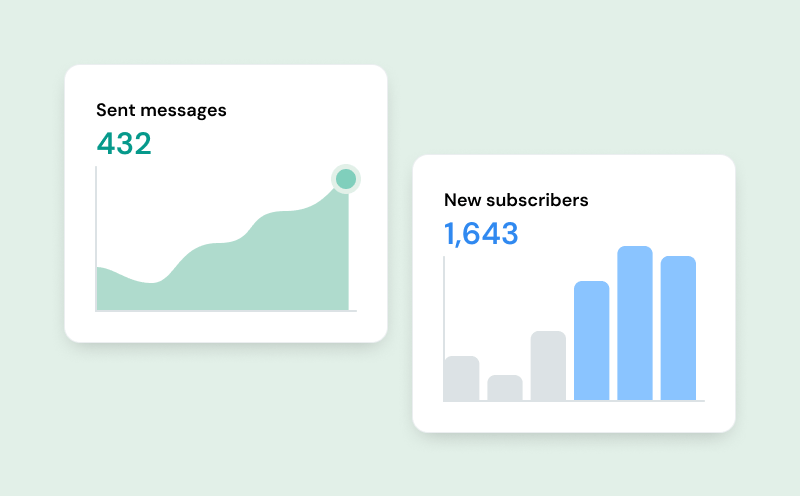
You can’t manage what you don’t measure. And for businesses with complex customer communications, like high-volume campaigns and multi-channel automation, not measuring marketing efforts is risky and expensive.
The SMS marketing market in particular is expected to reach $9.96 billion in the U.S. by 2030, largely because SMS campaigns convert at rates between 21% and 30%, crushing most other marketing channels. But those results don’t happen by accident. They happen because smart marketers measure what matters and optimize relentlessly.
This guide breaks down the SMS marketing analytics that drive tangible business outcomes. You’ll learn:
- which SMS metrics matter
- how to track campaign performance across platforms
- how to use that data to refine targeting, boost conversions, and justify budget increases
Core SMS analytics metrics to track
Not all SMS metrics deserve equal attention. Some are vanity numbers that appear impressive but don’t make a significant impact. Others are business-critical.
Here’s what to prioritize when measuring your SMS marketing efforts and analyzing SMS campaign performance.
Delivery rate
Delivery rate is the percentage of sent messages that reach the recipients’ inboxes.
It measures message reach reliability.
How to calculate SMS delivery rate:
Delivery rate = (Number of messages delivered ÷ Total number of messages sent) x 100
Say you’ve just sent out an SMS marketing campaign to 1,200 recipients, of which 1,140 were successfully delivered. To work out the delivery rate for your campaign, your calculation would look like this:
- (1,140 ÷ 1,200) x 100 = 95% delivery rate
Regardless of the industry you’re in, it’s always good to aim for a 95% delivery rate or higher. Anything lower signals issues with your SMS marketing platform, list quality, or compliance.
With 97% of U.S. adults owning a mobile phone capable of receiving texts, poor SMS delivery rates typically indicate fixable issues, such as invalid numbers or carrier filtering.
Open rate or read rate
Your open or read rate measures the number of people who open your text message versus those who don’t.
This metric is your engagement baseline. While email marketing marketers celebrate 20% open rates, SMS open rates hit around 98%. Even better, 90% of text messages are read within three minutes of delivery.
How to calculate SMS open rate:
Open rate = (Number of messages opened ÷ Number of messages delivered) x 100
If you sent 1,000 text messages and 950 were opened, your calculation would look like this:
- (950 ÷ 1,000) x 100 = 95% open rate
High open rates don’t guarantee action. You need to pair this SMS metric with what comes next.
Click-through rate (CTR)
CTR is the percentage of recipients who clicked a link in your SMS marketing message.
Average SMS CTR hovers around 21-35%, depending on your industry and message type.
Compare that to email marketing, where CTRs often struggle to break 3%.
How to calculate SMS CTR:
Click-through rate = (Number of clicks ÷ Number of messages delivered) x 100
Let’s say you sent 1,000 messages promoting a flash sale, and 280 recipients clicked the link. Your CTR calculation would be:
- (280 ÷ 1,000) x 100 = 28% CTR
For businesses running promotional campaigns or recovering abandoned carts, CTR is the clearest signal that your marketing message resonated enough to drive intent.
Conversion rate
The SMS conversion rate tracks how many recipients completed your desired action—made a purchase, booked an appointment, or signed up for an event.
How to calculate SMS conversion rate:
Conversion rate = (Number of conversions ÷ Number of messages delivered) x 100
If you sent 1,000 abandoned cart messages and 240 customers completed their purchase, your conversion rate would be:
- (240 ÷ 1,000) x 100 = 24% conversion rate
Opt-out or unsubscribe rate
Your opt-out rate serves as a key retention signal. It tells you if you’re over-messaging, mistargeting, or sending irrelevant content to your SMS subscribers.
How to calculate SMS opt-out rate:
Opt-out rate = (Number of opt-outs ÷ Number of messages delivered) x 100
If you sent 5,000 promotional messages and 75 people opted out, your calculation would be:
- (75 ÷ 5,000) x 100 = 1.5% opt-out rate
Healthy SMS marketing campaigns see opt-out rates between 1% and 3%.
If yours is higher, pause and audit your frequency, timing, and message relevance. Consumers would stop supporting a brand if they felt overwhelmed by excessive marketing messages. Don’t be that brand.
Response rate
Response rate tracks conversational engagement. For two-way SMS campaigns—customer support, lead qualification, appointment confirmations—response rate matters more than CTR.
How to calculate SMS response rate:
Response rate = (Number of responses ÷ Number of messages delivered) x 100
If you sent 500 appointment reminder messages and 225 customers replied to confirm, your response rate would be:
- (225 ÷ 500) x 100 = 45% response rate
If you’re using text messaging for customer service or sales conversations, this SMS metric tells you if people actually want to talk to you.
ROI / cost per conversion
SMS marketing ROI (return on investment) measures the financial return you generate from your SMS marketing campaign relative to what you spent on it.
It tells you whether your campaign was profitable and by how much.
Cost per conversion (CPC) measures how much you spent to generate each desired action.
While ROI measures the entire campaign, CPC measures the return on a unit level.
How to calculate SMS ROI:
ROI = [(Revenue generated – Campaign cost) ÷ Campaign cost] x 100
Let’s say you spent $200 on an SMS campaign (platform fees + messaging costs) and generated $8,000 in sales. Your ROI calculation would be:
- [($8,000 – $200) ÷ $200] x 100 = 3,900% ROI
How to SMS calculate cost per conversion:
Cost per conversion = Total campaign cost ÷ Number of conversions
Using the same example, if that $200 campaign generated 150 purchases:
- $200 ÷ 150 = $1.33 cost per conversion
Consider Oz Mobiles, a leading Australian electronics retailer. After integrating Sinch Engage with their Shopify store and launching automated SMS campaigns for cart abandonment and post-purchase follow-ups, they achieved a 3000% ROI.
The secret wasn’t just automation. It was using analytics to track which messages drove conversions and optimizing send times based on customer behavior data.
How to measure SMS campaign performance
Marketing metrics only matter if you can track them consistently. Here’s how to set up proper measurement for your SMS marketing campaign.
Use the right tools
Start with an SMS marketing platform that gives you real-time analytics and granular reporting.
Sinch Engage provides built-in analytics dashboards that allow you to track delivery rates, engagement metrics, and conversion data across all your text message marketing campaigns. You’ll see which messages drive revenue and which ones flop.
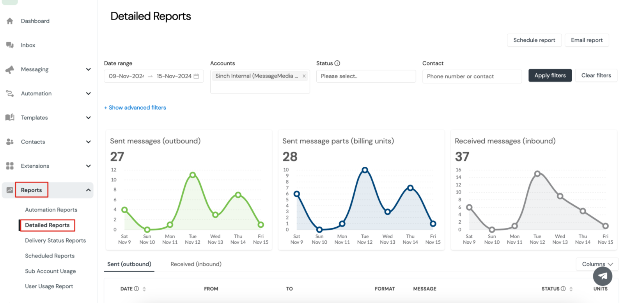
But don’t stop at your SMS marketing software. Pull in data from your CRM, POS system, and marketing automation tools to connect the dots between SMS campaigns and business outcomes.
Track specific campaigns with UTM parameters and short links
Want to know which SMS marketing campaign drove that sale? Tag your links.
Use UTM parameters to track SMS traffic in Google Analytics. Create unique short links for each campaign to measure clicks, conversions, and revenue attribution.
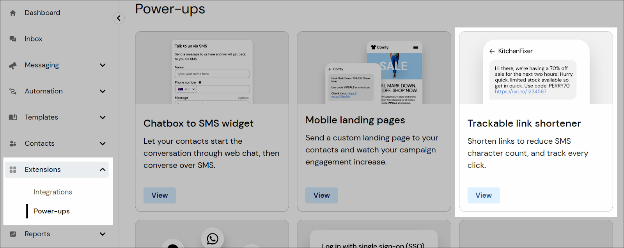
Tools like Bitly or Rebrandly work fine, but platforms like Sinch Engage have link tracking built in, which saves you from having to juggle multiple dashboards while analyzing your SMS data.
Run A/B tests and time-based analysis
Testing isn’t optional for optimizing your SMS marketing strategy. You need it to find out what works in your campaign.
You can test everything from send times to message length to CTAs.
Concise messages might outperform longer texts, but you’ll never know until you test it.
Time-based analysis matters too. Most people make purchases via SMS in the evening, but that doesn’t mean evening is optimal for your audience.
Segment by time zone, track campaign performance by hour, and adjust your send windows accordingly to improve customer engagement.
Integrate analytics from CRM and marketing automation
Your SMS data shouldn’t live in isolation. Connect it to your customer data platform for complete visibility into customer behavior.
If you’re using HubSpot, Salesforce, or NetSuite, integrate your SMS marketing platform to track how text campaigns impact your pipeline, customer lifetime value, and retention.
When you can prove that SMS subscribers convert 3x faster than email-only contacts, you’ll never have to justify your text message marketing budget again.
Strategies for optimizing SMS campaigns with analytics
SMS data without action is just noise. Here’s how to use SMS marketing analytics to improve your SMS performance and drive better results for future campaigns.
Refine targeting and messaging
Segment aggressively for your marketing campaigns. Don’t send the same marketing message to everyone.
Use your SMS analytics to identify high-intent segments—people who clicked but didn’t convert, repeat purchasers, recent browsers—and tailor messages to their specific behaviors.
This approach delivers better customer engagement than blanket campaigns.
Improve engagement and conversion rates
Look at your top-performing SMS marketing campaigns. What do they have in common? Short copy? Strong urgency? Clear value?
Test variations of your best performers. If a 20% off message converts at 28%, try 25% off and see if the conversion rate lifts or if you’re just eroding your margin. Analytics tells you where the ceiling is for your SMS marketing efforts.
Track your SMS campaign metrics weekly to spot trends.
Compare your results against benchmarks from your marketing channel mix. If your SMS marketing campaigns are outperforming your email marketing efforts, that’s data worth sharing with leadership.
Clothing the Gaps, an Australian fashion brand, used this exact approach. After partnering with Sinch Engage, they moved away from blast messaging and started using analytics to segment their audience.
For Black Friday, instead of sending to their entire list, they targeted their most engaged customers first based on past behavior data.
As a result: A 2,000% ROI and thousands of customers flooding their Shopify site the moment messages went out – engagement levels they’d never seen with email marketing alone.
Make real-time adjustments
If a campaign isn’t converting in the first couple of hours, don’t wait until tomorrow to fix it.
Monitor campaign performance in real-time, and don’t hesitate to pause underperforming campaigns before they exhaust your list of SMS subscribers.
Different SMS metrics for different use cases
SMS marketing isn’t one-size-fits-all. The marketing metrics you measure depends on what you’re trying to accomplish.
Marketing campaigns
For promotional marketing campaigns, such as sales, product launches, and seasonal offers, focus on CTR, conversion rate, and revenue per message.
Your goal is to drive immediate purchases, so track how many customers clicked through and completed transactions.
Compare your SMS marketing KPIs with those of other marketing channels like email and social media to see how effective it is.
Sales outreach
For sales teams using text messaging, response rates and lead-to-engagement conversions are the most important metrics for measuring the effectiveness of SMS communication.
If your reps aren’t tracking replies and follow-up conversations, they’re leaving deals on the table.
Track how SMS marketing messages influence pipeline velocity. When a rep sends a text message and gets a response in 90 seconds versus waiting hours for an email reply, that speed advantage compounds throughout the sales cycle.
Customer support
For support and service messages – appointment reminders, shipping updates, two-way help desk — SMS delivery rate and response time are critical. You need to know whether the messages reached customers and that your team replied quickly.
Track average response time and resolution rates to measure support efficiency. Businesses using text messaging for customer service report higher satisfaction scores than those relying solely on email marketing or phone support.
Your next steps with SMS analytics
SMS marketing analytics is about understanding what drives customer engagement on mobile, what kills conversions, and how to systematically improve both through smarter SMS marketing campaigns.
Ready to level up how your team uses SMS marketing analytics? Get started with Sinch Engage’s easy, secure SMS platform that has analytics built-in, or contact our team with any questions. You can also check out our customer success stories to see the ROI yourself.

Author: