Resources
12 proven strategies to reduce no-show appointments
The chair is empty. Your staff prepped the room, pulled the chart, and blocked the time — but the patient never walked in. Across the entire US healthcare system, missed appointments drain an estimated $150 billion annually.
No-show appointments are not inevitable. They are largely a communication failure, and that means they’re fixable. Whether you run a medical clinic, a dental office, a behavioral health practice, or a salon, the root causes are the same: people forget, life gets in the way, and one-way reminders are not enough to close the gap.
This guide gives you a clear, prioritized playbook. You’ll learn how to calculate your no-show rate, understand why patients miss appointments, quantify the financial damage, and implement 12 strategies — starting with the ones you can activate this week.
What is a no-show appointment?
A no-show appointment happens when a patient or client doesn’t come to a scheduled appointment without giving prior notice. Unlike a cancellation — where the client calls ahead and frees the slot — a no-show leaves no time to fill the opening. The result is direct revenue loss and wasted staff preparation time.
The American College of Allergy, Asthma, and Immunology (ACAAI) defines the no-show rate as “the percentage of appointment time lost because patients don’t show up or cancel at the last minute.” That definition matters because it includes last-minute cancellations alongside outright no-shows. Both create the same operational problem: an empty slot you can’t recover.
This problem extends well beyond healthcare. Salons, fitness studios, legal offices, tutoring centers, and B2B sales teams all face the same dynamic. Any business that relies on scheduled appointments loses money when clients don’t show up. The strategies in this guide apply across all of these industries.
What is the average no-show rate?
The national average no-show rate in the United States sits between 12% and 42%. But averages obscure wide variation — your specialty, patient population, and booking practices all influence where you land.
Booking lead time has a dramatic effect on no-show rates. The longer the gap between booking and showing up, the more likely life intervenes.
How to calculate your no-show rate
The formula is straightforward:
No-show rate = (Number of no-shows ÷ Total scheduled appointments) × 100
Example: If you had 10 no-shows out of 100 weekly appointments, your no-show rate is 10%.
Track this number monthly. You can’t improve what you do not measure, and a declining no-show rate is one of the clearest indicators that your patient engagement and communication strategies are working.
Why patients miss appointments
Understanding why people miss appointments is the first step toward preventing it. The causes are rarely malicious — most no-show patients fully intended to come. Here is what the data shows.
Forgetfulness and scheduling conflicts
The primary reason patients miss appointments is forgetfulness. These aren’t patients who decided your service was not worth their time. They’re busy people whose appointment slipped off their radar. That distinction matters because it means the solution isn’t punitive — it is communicative. A well-timed reminder solves the problem for more than a third of your no-shows.
Transportation and access barriers
For some patients, the barrier is physical. This is particularly acute in behavioral health settings and rural practices. When a patient can’t get to your office, the appointment becomes impossible — not optional. Telehealth alternatives and flexible scheduling can address this directly.
Lack of reminders and communication gaps
This statistic that should concern every practice manager: Nearly one in ten no-shows happens because the practice itself failed to communicate.
If your reminder workflow depends on front-desk staff making manual phone calls, gaps are inevitable. Staff get busy, numbers go to voicemail, and messages go unheard. Automated, multi-channel reminders eliminate this failure point entirely — and they do it without adding to your team’s workload.
12 effective ways to reduce no-show appointments
Now for the actionable part. These 12 strategies are ordered by implementation speed and impact. Start with the first three — they deliver the fastest results and require the least operational change.
1. Send automated SMS appointment reminders
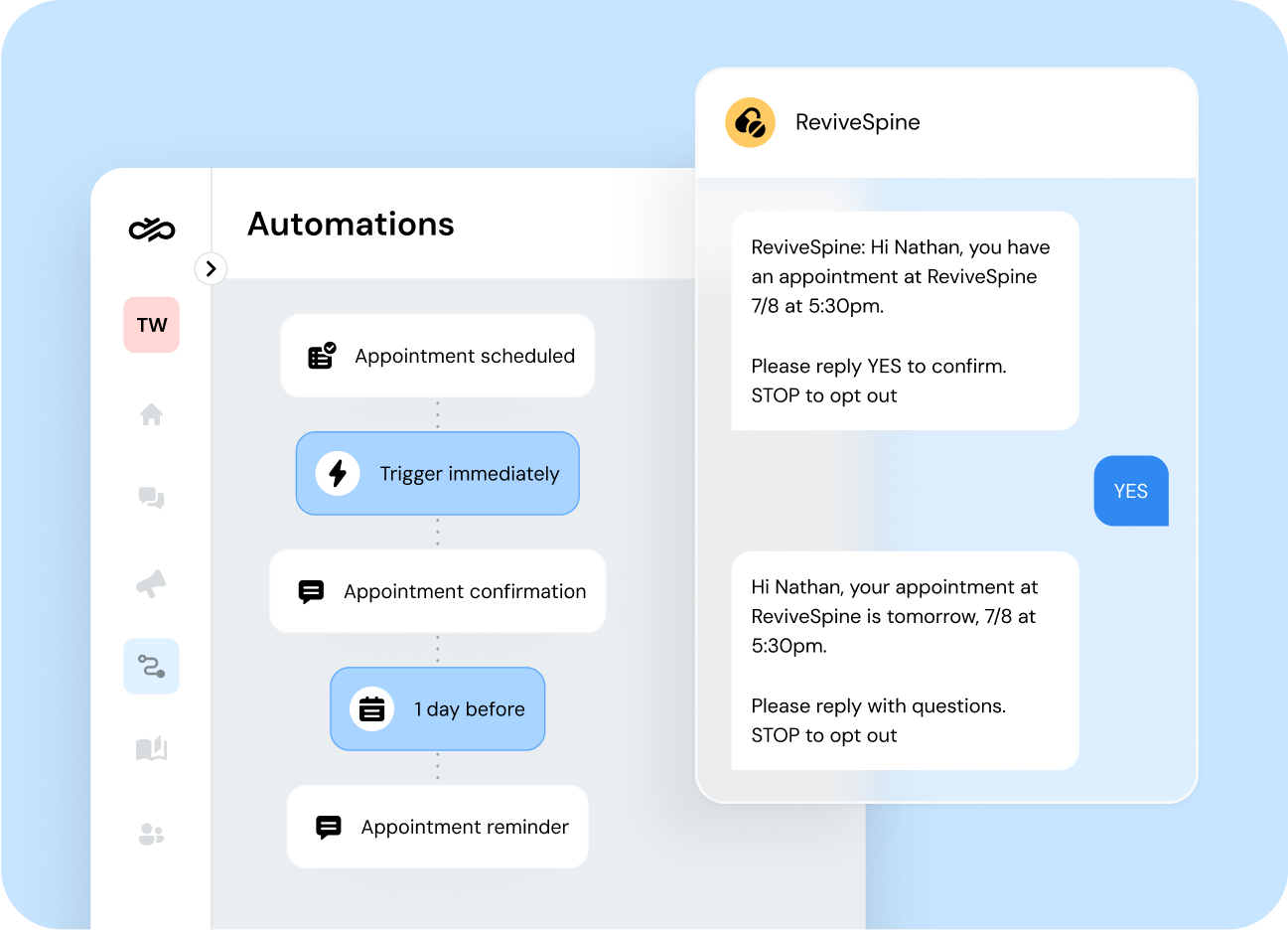
This is the single highest-impact, lowest-effort strategy you can implement. The optimal SMS reminder cadence is a sequence, not a single message:
- At booking: Immediate confirmation with date, time, and location
- One week before: A heads-up for appointments booked more than a week out
- 24–48 hours before: The critical reminder window
- 2 hours before: A final nudge, especially for afternoon appointments
SMS outperforms email and phone calls because it meets people where they already are — on their phone, with notifications on. If you implement only one strategy from this list, make it this one.
2. Use multi-channel reminders across SMS, email, and voice
Not every patient prefers the same channel. When patients initially schedule appointments, asking which contact method they prefer — call, email, or text — and using a combination approach keeps the upcoming appointment top-of-mind.
A multi-channel approach might look like this: An email confirmation at booking, an SMS reminder at 48 hours, and an automated voice call at 24 hours for patients who haven’t confirmed. This layered strategy catches people across different touchpoints and dramatically increases the odds of engagement.
For example: Everlab, a healthcare startup that provides preventative care to their patients, drove missed appointment rates down by 40% with SMS appointment reminders through Sinch Engage and its HubSpot integration. They previously saw only 15–20% open rates when sending appointment reminders by email, and now their reminders get an average open rate of 98%.
3. Enable two-way messaging for appointment confirmations
Here’s where most reminder systems fall short: they send messages but can’t receive replies. One-way reminders tell patients about their appointment. Two-way messaging lets patients act on that information instantly.
When a patient receives a text that says, “Reply Y to confirm or R to reschedule your appointment on Thursday at 2 PM,” they can respond in seconds — no phone call, no hold music, no navigating a patient portal. That reply triggers an automatic confirmation in your scheduling system or opens a rescheduling flow.
4. Offer online self-scheduling
Self-scheduling enables real-time waitlist management. When a patient cancels, the system can automatically offer the open slot to the next person on the waitlist — filling gaps that would otherwise become revenue losses.
5. Require a deposit or pre-payment at booking
Financial commitment changes behavior. Offering pre-paid appointments, often with an incentive like a small discount, dramatically increases client commitment and is highly effective in reducing no-shows.
This strategy is particularly effective for service businesses — salons, spas, fitness studios, and consulting practices — where collecting a deposit at booking is standard and expected. In healthcare, the approach requires more sensitivity, but having a deposit or credit card on file is an efficient way to act on your cancellation policy when no-shows do occur.
Start with a modest deposit — 25% to 50% of the appointment cost — and communicate it clearly at booking. Frame it as a reservation fee that is applied to the service, not a penalty. Pair it with an easy cancellation policy (24-hour notice to receive a full refund), and most clients will see it as fair.
6. Follow up promptly after missed appointments
A missed appointment does not have to mean a lost patient. A simple “Sorry we missed you!” follow-up text or email with an invitation to reschedule can prevent patients from disengaging entirely.
Send this message within one hour of the missed appointment. The tone should be warm and non-judgmental — not punitive. Include a direct link to reschedule or a prompt to reply and book a new time. Many patients who no-show feel embarrassed and avoid calling back. A proactive, friendly follow-up removes that barrier.
7. Shorten the time between booking and appointment
You don’t need to overhaul your entire scheduling model. Start by reserving 20–30% of daily slots for same-day or next-day bookings. Use your waitlist to fill these slots with patients who need to be seen soon. The result is higher attendance rates and better schedule utilization.
8. Offer telehealth as an alternative to in-person visits
For patients facing transportation barriers, childcare conflicts, or mobility issues, a virtual option can be the difference between attending and no-showing. Even outside healthcare, virtual appointments reduce friction. Consultations, coaching sessions, financial advising, and tutoring all translate well to video. Offer the virtual option at booking and in your reminder messages — “Can’t make it in? Switch to a video visit by replying V.”
9. Provide flexible scheduling and extended hours
Rigid scheduling creates no-shows. When your hours only overlap with your patients’ work hours, something has to give — and it’s usually the appointment. Practical steps include offering early morning, evening, or weekend slots for working patients. Make rescheduling easy — ideally through the same two-way messaging channel used for reminders. The fewer hoops a patient has to jump through to change their appointment, the more likely they are to reschedule rather than simply not show up.
10. Build personal connections with patients
New patients tend to have higher no-show rates. People are more likely to show up when they have a personal connection to their care provider and feel engaged in their treatment plan.
This doesn’t require grand gestures. A brief, personalized message from the provider before a first appointment — “Looking forward to meeting you on Thursday, Sarah” — can shift the dynamic from transactional to relational. Front-desk staff who greet returning patients by name and follow up on previous conversations build the kind of loyalty that makes people less likely to ghost.
For service businesses, the same principle applies. A personal text from a stylist, trainer, or consultant creates accountability that a generic system message cannot.
11. Educate patients on why their appointment matters
Some patients no-show because they underestimate the importance of the visit — especially for follow-ups, preventive screenings, or maintenance appointments. A brief educational message in your reminder sequence can change that.
Instead of “Reminder: You have an appointment tomorrow at 10 AM,” try: “Reminder: Your follow-up blood pressure check is tomorrow at 10 AM. This visit helps us make sure your medication is working and adjust if needed.” Connecting the appointment to a specific health or service outcome gives patients a reason to prioritize it.
This approach is especially effective in behavioral health settings, where appointment adherence directly impacts treatment outcomes. Framing the visit as part of a care plan — not just a calendar event — increases the patient’s sense of investment.
Start reducing no-shows this week
Missed appointments aren’t a scheduling problem — they are a communication problem. And communication problems have communication solutions. Start by calculating your no-show rate using the formula above. Identify whether forgetfulness, long booking lead times, or communication gaps are your biggest driver. Then implement automated, two-way reminders on the channel your patients actually use.
The practices and businesses that consistently reduce no-shows share one trait: they make it easier for patients to confirm, cancel, or reschedule than to simply not show up. That requires meeting people on their preferred channel with messages they can act on instantly.
You don’t need to implement all 12 strategies at once. Start with automated SMS reminders and two-way messaging — the two highest-impact, lowest-effort changes. Then layer in self-scheduling, shorter booking windows, and telehealth as your systems mature.

Author: